



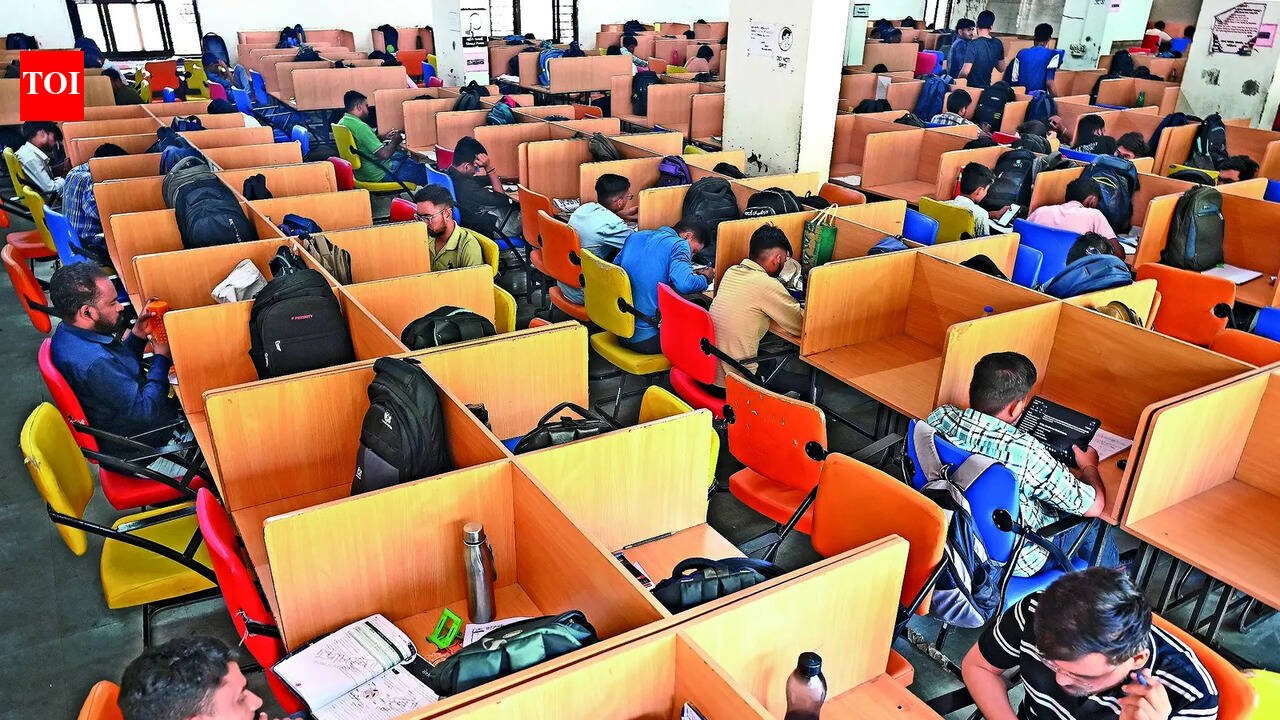
Every evening, the seats in a dozen-odd private reading rooms in Gandhinagar’s Sector 6 begin filling up with students, who come bearing the load of books and the ambition of getting a govt job. The ritual, dawn-to-midnight toil can last from four years to six years. The exam preparation is regimented by the coaching industry that has entrenched itself to create a bustle within the sedate bureaucratic citadel of Gandhinagar. As for the students, they migrate from rural talukas, and neighbourhoods reshape themselves to accommodate and profit from seekers of sarkari jobs. There is money to be made from this careerist ambition, with students’ families diverting their life savings to pay for coaching, lodging, and other non-discretionary expenses. Nerve centre of govt jobs Gandhinagar houses the machinery that produces jobs: the Gujarat Public Service Commission (GPSC), the Gujarat Subordinate Service Selection Board (GSSSB), and the Police Bharti Board. The proximity is psychological. The Gujarat govt plans to provide over 2 lakh jobs by 2033 to fill vacancies caused by retirements. According to a 10-year recruitment calendar, approximately 20,699 people will be recruited annually across state departments and district administrations. This initiative aims to strengthen public services and increase efficiency. It is estimated that 35,000 young aspirants have enrolled in coaching institutes and for their online video tutorials, studying in the shadow of these recruitment institutions. Some institutes are within a 5-12km radius of Gandhinagar. Coaching centres moved first. Students followed. Paying guest (PG) facilities expanded across Kudasan, Sargasan, Raysan, Vavol, and Sector 7. Residential neighbourhoods adapted quickly. Homes were converted into PGs and new buildings were designed with shared accommodation in mind. Govt service back in vogue Gandhinagar became a welcoming ground for coaching institutes as Gujarat’s young people began to disavow the notion of a govt job as a low-priority option. “Govt service used to be the third or fourth choice in Gujarat,” says Pankaj Kotak, a former bureaucrat and an expert on real estate. “The brightest went into medicine, engineering, pharmacy, or commerce tracks like MBA, CA, and CS,” he says. “Now the first preference is a govt job — doctors and engineers also try to get one.” Kotak calls it a structural shift. “Once-secure professions now feel unstable,” he says. “For instance, setting up clinics is tough because real estate is expensive and the private sector no longer guarantees steady returns.”
A separate section for women at the central library which will soon be fully airconditioned
Today, Gandhinagar functions as a major coaching hub for govt job aspirants, with more than 180 institutes. The “Kudasan-Sargasan” stretch operates as the primary nerve centre, hosting more than 30 institutes within a 5-km radius. Ahmedabad faces ‘realty’ “The rise of Gandhinagar as a coaching hub began with a practical constraint: Ahmedabad became unaffordable,” Kotak says. “Ahmedabad’s real estate market is expensive…coaching fees, rent, and maintenance made the city too expensive for students.” Against the background, coaching centres began to happily settle into Gandhinagar areas. The Infocity area caters to coaching institutes focused on management and tech-based exams. Older sectors — 6, 11, 16, and 21 — retain their hold over banking and local competitive exams by being the site of institutes specializing in those fields. Space, however, can still spur intense competition among students. Jigar Desai, a BCom graduate from Mehsana, pays Rs 100 for five years for access to the Gandhinagar Central Library. The competition for a seat is fierce here. “If a student leaves their desk in the library, the seat is immediately taken,” says Jigar Desai. Cost for chance at collectorate, police Private libraries charge up to Rs 2,800 per month, which is unaffordable for students like Jigar. His family’s dairy and farming income has become unstable. He says the Holstein-Friesian cow breed yields more milk, but “prices have plummeted because of low milk fat”. He adds that unseasonal rain and unreliable minimum support prices for crops strain earnings. The Covid era sealed his choice. “The private sector was shaken, and jobs disappeared, but govt salaries continued,” he says. To equip candidates to take a shot at govt earnings, coaching institutes annually charge between Rs 15,000 and Rs 30,000 for general govt exams, Rs 20,000 and Rs 50,000 for civil services, and significantly higher for premium programmes. The coaching market is anchored by three major streams. The largest is the Gujarat state services segment, centred on GPSC exams for Class 1 and 2 officers such as deputy collectors, DySPs, mamlatdars, and section officers. This stream also covers high-volume Class 3 jobs like talati-cum-mantri and junior and senior clerks. A second cluster caters to banking and insurance aspirants preparing for the Institute of Banking Personnel Selection, SBI, and RBI exams. This cluster also helps prepare for specialized tests for National Bank for Agriculture and Rural Development (Nabard), Railway Recruitment Boards, and LIC assistant administrative officer. The pros and pros of safety The third pillar is uniformed services, covering state police recruitments for PSI, ASI, constable, and LRD positions, alongside national-level coaching for the National Defence Academy, Combined Defence Services Examination, and Air Force Common Admission Test. For aspirants, the most critical infrastructure is not the classroom but the reading room. This facility has proliferated in Gandhinagar, with over 160 listings shown across the city. In high-density zones like Sector 6 and Kudasan, more than 30 reading rooms exist within a 2-km radius. At the Victorial Reading Room in Sector 6, one of the city’s oldest, motivations for a govt job vary among students. For women, a govt job carries a deeper significance. Megha Purohit, 25, wants to move up from her Class 3 govt job due to “work pressure” to a Class 1 post. “A govt job ensures a woman has some means. Without that, society sees you as having nothing,” she says. “In many families, a govt position legitimizes social mobility— allowing women to take their own decisions on work, travel, and even marriage.” Robust community support A defining feature of Gandhinagar’s ecosystem is the role of community organizations. Communities including Patidars, Anjana Patels or Chaudharis, Thakors, Prajapatis, Ahirs, Solanki Rajputs, Vankars, and Bharwads have built hostels that function as residential coaching centres. The Patidar community, which has a sprawling socio-religious campus in Ahmedabad, has been at the forefront of conducting classes for students preparing for various competitive examinations. While Sardardham, located near the Vaishnodevi Circle, has a learning and residential facility for students, Vishv Umiya Dham runs educational centres in Gandhinagar and Ahmedabad’s Nikol. According to Vishv Umiyadham Foundation (VUF) president R P Patel, there has been a 25% increase in students seeking to study at facilities. “Our operations are entirely based on social service and community welfare,” he says. “The collective cost of accommodation for students is about Rs 50,000 independent of our mentorship.” He says, “By absorbing substantial costs of students, our aim is to ensure that quality exam preparation is accessible to all.” Patel adds, “Currently, the budget dedicated to high-speed fibre internet services and the operation of our digital reading rooms account for about 70% of our total library resource budget.” He says the remaining 30% is allotted to continuous procurement and upkeep of traditional books. The VUF centres house 300 students and during peak periods, the demand increases by 20%. Patel says a rigorous tracking mechanism monitors the progress of students, and their security is considered paramount. “Strict biometric systems are used to ensure regular attendance and monitor entry and exit at hostels,” he says. “Dedicated female staff are stationed for counselling and support, and the entire campus and hostel premises are monitored 24×7.” All groups get a helping hand Chandravadan Sutariya is a member of the Vankar Seva Sangh, which has built Gyan Bhavan in Chandkheda. The five-storey centre has an air-conditioned library, WiFi access, and focused coaching for UPSC, GSSSB, and SSC aspirants. “These institutes were created to give the SC community an educational foundation, as social barriers make business unviable and traditional agriculture is declining,” Sutariya says. Community donors readily fund education projects, Sutariya says, enabling high-quality facilities at just Rs 300 a month for needy students, including ST, OBC, and EWS candidates. Sutariya adds, “Many young people pursue govt jobs because they lack alternatives.” He estimates that 25-30% of Gujarat’s successful candidates now emerge from such NGO-run centres. The blessing of a library Pankaj Goswami, Gujarat’s director of libraries, calls the State Central Library in Gandhinagar a vital “blessing” for aspirants who have no quiet space at home. He links today’s surge in footfall to the 10-year recruitment calendar and Gandhinagar’s rise as a competitive exam hub. However, some officials say that aspirants turn to these facilities too late. A senior Gujarat administration department (GAD) official said that approximately 70% of candidates begin preparation only after graduation, losing crucial early years. Over the next decade, the GSSSB will recruit around 2 lakh candidates, with annual intake rising to 15,000-18,000. The PG economy Kiran Patel of Credai Gandhinagar notes the sustained demand for PG facilities in Gandhinagar over the past five years, driven by both universities and exam aspirants. Sunil Dareja, who runs a PG facility, estimates that there are around 100 dedicated service providers in the city and surrounding areas. University enrolments exceed hostel capacity, while the growth of GIFT City and IT firms adds to demand. Saurabh Purohit, another PG operator, places PG residents at over 70,000. “We are concerned about the emerging nexus between some coaching centres and advocates who are exploiting aspirants,” alleges a senior GAD official. “They circulate rumours of ‘settings’, push frivolous objections to answer keys, and mobilize students into mass litigation to extract crowdfunded legal fees.” To maintain transparency, the GSSSB has shifted to a system where papers are digitally generated.Posts opening up through retirement Year Vacancies 2025–26 14,346 2026–27 13,883 2027–28 12,909 2028–29 11,829 2029–30 11,033 2030–31 10,059 2031–32 8,767 2032–33 8,829 Major coaching clusters in capital Kudasan-Sargasan Corridor: Modern educational nerve centre; UPSC/GPSC/NEET/JEE hubs | 30+ institutionsInfocity and surroundings: Tech exams, CAT/MBA, and professional skill prep | 20+ institutionsSectors 6, 11, 16, & 21: Legacy hubs; banking, SSC, and GPSC | 55+ institutions(Hybrid/digital hubs with AI-enabled platforms are growing rapidly)Fees across exam categories Category Annual fee range Govt Exam Tutorials – Rs 15,000-Rs 30,000 Banking/insurance/SSC – Rs 12,000-Rs 25,000 Civil services (GPSC/UPSC) – Rs 20,000-Rs 50,000 (DICS: Rs 59,000-Rs 85,000) NEET/JEE – Rs 25,000-Rs 45,000; (2-yearear courses cost about Rs 1.6 lakh) CAT/MBA – Rs 11,250-Rs 50,000


