



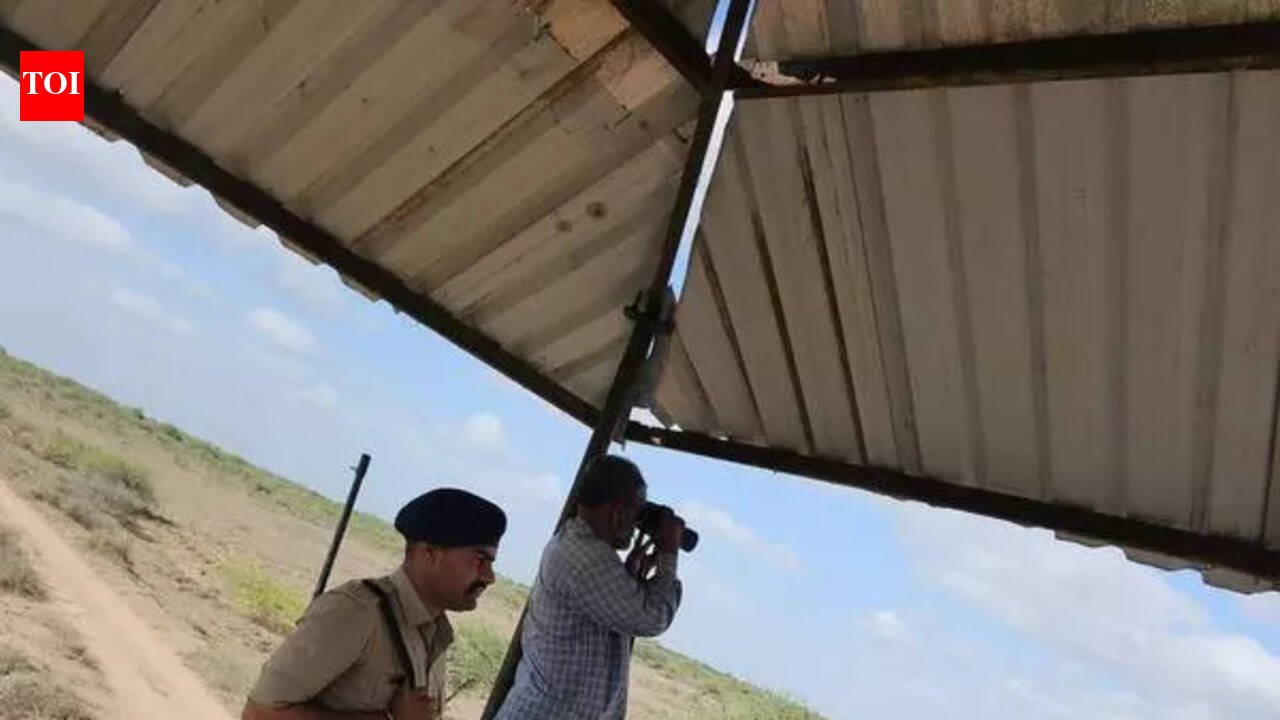
Ahmedabad: India’s Z+ security cover, the highest tier with 55 personnel, is reserved for VVIPs whose safety is deemed a matter of national importance. In the grasslands of Abdasa in Kutch, that kind of distinction now belongs to a Great Indian Bustard chick, hatched on March 26 — the first born in Gujarat’s wild in nearly a decade.Weighing barely 150 grams, this ‘Very Very Important Chick (VVIC)’ has a mega-team of 50 forest guards watching over it day and night from specially erected watchtowers fitted with tripods, spotting scopes and binoculars.These officials work in three rotating shifts and relay minute-by-minute updates to senior officers in Gandhinagar. Feral dogs and cattle are being kept at bay, village roads have been quietly shut, and damaged fencing is being repaired on a war footing by separate teams. Even the artificial waterholes dotting the landscape have been deliberately left dry, lest they draw predators too close to the newborn.For one of the most critically endangered bird species on the planet, the birth itself is a landmark. Officials say the hard part has only just begun. Hatching the egg required technical expertise. Keeping the chick alive through its first month, until it is strong enough to take its maiden flight, will demand faith, backed by huge manpower and extraordinary vigilance. The whole operation is being supervised by team of experts from the Wildlife Institute of India from Jaisalmer and Kutch.“The forest department is leaving nothing to chance to ensure the survival of this newborn,” said Jaipal Singh, principal chief conservator of forests (wildlife). “Several teams have been constituted, and round-the-clock surveillance is in place.”The mother bird is moving within a roughly 3 sq km stretch of grassland that she has, officials believe, chosen for its cover and rich food supply. Every movement is being tracked through a tag fitted to the bird last Oct. The data tells officers where the mother GIB is and how she is behaving. Short, unhurried trips are a sign of calm, while rapid, erratic movement would signal a threat, triggering forest staff to reach the spot within minutes.Dheeraj Mittal, conservator of forest, Kutch, said that, apart from the field staff, the assistant conservator of forests (ACF) and the deputy conservator of forests are also on the spot. “We have also recalled former staff who served here in the past and know this terrain well. A team of 50 field staff members is keeping a close eye from the watchtowers.”The department has also turned to the local community for co-operation. The officials recently held a meeting with villagers, requesting that they not take their cattle to graze in the sanctuary and have informed them that their rights of way through the area have been temporarily curtailed. A senior officer in Gandhinagar said: “At this moment, almost the entire staff is involved in caring for this chick the way they would care for a baby in their own home. Everyone is in touch with each other, and every staff member is eager to help in ways they can.”


