






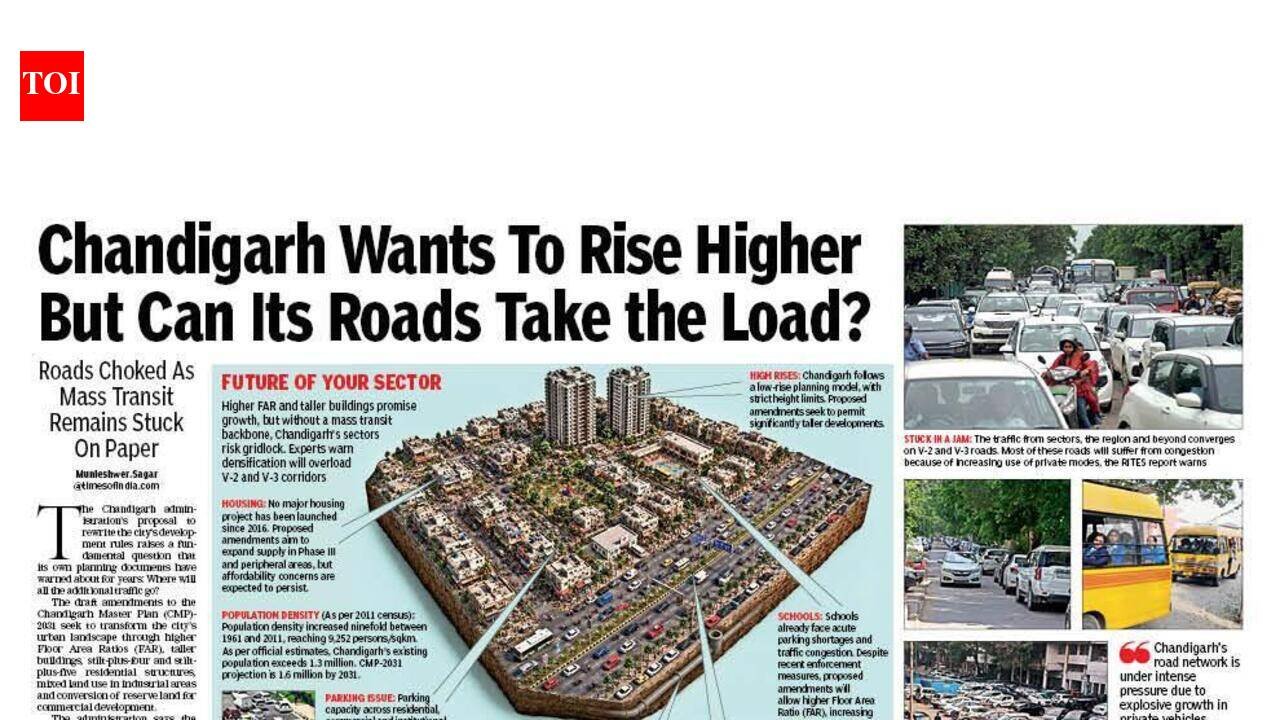
Chandigarh: The Chandigarh administration’s proposal to rewrite the city’s development rules raises a fundamental question that its own planning documents have warned about for years: Where will all the additional traffic go?The draft amendments to the Chandigarh Master Plan (CMP)-2031 seek to transform the city’s urban landscape through higher Floor Area Ratios (FAR), taller buildings, stilt-plus-four and stilt-plus-five residential structures, mixed land use in industrial areas and conversion of reserve land for commercial development.The administration says the changes are necessary to meet future housing and economic needs. But an examination of official planning documents, traffic studies and objections filed against the draft reveals a glaring gap — the city has proposed large-scale densification without first establishing whether its transport infrastructure can absorb the resulting surge in people and vehicles.The absence of a comprehensive traffic impact assessment (TIA) has emerged as one of the strongest objections of residents’ associations and urban planning experts. Their concerns are reinforced not by speculation but by the administration’s own reports.The Chandigarh Master Plan 2031 itself had warned that the city’s transport system was approaching its limits. It identified major corridors — including Madhya Marg, Dakshin Marg, Vikas Marg, Vidya Path, Himalaya Marg, Purv Marg and Udyog Path — as future congestion hotspots, driven primarily by rising ownership of cars and two-wheelers.Even when the master plan was prepared nearly a decade ago, Madhya Marg had already recorded a volume-to-capacity (V/C) ratio of 1.2, while Udyog Path stood at 1.1 — both exceeding their designed carrying capacity. The document categorically stated that most major roads had already been widened to their maximum practical limits, leaving little scope for future expansion.The latest RITES mobility study shows that the warning has become reality.Key roads across not only Chandigarh but the entire Tricity are now operating at or beyond capacity. The Kharar-Banur Highway recorded a V/C ratio of 1.3, while the Ropar-Chandigarh Road touched 1.2.A V/C ratio above 1.0 means demand has exceeded road capacity, leading to recurring congestion, longer travel times and declining service levels.Despite these findings, the proposed amendments seek to increase development intensity across the city without placing any publicly available traffic capacity study in the public domain.The contradiction becomes starker when the city’s transport pattern is examined.According to the RITES Comprehensive Mobility Plan of 2009, nearly 70% of all motorised trips were already being made by private vehicles because Chandigarh lacked an efficient mass public transport system.Instead of improving, the dependence has worsened.The 2024 RITES report shows private vehicles now account for 78.4% of all passenger trips. At several major intersections during peak hours, their share rises to 90%, while buses account for as little as 0.4% to 2.6% of total traffic.“The entire traffic from the sectors, the region and even beyond converges on the V-2 and V-3 roads. Most of these roads will suffer from congestion because of increasing use of private modes,” the RITES report warns.The Chandigarh Master Plan echoes the concern. “Chandigarh’s road network is under intense pressure due to explosive growth in private vehicles… There are limitations on the road space that can be provided within the existing built-up environment,” the document states.Those limitations are now evident on the ground.Average peak-hour speeds have dropped to around 28 kmph, while a CEPT University study estimates citywide speeds of just 23 kmph in the morning peak and 20 kmph during the evening rush. Himalaya Marg — one of the busiest links connecting Chandigarh and Mohali — records an average speed of barely 14.6 kmph.Traffic signals have become another major choke point. According to RITES, poorly coordinated signal operations account for 71% of delays during peak hours and 88% during off-peak periods, dwarfing delays caused purely by congestion.Yet the proposed amendments are expected to bring thousands of additional residents, offices and commercial establishments into the same road network.Urban planners argue that higher FAR, taller buildings and mixed land use inevitably translate into more vehicle trips, greater parking demand and increased pressure on neighbourhood V-4 and V-5 roads that were originally designed for low-density residential sectors.Long planned but still missing MRTSThe proposed amendments also revive a long-standing question: Why is Chandigarh pursuing higher urban density without first delivering the mass transit system that its own planners have recommended for decades?The master plan had repeatedly concluded that the city’s road network had little scope for further expansion and that future mobility depended on a robust public transport system. Yet, more than 15 years after the Tricity Metro was first proposed, the project remains caught in official indecision.The cost of that delay has been substantial. When the Metro was first examined, its estimated cost was around Rs 10,500 to Rs 11,000 crore. The latest RITES estimates have more than doubled that figure to Rs 23,263 crore for an all-elevated system and Rs 27,680 crore for a partially underground alignment, with the final completion cost projected between Rs 25,631 crore and Rs 30,498 crore, excluding land acquisition and rehabilitation expenses.While the Metro has remained on the drawing board, several other mobility reforms recommended by expert studies—including a comprehensive parking policy, scientific parking management, park-and-ride facilities and Bus Rapid Transit System (BRTS) proposals—have also failed to move beyond the planning stage.


