






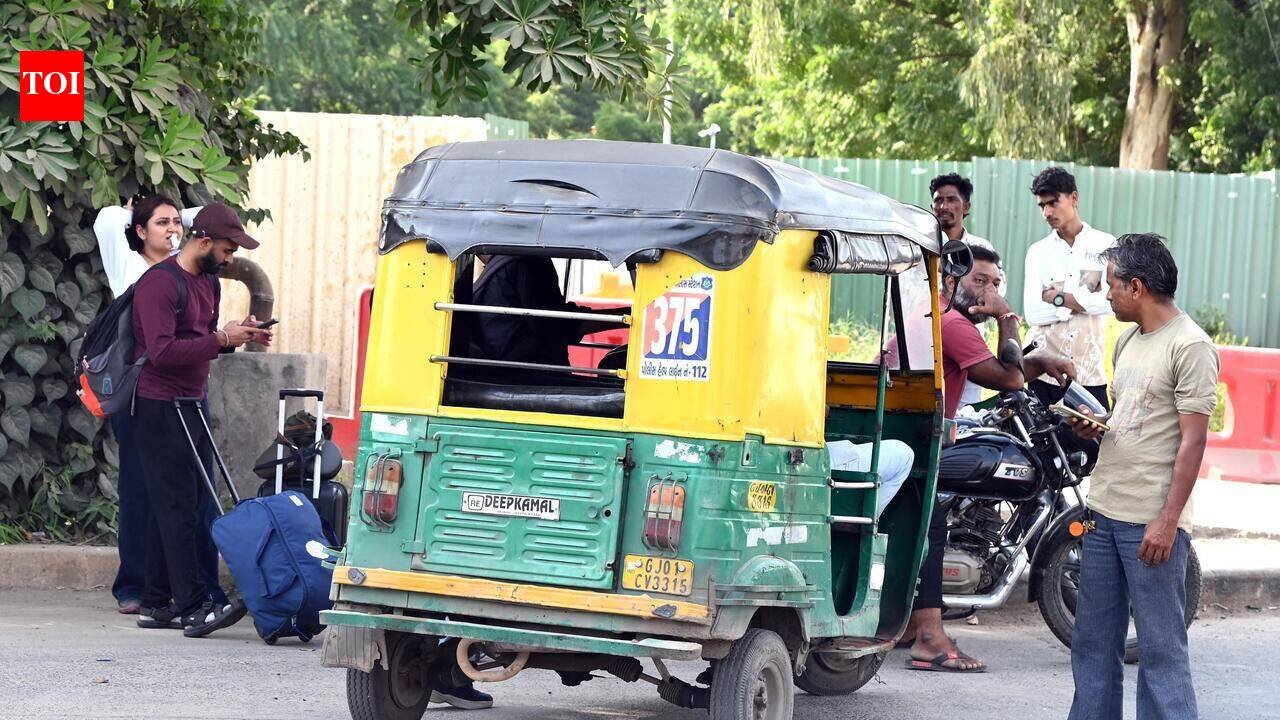
Ahmedabad: When medical student Tanay Shah landed at Ahmedabad airport around 11pm on Tuesday, he expected a cab ride to Chandkheda to cost about Rs 400. “Instead, after accepting my booking, the cabbie called up, asking for Rs 1,000 for the roughly 20-minute ride. I made three more attempts to book another ride. Each driver demanded a similar amount,” he said. Cab drivers outside the airport toll booth quoted Rs 800. With no affordable ride available, Shah asked his friend to drop him home.Shah is not alone. Hundreds of commuters have been hit by the taxi and autorickshaw strike, which entered its third day on Wednesday. Trying to hail a ride, especially from bus and railway stations and the airport, has been a harrowing experience marked by hope, haggling and, in the majority of cases, disappointment. It has been particularly troublesome for the sick and their family members who must visit hospitals and clinics.There are around 1.5 lakh auto rickshaws and 5,000 cabs in Ahmedabad. A large number of these have remained off the roads since Monday, as driver unions press for fare revisions to offset rising operating costs. They are demanding a minimum fare of Rs 20 per km and seeking action against app-based bike-taxi services.“I had read about the strike a few days before it began, but didn’t expect it to hit commuters this badly,” said Ayyan Karmakar, an entrepreneur, who had to spend 30 agonising minutes finding an auto ride on Monday. “Just as I asked my neighbour to drop me to work, one auto driver accepted my ride. On the way, several drivers tried stopping us. My driver smiled and waved to them, signalling that it was only a short trip,” he said.A Tragad resident said she came to know of the strike only when she was unable to book a ride. “All apps showed exorbitant fares. I couldn’t understand why. An auto driver finally accepted, but asked me not to reveal I was a passenger if stopped by other auto drivers. I was to tell them I was his distant relative,” she said, adding she paid Rs 300 for an 11km ride, which normally would have cost her under Rs 200.Thaltej resident Lily Mathew was willing to shell out more than double the fare she normally pays for a trip to Iskcon-Ambli Road. “It comes to Rs 100. But this evening, it showed Rs 250. I resigned myself to the fact as I had no other choice. Yet, no driver accepted my booking,” she said on Tuesday.Gujarat Sarthi Sangh, a union of autorickshaw and taxi drivers, has sought a clear regulatory framework for app-based bike taxis. In a representation to state transport authorities, the union sought permission for such services, permits for the vehicles or action against aggregator companies if the services violate existing rules. It has also demanded govt-notified fares for bike taxis and taxis under Section 67 of the Motor Vehicles Act.“If govt believes that app-based bike taxis are operating illegally, action should be taken against the aggregator companies and not the drivers. Alternatively, govt should frame clear rules, issue permits and notify fares for these services. The uncertainty is affecting both drivers and commuters,” said Rajvir Upadhyay, president, Gujarat Sarthi Sangh.Luxury cab owners propose separate fareThe Gujarat Luxury Cab Owners Association has proposed a separate fare structure for commercial cabs. It has pegged fares at Rs 14 per km for sedans, Rs 16 per km for mini SUVs and Rs 20 per km for SUVs. The association has also proposed 300km packages for the three categories. The rates work out to Rs 4,200 for a sedan, Rs 4,800 for a mini SUV such as an Ertiga and Rs 6,000 for an SUV.DIRE STRAITS
A major inconvenience


