



Bettiah: Once a common sight in the wetlands around the Valmiki Tiger Reserve, the Sarus crane, the world’s tallest flying bird, is now on the verge of disappearing from West Champaran. Conservationists say the decline reflects the rapid degradation of wetlands and changing farming patterns in north Bihar.Recognised for its long legs, red head and lifelong pair bonding, the Sarus crane is considered an ecological indicator of healthy wetlands. According to Wildlife Trust of India joint director Sameer Kumar Sinha, the bird’s shrinking population mirrors the deteriorating condition of the region’s water bodies.“Sarus is the ‘symbol’ or ‘icon’ of wetlands. Its presence indicates that a wetland and its biological and physical components are functioning well,” Sinha said, adding that the name “Sarus” is derived from the Sanskrit word ‘Saras’, meaning lake or wetland.The situation is particularly worrying in West Champaran. Sinha recalled regularly spotting three to four pairs of Sarus cranes between 2003 and 2005 at Daruabari Tal and Hardiya Chanti Chaur near the Valmiki Tiger Reserve.“Now they are rarely seen. Hardiya Chanti Chaur has virtually disappeared and farming is carried out there throughout the year. Most parts of Daruabari Tal, too, have been converted into agricultural land, particularly sugarcane fields, which are unsuitable for Sarus,” he said.Historical records show the bird was found in Bihar until the early 1980s. Distribution maps prepared by ornithologists Murray (1890), Ali and Ripley (1960), and Jonsgard (1983) recorded the species in the state. However, later studies by Gole (1989) and Meine and Archibald (1996) excluded Bihar from its range.A nationwide survey conducted by the Wildlife Trust of India in 1998-99 also failed to record the bird in Bihar. “These studies do not necessarily prove that the Sarus has become extinct in the state, but they certainly indicate that its population has dwindled to negligible levels,” Sinha said.Habitat loss, egg theft and pesticide use have worsened the crisis. According to Sinha, Sarus cranes nested in Daruabari Tal in 2003-04, but villagers frequently stole their eggs.“In the absence of wetlands, the species prefers paddy fields, which are considered man-made wetlands. The expansion of sugarcane cultivation, however, has reduced suitable habitats,” he said.“We have created such adverse conditions for this bird that its return to Bihar’s wetlands will require sustained and dedicated conservation efforts,” Sinha added.
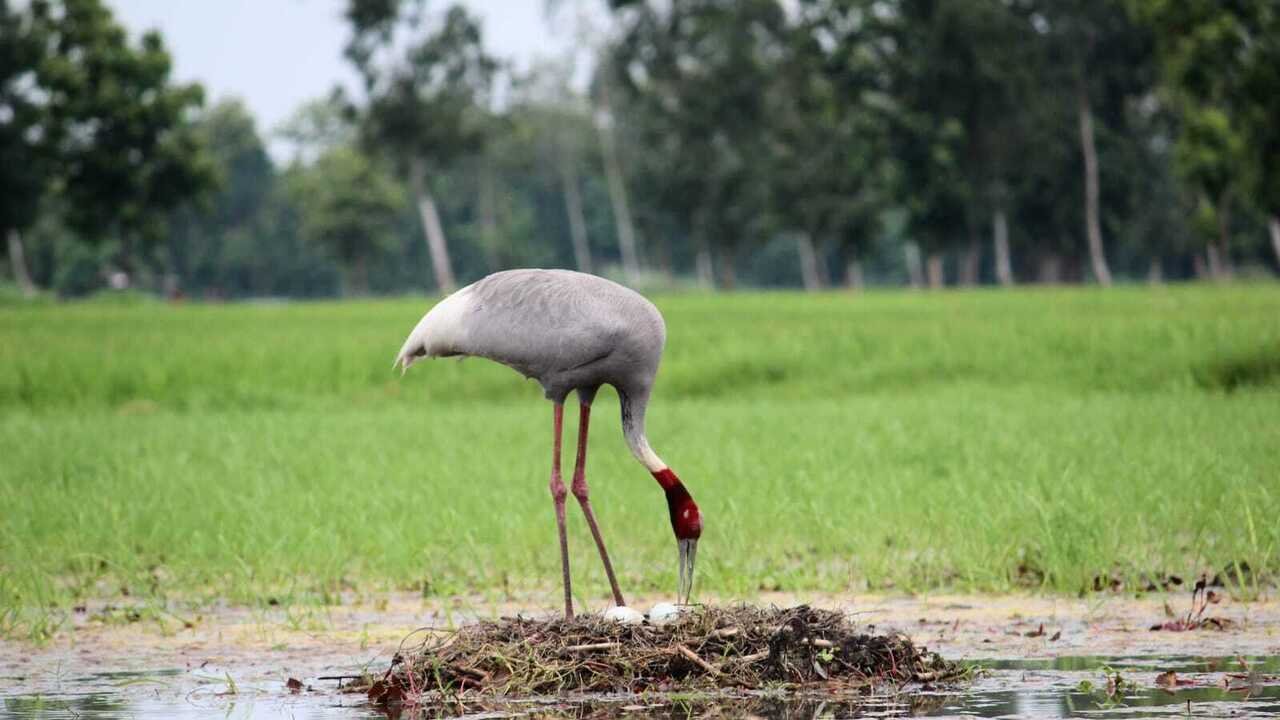
Recognised for its long legs, red head and lifelong pair bonding, the Sarus crane is considered an ecological indicator of healthy wetlands


