





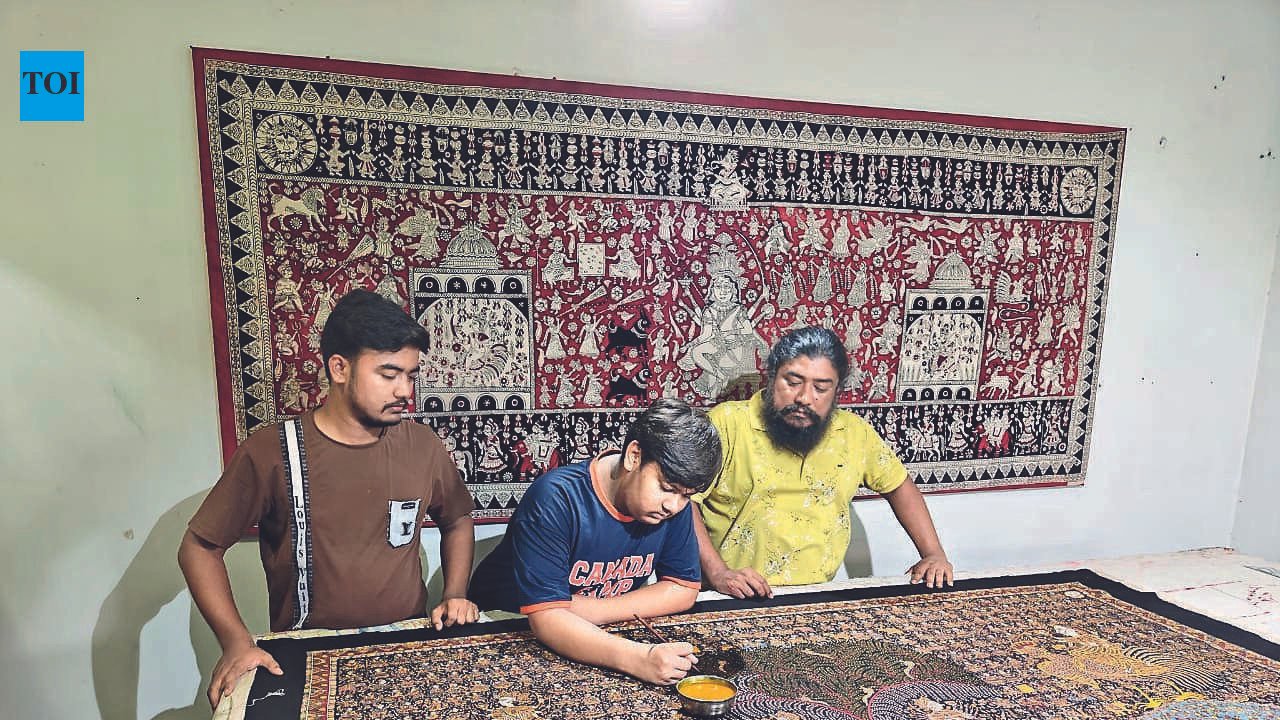
In the iconic scene from “Mother India”, Nargis’s Radha drags the plough through the field. Decades later, that familiar image appears on a gallery wall in Mumbai — but transformed. Radha’s eyes are half closed, her sari is draped the Gujarati way, and the bottom of the composition comes alive with plants, fish, turtles and crocodiles. Bollywood’s most enduring image has been reimagined in the style of Mata ni Pachedi — Gujarat’s nearly 400-year-old sacred cloth tradition, in which painted textiles are used as a backdrop for the Goddess.Radha is joined by a host of other screen favourites on the wall. Sumit and Vivek Chitara, brothers from Ahmedabad’s Vejalpur and the fifth generation of their family to practise Mata ni Pachedi, have also recreated posters of “Enter the Dragon”, “Harry Potter” and “Titanic”, alongside Bollywood titles such as “Sholay”, “Deewar”, “Don”, “Dil Chahta Hai”, “Lagaan” and “Phir Hera Pheri”.“It started as an experiment suggested by Pavitra Rajaram, the creative director of Mumbai-based Nilaya Anthology, and the gallery team. They were aware of the work we had been doing with the art form and wanted to capture the distinct look and feel of Mata ni Pachedi, which has been used to depict Goddesses for generations,” says Sumit, 22, the elder of the two brothers who painted the posters.The launch brought the young artists face-to-face with Bollywood personalities — director Imtiaz Ali, actor Konkona Sen Sharma, critic Anupama Chopra and singer Benny Dayal were among those who attended. “Ali posed with us near the “Sholay” poster and was also intrigued by the custom jackets we wore with Mata ni Pachedi motifs,” says Vivek, 17.
ATTIRE: The Chitara brothers have dressed Pushpa, the protagonist, in the patterned attire they traditionally reserve for Gods on the Pachedis
Sanjay Chitara, the proud father of the young duo, sees in their work a departure from the way the art has been practised for generations. “I was about 5 or 6 years old when my grandfather took me to the area where a large cloth was worked on by different family members. Some drew the lines, while others filled in the colours. Back then, we repeated the fixed designs that the market demanded. But times have changed,” he says.Choosing the gods to paintWhat makes this experiment stand out? Sanjay Chitara explains that not every work done in this style qualifies as Mata ni Pachedi. “There are several imitators, but the extended Chitara family is considered the custodian of the art. The distinctive features include the side profile of the Goddess, primary colours derived from natural sources using age-old methods, motifs associated with the Goddess, and the unique kalamkari (art of the brush) used to depict different elements,” he says.
MOTIF: The poster incorporates aquatic elements such as fish, crocodiles and turtles, inspired by the film’s ocean setting and reimagined through the art form
Those elements continue to shape their film posters too. In the “Lagaan” poster, for instance, the characters mostly face either left or right, following the visual language of the form. “Eyes and expressions are very important. Even when we paint a front-facing face, there is a certain symmetry that becomes an artistic expression. In the ‘Sholay’ poster, the tonga that Basanti rides looks like a chariot, while the lion in ‘The Lion King’ poster is closer in style to the Asiatic lion we are familiar with,” says Sumit.The colours follow the familiar Mata ni Pachedi palette — ochre, red, black, blue and green — while every inch of the canvas is filled with intricate details, leaving no space untouched. The cloth is first treated with alum and then a mordant to help the colours remain vibrant for years. “Each piece has taken us 20 to 45 days. We chose the films based on some of our favourites, while also making sure they represented different decades,” says Sumit.
COLOUR: Yellow is an unusual choice for Pachedi art. The artists created this vibrant shade using natural turmeric and marigold, following the tradition that every colour comes from a natural source
Heritage expert Girish Gupta says such attempts do not dilute the original form. “It has been a part of our culture and tradition for centuries and will continue to remain so. But when such experiments reach wider audiences, they create awareness by presenting familiar tropes in an unfamiliar style. It is both visually stunning and culturally significant because it breaks the existing mould and explores new ground,” he says.From devotion to regional identityMata ni Pachedi, which received its Geographical Indication tag in 2023, has a history of nearly 400 years, according to the documents submitted for the recognition. The name means ‘behind the Goddess’, as the cloth is considered sacred and is placed as a backdrop for the Goddess’s idol during special occasions and the two Navratris of the year — Aso and Chaitra.
This Pachedi has recreated the poster of Mother India. Unlike in the film poster, Radha’s eyes are half closed, her sari is draped the Gujarati way, and the bottom of the composition comes alive with plants, fish, turtles and crocodiles Screenshot
Bhanu Chitara, one of the eminent Pachedi artists, received the Padma Shri in 2023 for his contribution to the art form, while several other practitioners from the Chitara family have also received state and national honours.The art form gained global attention when Prime Minister Narendra Modi gifted a Pachedi to UK Prime Minister Rishi Sunak in 2022.According to the description submitted with its GI tag application, these textiles are traditionally hand-painted or block-printed on rectangular pieces of handspun cotton cloth, using natural and mineral colours for filling the spaces and for dyeing. When square in shape, they are referred to as Mala no Chandarvo — the great square shrine canopy. The folk art is dedicated to depicting stories of the Mother Goddess and, because of its sacred nature, is also known as sacred cloth, temple cloth, temple hanging, shrine cloth or ritual cloth.A common language called cinemaPavitra Rajaram, who helped shape the experiment, said she has been collecting Mata ni Pachedi works for over a decade.“When I saw young Sumit drawing objects such as autos and cold drink bottles in the style he had learned, it gave us an idea. We encouraged him and Vivek to explore their favourite films in the Mata ni Pachedi style. For me, it is more than just an art form. Those who know its history know that it began as this community’s response to being denied entry into temples and the opportunity to worship the Goddesses through this beautiful art,” she says.
The Chitara brothers, accompanied by Pavitra Rajaram, presenting the Pachedi-style “Lagaan” artwork to director Imtiaz Ali at a Mumbai gallery
Films, she says, are a common denominator for a large section of Indians. “It was an easy decision. We were amazed when we got to know the range of films the brothers had watched and enjoyed, from ‘The Grand Budapest Hotel’ to ‘Thor’, ‘Enter the Dragon’ and ‘Baasha’. In a way, it also represented different film industries. We are glad that the works have remained authentic — using vegetable dyes, following the traditional process, and even washing the cloth in the Sabarmati,” she says.Gallery officials said the show was a runaway success, with half of the 40-odd artworks sold on the opening night itself. Such initiatives help a much wider audience discover the art form, Rajaram says. “It is like introducing a youngster to the works of Homer through the recent movie, ‘The Odyssey’,” she concludes.Art steeped in history– The 17th century tradition is closely associated with Gujarat’s Devipujak community-The Goddesses depicted on a Pachedi — including Meldi Mata, Vihat (Visat) Mata and Bahuchar Mata — are specific to the region-According to the GI tag document, while the art was earlier practised in places such as Dholka, Dhandhuka and Amreli, Ahmedabad is now its sole hub-The Chitara community is concentrated in parts of Vasna and Vejalpur, with several generations involved in the process — from washing the cloth to painting and colouring it-Traditional motifs include the Sun, bold triangular borders, processions, scenes from “Mahabharata”, “Ramayana” and “Devi Purana”, milkmaids, celestial maidens, devotees, the priest (Bhuva), the Goddess’s shrine, her vehicle, and smaller images arranged around the primary deity– Several museums across the world have begun collecting these works for their historical and cultural value– In recent years, a younger generation of artists has also collaborated with international artists on fusion pieces that have travelled globally, while some community members are training foreign artists in the traditional motifs


