



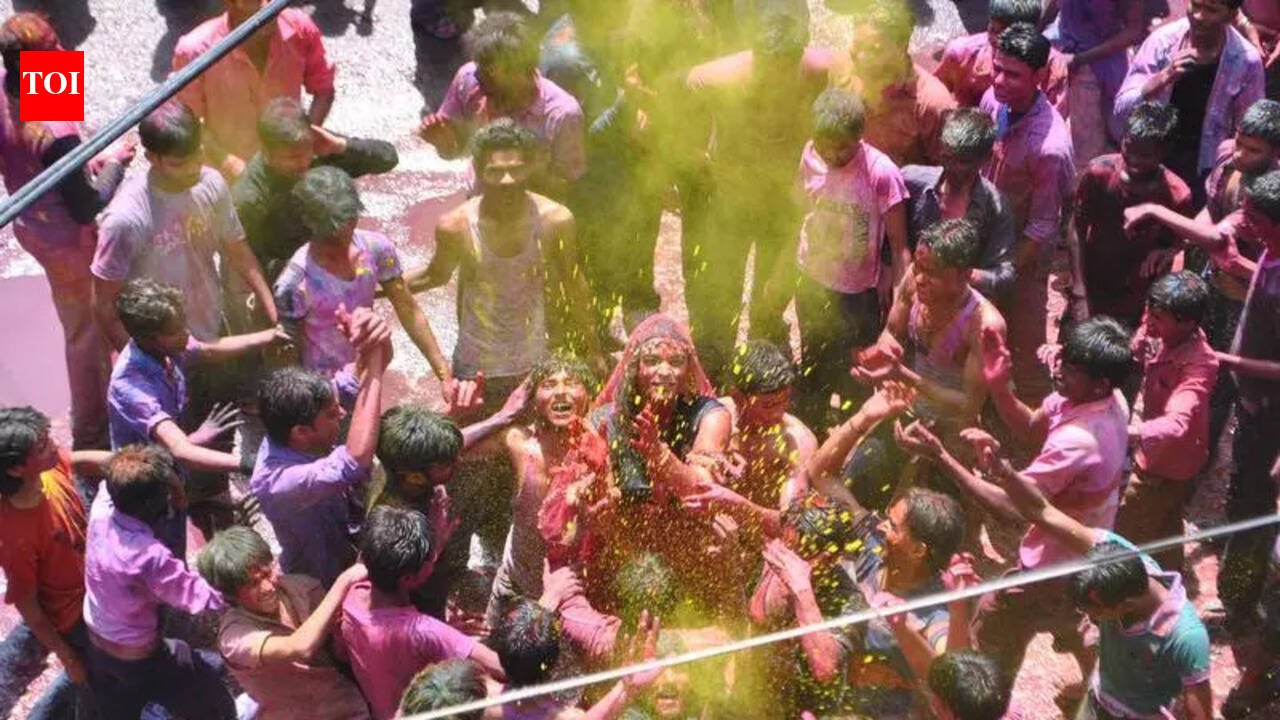
Kanpur: Holi becomes a week-long cultural celebration in the city, culminating in the unique and historic Holi Ganga Mela, an event that blends festivity with memories of India’s freedom struggle and the city’s rich social traditions. It is observed about a week after Holi on the banks of Ganga under the auspicious Anuradha Nakshatra. This year, Holi Ganga Mela will be observed on Tuesday, Mar 10.Its origin goes back to 1942, when British rulers imposed restrictions on public celebrations and defying these embargoes, patriotic youths of Kanpur would hoist the tricolour flag at Rajjan Babu Park a day after Holi.According to accounts preserved by families of those involved, including Mool Chandra Seth, whose father participated in the protest, British officers attempted to remove the flag, leading to clashes between citizens and the colonial police. Around 45 people were arrested, including Gulab Chandra Seth, Raghubar Dayal Bhatt, Bal Kishan Sharma, Kanhaiya Lal Gupta, Amrik Singh, Pt Munshi Ram Som, Shyam Lal Gupta, Budho Lal Mehrotra and Hamid Khan.The arrests triggered widespread protests and markets closed, while mill workers struck work and transport services came to a halt. Residents of Hatia locality and other parts of the city joined demonstrations against British, a movement that gained national attention and received support from leaders Mahatma Gandhi and Jawaharlal Nehru.The scale of protests eventually forced British officials to negotiate with Indian leaders. A meeting at Rajjan Babu Park resulted in unconditional release of the detainees. Significantly, the day of their release fell under the Anuradha Nakshatra.As the protesters were freed, citizens welcomed them, faces smeared with colours as people celebrated Holi once again. The jubilant crowd then moved to Sarsaiya Ghat on the banks of the Ganga, where they bathed in the river, marking the beginning of a tradition that continues to this day.A distinctive feature is the procession known as ‘Rango Ka Thela’, a colourful parade carrying drums filled with coloured water.In earlier times, the procession moved 11 kms through the city on a buffalo cart, covering several old localities before returning to the park. Over the years, modern vehicles joined the procession, but tradition is preserved by including at least 1 buffalo cart in the caravan.In the evening, citizens gather at Sarsaiya Ghat for the grand Holi Mela. Traders, political leaders, social figures, and district administration officials all come together on this occasion. The mela has roots in the city’s commercial past too. During British rule, the city developed into a major trading centre serving large parts of North, Central, and Eastern India. Many workers and labourers in the markets returned to their native villages only once a year. To allow them time to travel and celebrate, markets often remained closed for up to five days during Holi. Nearly 18 villages along the Ganga, including Wajidpur, Pyondi, Sheikhpur, and Ahirwan, celebrate Holi not on the main day but on Rang Panchami, the fifth day after Holi.Local lore states that during the British era, heavy taxes were imposed on villagers, leading to strong opposition under the leadership of local zamindars. When several villagers were arrested, the community refused to celebrate Holi in protest. Only after their release on the fifth day did the residents celebrate, establishing a tradition that continues even today.


