



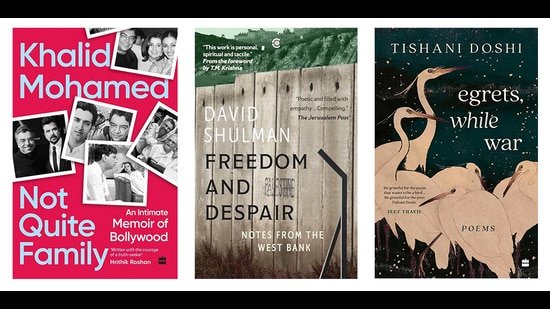
A view of old tinsel town

Khalid Mohamed grew up movie struck, watching films at halls near his house with his grandmother. Once he became a reporter at The Times of India, his beat eventually took him to the movie world – and right into the heart of the lives of icons he had always admired. He developed a rapport with stars like Dilip Kumar, Raj Kapoor, Dharmendra and with actresses like Raakhee, Smita Patil, Karishma Kapoor, Rekha and others whom he interviewed, cast in his movies or got to know as people away from the interview circuit. With some, it was quite the family affair. But friendship, as he discovered time and again, was fickle, lasting only as long as he gave favourable reviews to their films. Where he used his sharp critical scalpel, the welcomes froze.
Not Quite Family is an account of Khalid Mohamed’s exciting years in the Bombay film world. It is also an emotive rendering of the Bombay that was –temperate and gracious. As the city is increasingly smothered by skyscrapers and dust, he takes us behind the curtain to show us the lives of the stars of Juhu-Vile Parle, Pali Hill and Worli.*
An Israeli peace activist’s notes from the West Bank
Interweaving powerful stories and deep meditations, Freedom and Despair offers vivid first-hand reports from the occupied West Bank in Palestine as seen through the eyes of David Shulman – an experienced Israeli peace activist who has seen the Israeli occupation close up as it impacts on the lives of all Palestinian civilians.
Alongside a handful of beautifully written and often shocking tales from the field, Shulman meditates deeply on how to understand the evils around him, what it means to persevere as an activist decade after decade, and what it truly means to be free. The violent realities of the occupation are on full display. We get to know and understand the Palestinian shepherds and farmers and Israeli volunteers who face this situation head-on with non-violent resistance.
Inspired by these committed individuals who are not prepared to be silent or passive, Shulman suggests a model for ordinary people everywhere. Anyone prepared to take a risk and fight their oppressive political systems, he argues, can make a difference – if they strive to act with compassion and to keep hope alive.*
Of massacre, ageing and memory
egrets, while war, Tishani Doshi’s fifth poetry collection, is alive with birds – woodpeckers and golden orioles, lapwings and ‘grey-hooded crows’, pigeons and egrets and The Ramayana’s kraunca. These are creatures that know not pristine lands, but terror-fields ravaged by famine and war.
Amidst such wreckage, they become prayers and prophecies, omens and oracles, messengers of gods and winged-gods themselves, holding within their wildly beating hearts news of an afterlife – ‘Someone said, when children die, they become birds / in heaven.’
An extraordinary collection that navigates the deep entanglements between massacre, ageing and memory, ēgrets, while war tells of a world where exile and extinction press close – ‘The dirge of loss recovery / loss loss loss continues’ – but it offers, too, against the odds, a possibility of coming out alive: bedazzled, birdlike and blue-throated. ‘Now scream,’ Tishani Doshi tells us, ‘now sing.’*
*All copy from book flap.


