


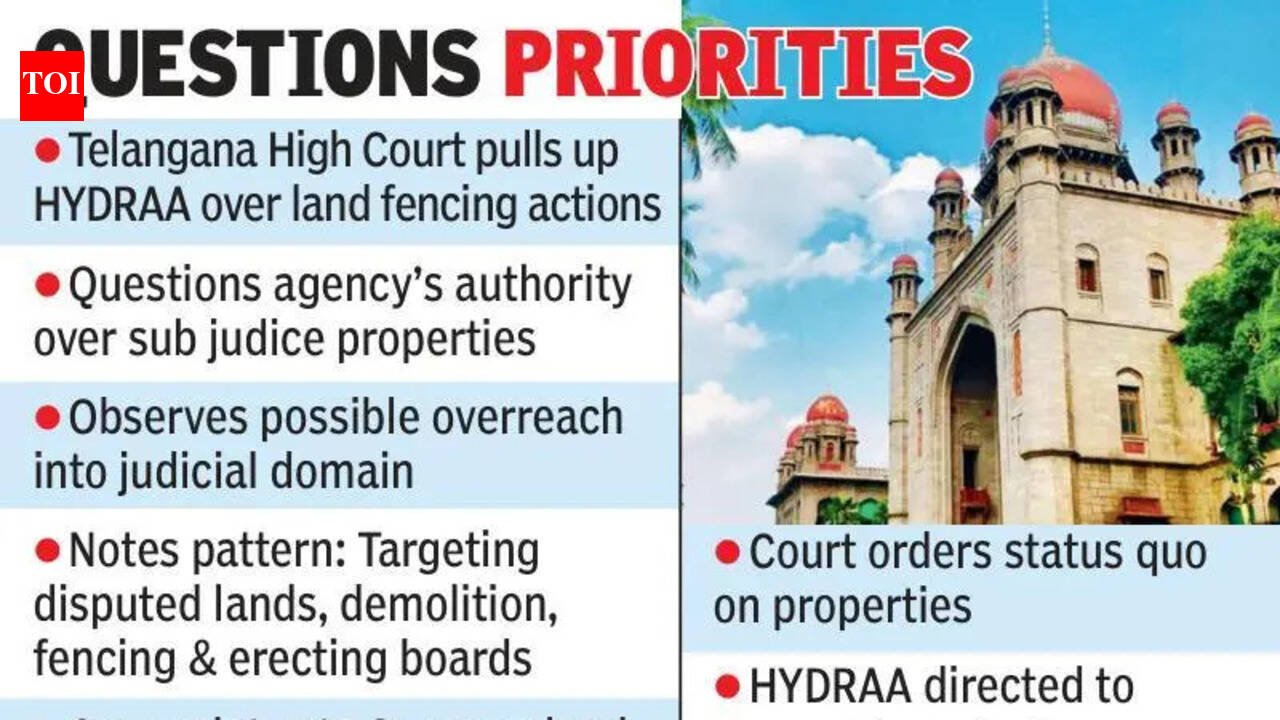
Hyderabad: Taking a stern view of Hyderabad Disaster Response and Asset Protection Agency’s (HYDRAA’s) moves to fence land parcels under the guise of removing encroachments, Telangana high court has asked if the agency was “thinking itself (to be) above the courts” or “running a parallel govt” by unilaterally taking possession of land parcels that are sub judice.Further reprimanding the agency, Justice NV Shravan Kumar noted that the agency’s actions were overlapping judicial authority and pointed out that it is not for HYDRAA to decide where to intervene and take possession of any disputed property.The judge further questioned if HYDRAA had any “vested interest” in targeting disputed land parcels, noting a pattern in the agency’s conduct of selecting properties under litigation, demolishing structures, fencing them, and erecting boards declaring them as govt land.The judge made these remarks while hearing petitions challenging the agency’s action of taking possession of land parcels at Suraram in the city, fencing them, and erecting boards on the property without putting the owners on notice.The judge, while ordering a status quo on the land parcels, further directed HYDRAA to immediately remove the boards erected at the site while allowing the fence to remain. The judge also directed that the Medchal–Malkajgiri district collector be made a party to the petitions and posted the matter to June 10 for further hearing.During the hearing, Justice Shravan Kumar, referring to the properties being sub judice, asked the agency, “Who authorised you to take possession of such land? Was it the revenue department or the MAUD department?”The judge also directed HYDRAA to place on record any permission or communication empowering such actions, while making it clear that unilateral intervention in disputed properties, especially those sub judice, cannot be justified.The judge questioned the agency’s priorities, remarking that the govt body to be focusing disproportionately on disputed land instead of its core mandate of protecting water bodies and managing disaster response. “Why is there no similar urgency in safeguarding lakes and water bodies?” the judge asked.“If you really want to protect such land parcels, file applications before the court and ask for protection. But how could you go to the land parcels, which are sub judice, and how will you decide the title of the land and take possession of it by throwing all residents out?” the judge remarked.
