



In one black-and-white photograph from 1978, farmers till their fields as two of them sit back on a cot, smoking a hookah, with a buffalo sitting near them. Above them, an aircraft flies across the sky. It offers a glimpse of villagers at work alongside an expanding capital.
A man leading a bullock cart along a road in Lutyens’ Delhi in 1980s(Photo by Claude Poulet, from the book ‘Agra and Delhi’)
Another photograph, from the early 1980s, taken from a book titled “Agra and Delhi”, shows a man leading a bullock cart along a road in Lutyens’ Delhi, with the red sandstone government buildings behind him. An Ambassador car passes in the background, but the road is otherwise almost empty — a scene that would be difficult to imagine in today’s traffic-choked central Delhi.Then there is a black-and-white video recorded more than six decades ago. Farmers are harvesting wheat in a Delhi village, some using tractors and bullock carts to move the crop, while women and children bend over the fields, cutting wheat by hand.
A large number of people gathered outside this haveli in Kadipur village on Jan, 1915(Source: Harpal Singh Rana family’s album)
These are some of the fragments of Delhi’s past that have disappeared behind planned colonies, high-rises, flyovers, Metro lines and manicured lawns.As the national capital’s relentless expansion has erased most villages’ physical landscape, projects such as Dilli Dehat Project and Delhi Villages Culture are attempting to document these villages, using Instagram to preserve their memories, traditions and landscapes.
Khera Kalan village is known for its pond, a village elder explains
Started more than a year ago by Hardeep Shokeen (33), a teacher, the Delhi_villages_culture handle on Instagram has over 42,000 followers. A resident of Nilothi village in west Delhi, Hardeep decided to create an informal digital archive of village life.“Rapid urbanisation has meant that much of the history and culture of Delhi’s villages has been lost. If you talk about Haryana, people immediately associate it with rural traditions and village culture. But when you talk about Delhi, that connection is missing,” said Hardeep.
Hardeep Shokeen at a haveli, which was built in 1968 in Nilothi
Take Nilothi, for instance. “Many people may not recognise the name, but if you tell them it is near Vikaspuri, they can connect it, though Vikaspuri came much later than the original village. Similarly, few people know about Masoodpur village, but Vasant Kunj, a well-known locality today, came up on its land. Everyone knows Sarojini Nagar market, but not many would know that Pilanji village where the market eventually came up.”“Greater Kailash was also built on the land of Zamrudpur, yet the village remains largely unknown. Punjabi Bagh locality is famous, but hardly anyone knows about Madipur village. That is the irony of Delhi’s urbanisation — the names of the new neighbourhoods have survived and become familiar while hundreds of years old villages on whose land they were built have gradually faded from public memory,” he said.
Entrance of the haveli in Kadipur
Hardeep said while people are aware of the traditional attire of states like Rajasthan and Gujarat, many think Delhi has no distinct traditional outfit.“However, we had traditional attire depending on the community, like Gujjars, Ahirwal and Jats in villages,” said Hardeep while recording a video of a nearly 60-year-old haveli in Nilothi that has intricate floral motifs, traditional jaali work and a colourful facade.
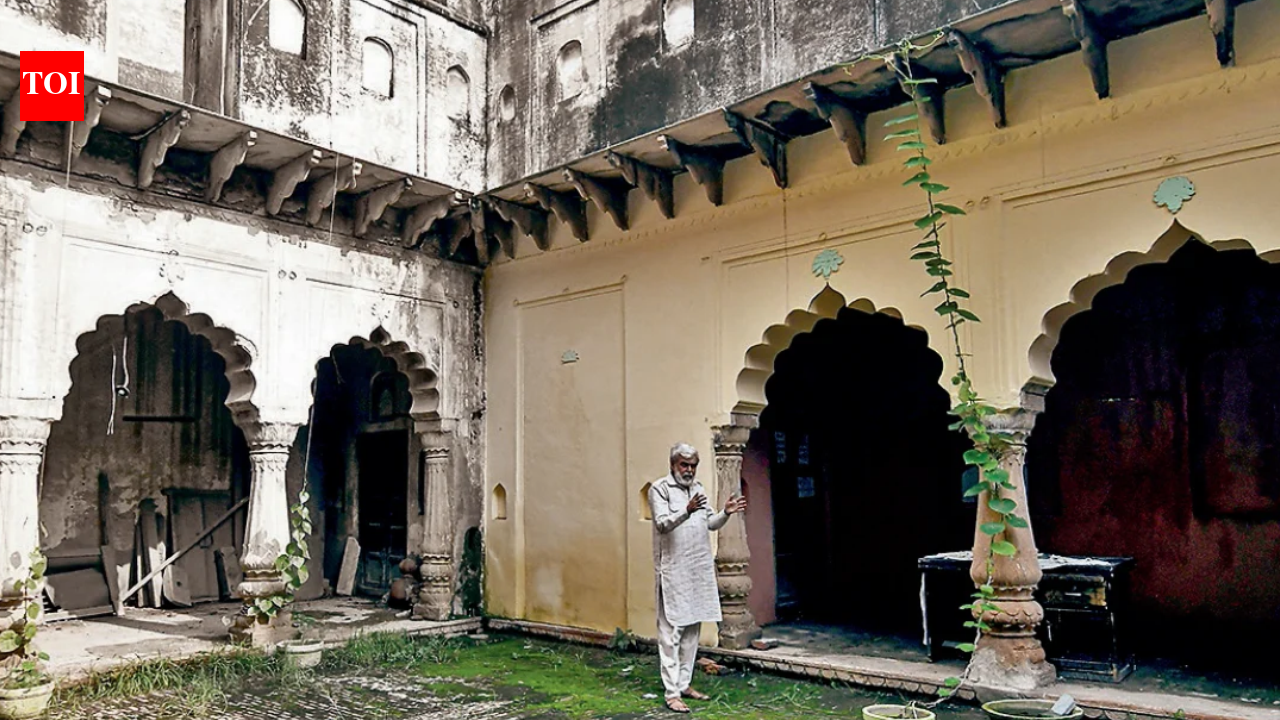
This dilapidated haveli in Nilothi is believed to be around 300 years old
During a spot visit to Nilothi, TOI came across a dilapidated haveli, believed to be around 300 years old. Hardeep pointed towards thin Lahori or Lakhori bricks that some villagers used to make in their homes.Showing his village, Hardeep said the tradition of worshipping the ‘gram devta’, or village deity, continues to remain an important part of community life.“Whenever there is an auspicious occasion like a wedding, the birth of a child or the first harvest, villagers first visit the gram devta to offer prayers.”However, the small, kutcha shrine that once stood here has now given way to a more modern structure, covered with tiles — a reminder of how the village has changed with time.To source old photographs and videos, Hardeep travels to villages and meets their elders, many of whom are the last custodians of memories.“Whatever history remains now is largely with the elders. Some of them have preserved old photographs and newspaper clippings, and memorised folk songs. But that generation will eventually pass away,” he said.Alongside these personal archives, Hardeep also relies on old history books to piece together the stories of Delhi’s villages.Similarly, Dilli Dehat Project, founded by Puneet Singh Singhal, Gagandeep Singh Khadar Bidhuri and Parth Shokeen, seeks to centre the voices of communities whose stories are frequently overlooked, while also building a shared understanding of how caste, land, labour, migration and urbanisation intersect in shaping the city.The project, which began in mid-2023, now boasts nearly 70,000 followers on Instagram.For Puneet (30), a disability rights advocate, the project is also about correcting what he sees as an imbalance in the way Delhi’s history has traditionally been told.“When we talk about Delhi’s history, we mention the Mughals, the British and Shahjahanabad, the Walled City. But villages that are hundreds of years old, and some even thousands of years old, do not find much place in that narrative,” he said.Through photographs, videos, maps, personal memories, conversations with villagers and collaborations, the project is bringing Delhi’s overlooked village histories into public view and, increasingly, turning its followers into contributors to that archive.“We receive nearly 70 DMs and emails every month. Some people share details, photographs or stories about their villages, while many others reach out because they want to know more about the history of their own villages,” said Puneet, who lives in Devli village in south Delhi.TOI visited Kadipur village in north-west Delhi, where Puneet and Parth, along with a volunteer, Lavanya Rana, recorded the old haveli of a local, Harpal Singh Rana.The haveli belonging to his grandfather has an old black-and-white photograph taken on Jan 10, 1915, during a ceremony where a large number of people gathered outside its main gate.“We have pictures of how it looked like in 1915, and how it looks now,” said Puneet.While visiting Khera Kalan, Puneet told TOI that the village is known for its pond and most of its old houses have been replaced by new ones.
