



Sport has an old rule about momentum: catch fire late in a season, and the off-season usually douses it. That sentiment holds for most part. But, as with most things in life, there are exceptions. Elena Rybakina’s is one.
The Russian-born Kazakh couldn’t get past the fourth round at the Grand Slams last year. Form looked to have deserted her and the season was all set to be chalked up as yet another ‘learning experience’ in her career.
Then, it all changed.
She came through a tough set of tournaments in September and October, won in Ningbo and closed the year by defeating Aryna Sabalenka in the WTA Finals title decider, taking home more than $five million in prize money, the largest purse in women’s tennis history at that time.
The soft-spoken 27-year-old later disappeared for the off-season. When she resumed action, she picked up from where she had left off, looking just as dangerous as she’d been. Rybakina reached the Australian Open final without dropping a set, clawed back from 0-3 down in the third set to beat Sabalenka again for her second Major. She became the first player in eight years to win the WTA Finals and the Australian Open in succession.
What followed was, by any measure, a strong season: a title in Stuttgart along with runner-up finishes at Indian Wells and the Canadian Open. She also banked her 400th career win on the way.
The underlying numbers are absurd. Since last year’s US Open, nobody on the Tour has won more matches than Rybakina (62) and nobody has beaten more top-10 players (16, with a 16-6 record). She leads the field in winners (1,569), in aces (394) and break points saved (65.5%). She made six finals (tied with Jessica Pegula for most on the Tour) and clinched four crowns, more than anyone else.
READ | Stability at the top: On the tennis and the U.S. Open
Put it all together and you get a first-time World No. 1: the first from Kazakhstan, and at 27 years and 89 days, the second-oldest woman ever to reach the summit for the first time. She rose to the top, tournament by tournament, so relentlessly that by the time it actually happened, nobody blinked.
And yet a year ago, the idea of Rybakina dethroning Sabalenka looked unthinkable, unattainable even. Last September, she had 3,833 points to Sabalenka’s 11,225 — barely a third. By last month, that gap had shrunk to 360 points, before she finally ended Sabalenka’s 99-week reign as the No. 1.
Even before she ascended to the top of the rankings, Rybakina had already beaten a reigning World No. 1 nine times, a mark bettered only by Gabriela Sabatini’s 10. The Kazakh has now beaten nine of the last 10 women who have held the top ranking. Only Ashleigh Barty got away.
Crowning moment
Impressive as all that is, the true crowning moment of Rybakina’s year came at Flushing Meadows; she barely stumbled, let alone look anywhere near beatable. The strange part is that heading into the tournament, nobody was asking how far she’d go. They were instead wondering if she’d play at all.
On August 14, she was steam-rollered by Iga Swiatek to the Canadian Open title. A week later, Rybakina was forced to retire after just five games of her Cincinnati quarterfinal against the same opponent.
An Achilles injury was suspected, though little else was confirmed. In the week before the US Open, Rybakina barely picked up a racquet. As far as preparation for one of the biggest titles in the sport goes, it was far from ideal.
“It wasn’t the best time, for sure, because I was so upset. I didn’t know how it was going to be, day by day. We arrived in New York, did an MRI and it didn’t look that great. We had to talk with a lot of doctors to get an opinion on what we should do,” she said, hours after conquering New York.
She started practising just four days before the US Open got underway and with each match, she looked less like a woman shaking off rust and more like one reminding everyone who she was. The power was there and the aces were pulled out of nowhere when they were needed the most.
Since last year’s US Open, nobody on the WTA Tour has won hit more aces than Elena Rybakina (394).
| Photo Credit:
Getty Images
“Just four days of practice, a lot of belief in myself and talking with the team non-stop about the tactics… that’s how I played in Canada, how I played in Cincinnati. I mean, it’s just so many things. Everything went my way. I’m shocked.”
Her tennis over the fortnight told a different story. Nothing about this triumph was shocking. Everything came together for Rybakina one way or the other.
Sabalenka loves to feast on her opponent’s second serves, as Pegula was harshly reminded in the semifinals. So when Rybakina landed just eight of her 30 first serves in the opening set of the final, logic dictated that the Belarusian would seize control of the contest.
The logic was wrong. Rybakina pulled out heavier, quicker second serves and deep, powerful groundstrokes to put Sabalenka on the back foot. If one moment captured how the final unfolded, it was the last game of the opening set, where Rybakina couldn’t hit a first serve but ended up on top despite everything thrown at her.
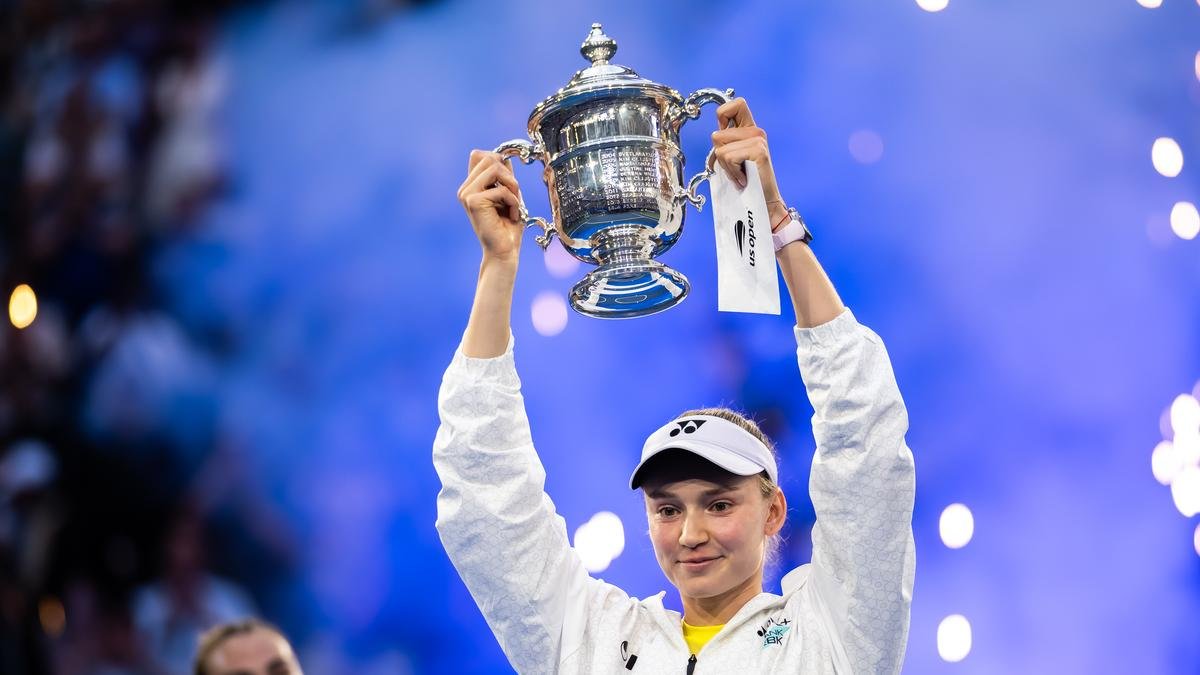
By the end of the night, as she did at the WTA Finals, Rybakina had a trophy and a fat cheque in hand, but this time as World No. 1. Four years ago, she barely managed a smile after conquering Wimbledon, and the tennis world wondered if she’d ever let herself feel a title the way champions are supposed to. In New York, something shifted. The fists were raised, the celebration stayed brief; however, underneath it, for the first time, was an unmistakable and hard-earned joy.
Rybakina wins the way glaciers move: silently, relentlessly, until you look up one day and the entire landscape has changed. New York didn’t just hand her a trophy; it handed women’s tennis a warning wrapped in ice — quiet on the outside, catastrophic on the inside.
A year earlier, after finishing runner-up to Rybakina at the WTA Finals, Sabalenka — far from being tennis’ most gracious loser — was overheard reaching for a Russian idiom that translated to: “Once a year, even a stick shoots,” suggesting Rybakina’s form was little more than a fluke. Famous last words.
Overcoming controversy
Like most of the sport’s best players, Rybakina hasn’t always made headlines for the right reasons. First came the injuries and health scares that dragged her out of tournaments through 2024 and ’25. Then her ‘worrying’ relationship with coach Stefano Vukov landed under the microscope.
In September 2024, she fired Vukov and hired Novak Djokovic’s former coach Goran Ivanisevic, before reinstating Vukov. A WTA investigation later found that Vukov had engaged in abusive conduct towards Rybakina, and he was banned from coaching at WTA events in January 2025. The ban was overturned on appeal that August.
Rybakina never softened her stance towards the WTA through it all, even declining to pose for a photo with the then-CEO Portia Archer after beating Sabalenka to win the WTA Finals on November 8.
Long before the WTA formally looked into the Vukov relationship, fans and pundits had already suspected that something was off. He was always very vocal in relentlessly criticising during matches, well beyond any reasonable idea of ‘tough love’ coaching.
One can argue that Vukov has been noticeably softer since the ban ended. Criticism has largely given way to encouragement. Optimists will call it a man who learnt his lesson. Cynics will call it a man who learnt to behave when the cameras were rolling.
ALSO READ | Federer’s final masterpiece: Roger’s homecoming to the Hall of Fame
Rybakina herself has stayed quiet on the specifics, but she’s hinted that having her team back in place has mattered.
“I think I have a very good team and good people around me now. It definitely helps. A lot was going on in the previous year outside of the court. I think now all my focus is on tennis. I can’t always perform at my best. There are always ups and downs, but I think we’ve been doing a very good job, taking the right decisions in certain situations, because every day is a challenge,” she said last week.
The Vukov chapter may never be fully closed in public, but it changes nothing about where Rybakina stands right now. What once looked like a hot streak has long since stopped resembling one. Nothing about her has come out as a fluke.
She will now head into tournaments, starting with the China Open later this month, as the top seed and a clear title favourite. Given how balanced she is in success and adversity, none of that seems likely to rattle her.
“I feel like you will appreciate and think about it [becoming World No. 1] even more when you finish your career. For now, you need to keep going. You never know how long you’re going to stay. All my thoughts are just for the next match,” she said after her quarterfinal win over Qinwen Zheng.
Call it humility. Call it how elite athletes are wired. Call it a deliberate way of shrugging off the spotlight before it gets too heavy. Whatever it is, one thing isn’t up for debate: the girl who once played tennis as an after-school pastime, who didn’t consider it a career until she was 17, has walked out of New York as the most dominant force in women’s tennis. Rybakina is pure potential energy, coiled at the very peak of her arc. Buckle up.
