



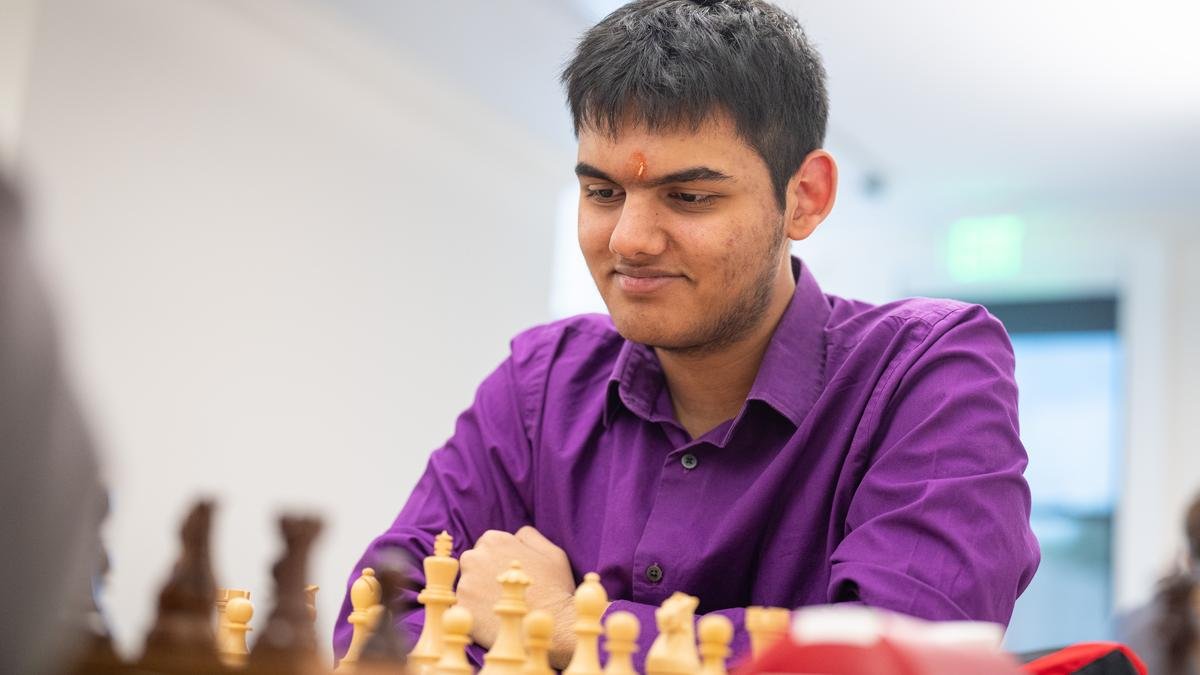
Abhimanyu Mishra became the world’s youngest Grandmaster at the age of 12 in 2021. He still has that record. He is also the youngest player to defeat a reigning World champion. Excerpts from an interview Abhimanyu gave The Hindu in Bengaluru, where he played for PBG Alaskan Knights in the Tech Mahindra Global Chess League:
How do you look back at your journey of becoming the youngest Grandmaster?
It was part of a bucket list. It was in the middle of the pandemic. Everything in the world had shut down, and I desperately wanted to break this record. I went eight months without playing any tournament. Me and my dad decided to take this insurmountable risk. I am not sure if I would take the same risk today. We went to a different country in the middle of a global pandemic, and if either of us got the virus, we would be admitted to a hospital. It would have been an absolute nightmare.
But despite all odds, we decided to take the risk. Taking the risk was one thing, but getting the title was another. I had a rating of about 2410 and no Grandmaster norms (a player needs three). I think I scored norms from two of the first three events, and after that I hit a dry streak. I had to hit the rating of 2500 for the Grandmaster title. I was missing the final norm narrowly. But I made it in cinematic style in the last tournament. I needed to win with black pieces against [India’s] Leon Mendonca, and I did. I was euphoric that this journey was finally over for me and my family.
You had another interesting game with Mendonca here at the GCL. From a winning position, you put your promoted queen on the wrong square, and he claimed it was an illegal move. The arbiter agreed, and you had to replay the move in one second, which was humanly impossible. And you lost on time…
We would have needed an F1 driver to make a move so fast. But I am okay with the claim made by Leon. It is what you do, especially in a team event, where every point matters. I would have done the same. I would do a lot worse actually.
Your thoughts on your maiden GCL?
I actually wanted to play last year, but it did not work out. I had some school obligations and some other stuff, so unfortunately I couldn’t play. I was determined to play this year. I had been following the GCL from the beginning and I found it entertaining. This is a very strong event. We have the world’s best players.
From the spectators’ point of view too, it is an exciting event. It is good to see the audience cheering for you from inside the venue. It actually gives chess a new life in some regard. I loved being part of my GCL team, PBG Alaskan Knights. We had [Viswanathan] Anand, who is one of the greatest players of all time. There was Arjun Erigaisi, who is very creative and an absolute madman. I love his creativity, and the way he can transform any game into a very sharp, complicated minefield.
Arjun also has the ability to take risks, and that is very important. He doesn’t mind being in a minus position, according to the computer, but as long as he is comfortable, he would go for anything. We also had in our team Yagiz Kaan Erdogmus, who is very, very strong.
Your thoughts on the other prodigies of Indian chess – Gukesh, Praggnanandhaa and Nihal Sarin?
Gukesh has this ability to bounce back from very tough situations. Yes, his recent form hasn’t been good, but it happens sometimes. I am sure he will be back to his best. Pragg has had a phenomenal run of late, and he is mentally strong, like we saw recently in the Grand Chess Tour final against Fabiano Caruana. He was down by six points at one stage, but came back and won the match. Nihal is very tricky and does well in time scrambles. I have played with him a lot online and he is very, very strong in bullet chess.
You beat Gukesh at the Grand Swiss last year and became the youngest player to beat a defending World champion…
That was a very interesting game. Before the start, I realised I had two options. I was white, yes, so I could play something solid and I could try to press a little bit. But he is very strong, so it was unlikely I would be able to create real chances and win unless he made some very big mistakes.
The other choice was that I could view this game as a unique opportunity to create history. If I had lost that game, no one would have remembered, but it was an opportunity to beat the World champion.
That’s something I wanted to. So I decided to play the sharpest line in my repertoire (Bg5 in the Italian Game) but he has one of the world’s greatest opening preparations. He had come prepared for this, and I was thinking over the board, and I had this idea to sacrifice a piece. You are playing against the World champion, so sacrificing a piece is probably the last thing to do.
But I was trying to replicate what Arjun does in these scenarios. I mean, it was fine as long as I understood what I was doing in this position. During the Grand Swiss, I felt like I was sort of untouchable. I was in a very good state of mind, and it was like I would play my best chess.
If Gukesh wanted, he could have made a draw. But he desperately wanted to win. He has this hunger even after becoming World champion… he still wants to kill everybody. This is both a positive and negative trait, but I believe if you want to reach the very top, you need to be like this. You will lose games, but you will win more. In our game, he tried to do this, but it backfired, and I found some very accurate moves. I got to a rook ending, and then clearly converted my advantage.
There doesn’t seem to be as much support for chess in the United States as in a country like India…
Yes, it is quite difficult to be a full-time chess player in the USA. I don’t really have sponsors, but I am a very positive person. I hope things can still work. And yes, the Kasparov Chess Foundation has been supporting me.
Published – September 19, 2026 06:30 am IST
