An often cited principle states that true justice uplifts the weak without penalizing those who are capable. Does this idea actually hold a firm position in modern-day society? Unfortunately, the answer is no. What we today term as affirmative action is just a way of hindering growth towards a well-developed society.
The reservation system was first introduced by the Government of India Act, 1909. It involves providing quotas in education, employment, and jobs to those belonging to disadvantaged groups. This idea was initially adopted to provide social equity and representation to the socially and economically backward classes.
The history of the reservation system in India dates back to British rule. The Government of India Acts (1909, 1919, 1935), under the British government, established separate electorates for communities, especially the minorities. In 1902, Kolhapur’s Chhatrapati Shahu Maharaj declared 50% reservation for non-Brahmins in state services. This was India’s first concrete reservation system.
One of the most instrumental figures in establishing the reservation system in India was Dr. B. R. Ambedkar. He fought against the discrimination that depressed classes faced in everyday life. Apart from this, he embedded the concept of equality and the provisions of reservation in the Indian Constitution. His ultimate goal was to achieve a society where caste discrimination vanished. This reservation system is supported by the legal framework provided by the Constitution of India.
Article 15(4) and Article 15(5) provide provisions for the advancement of socially and educationally backward classes in educational institutions, including private institutions. Article 16(4) reserves posts in public employment for backward classes. In Article 16(4A), promotion for SCs and STs is mentioned. Other such Articles supporting the reservation system are Articles 17, 46, and 335.
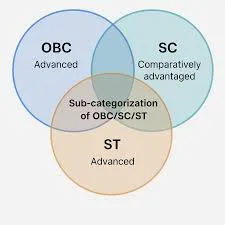
The reservation structure can be classified into two categories: vertical reservation and horizontal reservation. Vertical reservation includes Scheduled Castes (SCs), Scheduled Tribes (STs), Other Backward Classes (OBCs), and Economically Weaker Sections (EWS). Specific groups like women, ex-servicemen, or people with disabilities are placed under horizontal reservation.
In central educational institutions, quotas are provided to candidates belonging to the depressed classes of society. Fifteen percent reservation is provided to the Scheduled Castes, who have been historically targeted as the untouchables; 7.5% to the Scheduled Tribes, who are the indigenous communities; and 27% to the Other Backward Classes. This reservation in government and private institutions is a way to address historical injustice.
Despite being considered a way to promote social inclusion, it cannot be ignored that the reservation system sabotages merit-based selection. Rather than fostering a casteless society, it emphasizes caste identity and raises consciousness among people. Apart from this, there are many creamy layer issues associated with the reservation system.
Creamy layer refers to the wealthier, more educated, and socially advanced group within the backward classes. In the OBCs, the creamy layer is not eligible for reservation. However, its application to SCs and STs is still an ongoing legal debate. This implies that those among the Scheduled Castes and Tribes who have advanced in society still possess the opportunity to utilize their reservation.
Reservation can also be found in the employment sector (government). Candidates from the backward classes are recruited and, in the case of SCs and STs, promoted based on the percentages allocated to them. In legislatures and local bodies, a fixed number of seats is reserved for the historically disadvantaged groups, such as the Scheduled Castes, Scheduled Tribes, and women. This is considered a way to ensure representation in politics.
The reservation system has been criticized predominantly for its impact on meritocracy. Meritocracy asks for a system where everyone starts with equal opportunities. An individual’s selection depends on the talent portrayed, effort given, and performance shown. Reservation supports category over merit. This leads to the dilution of efficiency, especially in competitive exams. This system is mainly based on caste and not on income or economic conditions.
Thus, the benefits of the reservation system can also be utilized by those historically backward groups who have advanced socially and economically. In India, some tribal-dominated regions are declared as Scheduled Areas, where ST reservations apply strongly. However, it is not necessary that every person belonging to the particular area would be socially or economically backward. In such cases, reservation is misused by those who are socially or economically sound.
The reservation system was initially intended to be temporary, with a 10-year limit in the Constitution. However, it continues to exist without regular reassessment. Despite being socially advanced, some groups continue to receive the benefits of the reservation system. Also, primary education is neglected due to the existing reservation system. Rather than improving basic schooling, our attention is fixed on reservation provided in higher education and employment. If society does not focus on foundational education, equality can never be achieved.
The reservation system also affects the non-reserved categories in adverse ways. This system results in increased competition and delayed opportunities. It may cause psychological stress and frustration in aspirants. Also, the lack of opportunities in one’s home country leads to brain drain. Brain drain is the migration of skilled individuals to foreign countries for better jobs and opportunities. This may bring about the loss of skilled human resources for the country.
There are certain measures that the government can take to ensure that reservation balances meritocracy and social justice. The creamy layer rule should be implemented strictly, with regular updating of income limits. Data and surveys should be taken into consideration to reassess the population in need of support.
The groups that are no longer socially or economically backward should be removed from reservation categories. The condition of government schools, hostels, scholarships, and coaching should be improved. Also, the benefits of the reservation system should not be provided repeatedly to the same family.
The debate between meritocracy and social justice has been going on for years. Indeed, the reservation system helped to ensure representation for the historically disadvantaged population. However, it also raises concerns about the undermining of meritocracy and fairness.
The key solution to the problem does not lie in the removal of the reservation system. Instead, the need of the hour is reform within the reservation system. It must be kept in mind that affirmative action must be a bridge to equality, not a permanent crutch.