






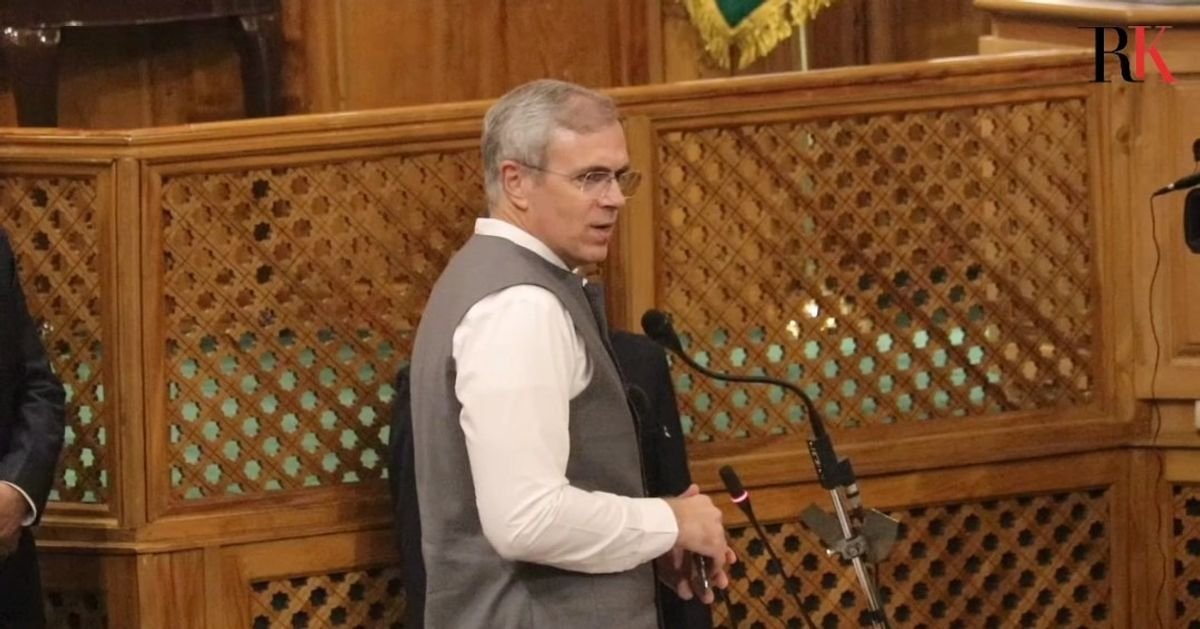
Srinagar, Sep 28 : Chief Minister Omar Abdullah on Monday sought clarity from the Centre on the timeline for restoring statehood to Jammu and Kashmir, questioning what the phrase “as soon as possible” actually means and asking New Delhi to specify when it considers the “appropriate time” for taking the decision.
Addressing the Legislative Assembly during the debate on the resolution seeking restoration of statehood, Omar also questioned any attempt to link the restoration of statehood with the security situation or militancy, saying such a condition would effectively place the decision in Pakistan’s hands.
“I ask the Centre at every possible forum: tell us, what is the appropriate time to seek statehood?” Omar said.
He said that if the Centre’s position was that statehood could not be restored until militancy ended, it would imply that the decision was no longer entirely in New Delhi’s hands.
“If you are saying that statehood will not come until militancy ends, then you are effectively saying that the decision on the statehood of Jammu and Kashmir does not lie in New Delhi but in Islamabad,” he said.
Referring to Pakistan’s role in militancy and incidents including Uri and Pulwama, Omar questioned whether restoration of statehood was effectively being made conditional on Pakistan ending violence.
“Are you leaving this decision to Pakistan? You are saying that they will stop the gun and then you will give us the state,” he said.
Omar said Jammu and Kashmir had accepted that the decision on statehood rested with New Delhi and questioned the rationale behind attaching conditions to the Centre’s commitment.
“If you have already decided that your Prime Minister will not give statehood to us during his tenure, then it is a matter of great regret,” he said.
Omar defended the wording of the resolution seeking restoration of statehood, saying it had been drafted after careful consideration to prevent anything in it from becoming a pretext for disrupting the House.
He said the government had consciously kept Article 370, Article 35A and the issue of special status out of the resolution.
“Read the resolution and tell me where we are asking for a vote on 370, 35A or special status,” he said.
Omar said some of his colleagues had moved amendments seeking to bring these issues into the resolution, which, he said, could provide an opportunity for disruption.
“My colleagues have fallen into that trap. When they add 370 and 35A to it, they give them an opportunity,” he said.
He pointed out that the Assembly had previously passed resolutions concerning special status, including one in 2000 during the government headed by Farooq Abdullah.
“The House has passed a resolution on special status not once but twice. One was in 2000 under Farooq Abdullah,” he said.
Omar said the present demand was straightforward—restoration of the constitutional and political status Jammu and Kashmir had before its reorganisation.
“We are saying, give us back the status that we had, which others did not have. That is all we are asking from the Centre,” he said.
The Chief Minister rejected the argument that restoration of statehood would weaken political parties seeking it, saying the issue concerned the people of Jammu and Kashmir rather than any individual or political organisation.
“It is not as if the state belongs to me, my family or any political party. It belongs to the people,” he said.
Omar said the absence of full statehood had an impact on the functioning of the elected government and day-to-day administration.
“There will be an impact somewhere or the other every day because we do not have statehood,” he said.
The Chief Minister also questioned the division of powers between the elected government and the Lieutenant Governor’s administration under the Union Territory framework.
He questioned why the Revenue Department had been kept outside the elected government’s control.
“We are told that in the UT, security and law and order are theirs, while the rest is ours. Then why has the Revenue Department been kept outside our sphere?” he asked.
Omar also referred to the J&K Academy of Art, Culture and Languages, questioning its connection with security or law and order.
He further referred to universities, including IUST and Baba Ghulam Shah Badshah University, and questioned the curtailment of the Chief Minister’s role while the Lieutenant Governor functions as Chancellor.
Omar said the government had sent its Business Rules to the Centre nearly two years ago but was still awaiting approval.
“Nearly two years have passed since we sent the Business Rules to the Centre. They have still not been approved,” he said.
He said the delay had contributed to uncertainty over the division and exercise of executive powers under the UT arrangement.
The Chief Minister also raised the issue of the appointment of an Advocate General, saying Jammu and Kashmir had completed nearly two years under the elected government but was still without one.
“Nearly two years have passed since our government was formed, but Jammu and Kashmir still does not have an Advocate General,” he said.
Omar said the government had already submitted its proposal and that the matter had gone through the Cabinet before being forwarded for consideration.
He questioned why the appointment had still not materialised.
Omar said the issues being faced by the elected government were a direct consequence of Jammu and Kashmir’s Union Territory status.
“Tell me, in which state does this happen? A Chief Minister moves a resolution and the Law Secretary gives an opinion. This can happen only in a UT,” he said.
He also questioned why legal opinions concerning the elected government were being issued without adequate consultation with the political executive.
Omar said that at one point he himself was unaware of a Law Department opinion despite being both Chief Minister and Law Minister, while the matter had already been communicated elsewhere.
“As Law Minister and as Chief Minister, I do not know, but you have received the letter. This is the direct result of being a Union Territory,” he said.
Omar also referred to the historical constitutional framework associated with Jammu and Kashmir, including the arrangements concerning Maharaja Hari Singh and protections for state subjects.
He alleged that the constitutional and legal framework associated with the erstwhile state had subsequently been altered following the reorganisation of Jammu and Kashmir.
The Chief Minister said the government had constituted committees on several issues, but their reports were still awaited.
“We have been humiliated. We want an account of this. We are asking for our rights,” Omar said.
He said the Centre should fulfil its commitment to restore statehood and reiterated that the Legislative Assembly had made its position clear.
“Jammu and Kashmir’s Legislative Assembly is asking the Centre to restore statehood,” he said. —(KNO)


