






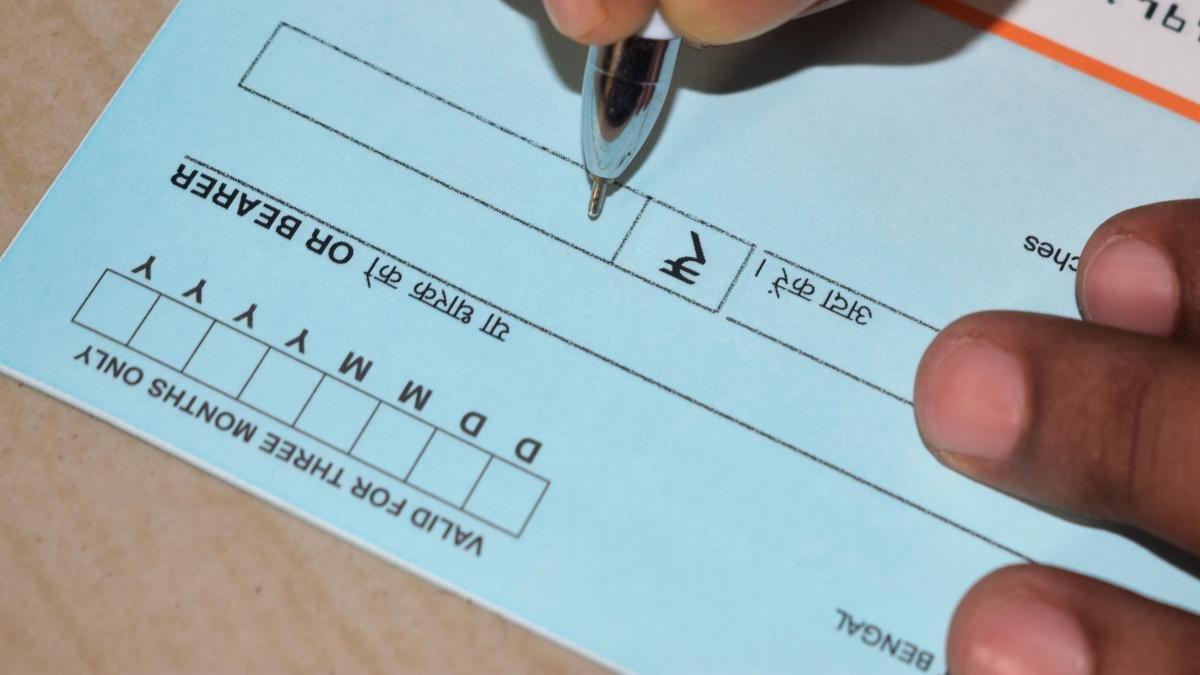
Image used for representation purpose only.
| Photo Credit: Getty Images/iStockphoto
In this digital era, cash is gradually losing its sheen while digital payments are rising. Yet, in certain high-value transactions such as property purchases, business deals and loan repayments, cheque continues to hold its ground. A cheque is a bridge between a promise and a payment. When the bridge collapses, the promise is breached, money fails to reach its destination, giving rise to financial and legal consequences.
Let’s address some rudimentary aspects. To mitigate risk of disputes, both parties must verify the cheque’s particulars and check for errors or unauthorised alterations. The issuer must ensure sufficient balance when the cheque is presented and avoid issuing signed blank cheques.
However, a cheque may still be dishonoured by the bank, that is, payment may be refused and the cheque returned unpaid, a situation known as a cheque bounce. Generally, when a cheque bounces, the bank provides a return memo to the recipient stating the reason. The recipient must retain the memo and notify the issuer to resolve the payment issue. A cheque may bounce for several reasons, including insufficient funds, account closure, stop-payment instructions or signature mismatches. The legal consequences rest on reason for dishonour and circumstances.
Legal consequences
A cheque bounce may be treated as a criminal offence under Section 138 of the Negotiable Instruments Act, 1881, punishable with imprisonment of up to two years, a fine of up to twice the cheque amount or both, if the statutory conditions are met.
Under Sections 118 and 139 of the Act, the court presumes, unless the contrary is proved, the cheque was issued for consideration and towards a legally enforceable debt or liability. The drawer (or accused) can rebut this by raising a probable defence that challenges the existence of the legally enforceable debt or liability.
For instance, Kamal issues Priya a cheque for ₹50,000 which is dishonoured due to insufficient funds. The court initially presumes Kamal owed Priya ₹50,000 and issued the cheque only to repay that debt. Kamal can challenge this by presenting evidence that casts doubt on the existence of his liability to Priya. However, he does not have to prove his case entirely on his own; the court considers proofs from both sides before arriving at a conclusion.
Legal timeline
The payee can initiate proceedings under Section 138 only if the cheque was presented within validity period, usually 3 months from its date. If the cheque bounced, the payee, within 30 days of receiving information from the bank, must send a written demand notice to the issuer. The defaulter has an option to settle the payment within 15 days from the date of receipt of the payee’s demand notice. If payment is not made within the stipulated time, the payee might file a written complaint before the competent Magistrate within a month (30 days) after the 15-day notice period expires.
The court may accept a late complaint if the complainant provides sufficient reason for the delay. The parties may also settle the case by mutual agreement as Section 147 of the Negotiable Instruments Act, 1881, permits such cases to be settled amicably. Further, the recipient may approach a civil court to recover the unpaid amount. For eligible claims, a summary suit offers a procedure to speed up the recovery of certain debts. Under the Limitation Act, 1963, a money-recovery claim usually must be filed within three years though the date from which this period begins depends on the nature of the claim.
(Dr. Sincy Wilson is an Assistant Professor of Law, Vels University (VISTAS). Dr. Vaishali R. Venkat is an NISM & CRISIL-certified Wealth Manager and certified in NISM’s Research Analyst module)
Published – October 19, 2026 06:32 am IST


