



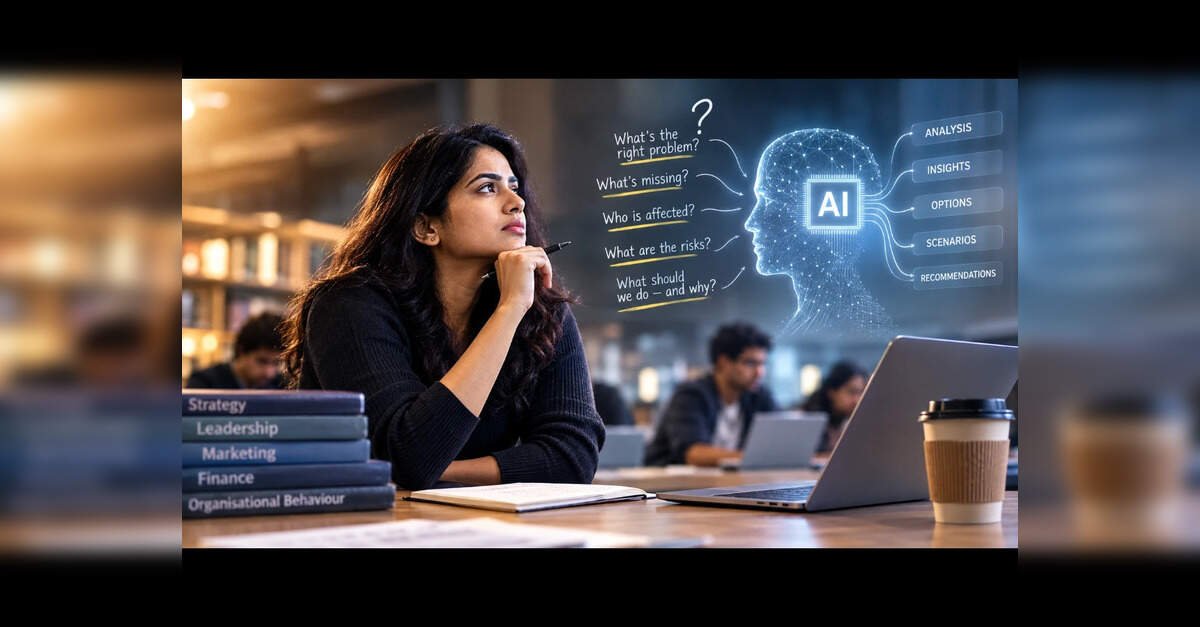
“I fear that future generations of management graduates will outsource their thinking to AI unless management education shifts its focus to encouraging students to ask questions rather than answer them.”
That warning from Dr Suresh Ramanathan, CEO of IMI, goes to the heart of a question India’s business schools can no longer treat as simply a curriculum exercise: if artificial intelligence can produce a market analysis, build a financial model, summarise a case, generate a presentation or suggest a strategy in seconds, what exactly should an MBA graduate be exceptionally good at?
The answer emerging from conversations with management education leaders across India is not that business schools need to turn every MBA student into an AI specialist. It is almost the opposite. They need to become better at teaching students what machines cannot be trusted to decide for them: which problem is worth solving, what question should be asked, whether an answer is credible, what information is missing, whose interests are at stake, what risks follow from a decision and who should take responsibility for the outcome.
That is a more fundamental shift than simply adding artificial intelligence to the MBA syllabus.
AI is changing the economics of knowledge. Answers that once required hours of research can now be generated almost instantly, while routine analysis and other entry-level tasks are increasingly being automated. As that happens, the value of a management graduate cannot rest simply on knowing more information than the next person. It has to rest on knowing what to do with information, technology and people when the answer is not obvious.
That is why the question facing India’s business schools is not whether the MBA will survive AI. It is what kind of MBA will remain valuable because of it.
The MBA is not losing relevance. Its value proposition is changing
There is an important distinction in the emerging debate. Employers have not lost faith in management education. In fact, the latest evidence from the Graduate Management Admission Council (GMAC) suggests the opposite.Its 2026 Corporate Recruiters Survey found that 100% of surveyed employers expressed confidence in graduate management education, though the same survey recorded a meaningful decline in the share of employers who think today’s graduates are as professional as previous cohorts, even as the skills they value are changing. Technology, AI and data-analysis capabilities recorded the largest increases in importance, while communication and problem-solving remained among the most valued capabilities and adaptability also gained importance.
That creates the central paradox for business schools: the MBA is still valuable, but the things that make it valuable are changing.
The traditional model of management education was built around acquiring frameworks, understanding concepts, analysing cases and applying established tools to business problems. The emerging model will have to preserve those foundations while placing greater emphasis on problem framing, judgement, experimentation, communication, collaboration and responsible use of AI.
Dr T.V. Raman, Registrar and Professor at Birla Institute of Management Technology (BIMTECH), argues that AI “can no longer remain a standalone elective”.
Students, he says, should learn to use AI for analysis, research and decision-making while also learning to interrogate its outputs, identify bias and exercise managerial judgement. His objective is to produce what he calls “AI-augmented managers”: professionals who understand technology but do not surrender their thinking to it.
Dr Kartikeya Bolar, Professor and Chair, Office of Examinations, in the Information Systems and Analytics area at T A Pai Management Institute (TAPMI), Manipal Academy of Higher Education, takes the argument further. Business schools, he says, need to move “beyond AI courses” and redesign management education around AI-augmented decision-making.
The distinction matters. The workplace does not simply need more graduates who know how to operate an AI tool. It needs people who can decide when to use it, when not to use it, how to test its conclusions, what context it is missing and what the organisation should actually do next.
That is a very different definition of technological competence.
When AI enters the workplace before the graduate does
The urgency comes from the speed at which AI is moving into actual work. Deloitte’s 2026 India Gen Z and Millennial Survey found that 93% of Gen Z respondents and 95% of millennials in India use AI in their day-to-day work, underlining how quickly AI has moved from an emerging technology to a normal part of professional life.
In other words, the question of whether an MBA graduate will work with AI is increasingly irrelevant. They already are. The more important question is whether the graduate has learnt how to work with AI without becoming dependent on it.
nasscom’s January 2026 analysis, Work Reimagined: The Rise of Human-AI Collaboration, similarly frames the transition around human-AI collaboration and the way AI is reshaping work across India’s technology industry.
For management schools, that distinction has consequences far beyond an AI elective. A student may graduate knowing how to write sophisticated prompts, generate strategic options or produce an excellent presentation in minutes. Those capabilities will matter, but a manager still needs to decide whether the question itself is worth asking, which option is commercially viable, ethically defensible and politically workable, and how to persuade people who disagree with the recommendation.
AI can accelerate the production of managerial work. It cannot remove managerial responsibility.
That is where business education’s next competitive advantage could lie.
The first casualty may be the old idea of the job-ready graduate
For decades, entry-level employees learnt by doing the routine work around more experienced professionals. They prepared spreadsheets, collected information, built presentations, conducted basic analysis, responded to customers and gradually learnt how organisations actually function. Some of those tasks are precisely the ones AI is increasingly capable of performing.
GMAC’s 2026 Corporate Recruiters Survey found that one in three global employers reported replacing at least some entry-level jobs with AI. The report says such replacements were most prominent in technology and manufacturing, with recruiters citing tasks including coding, data entry and customer service.
The finding does not mean that one-third of all entry-level jobs have disappeared. It does, however, signal a change in the traditional pathway through which graduates acquired their first workplace experience.
That creates a difficult problem for management education. If companies automate some of the routine work through which young employees traditionally learnt, they may simultaneously expect new hires to contribute at a higher level from the beginning.
The learning curve is being compressed at the same time that the performance bar is rising.
Prof. (Dr.) Rushi Anandan, Area Chairperson for General Management at K J Somaiya Institute of Management, captures the challenge in unusually direct terms: “Thus far, b-schools have delivered students as products. They need to acquire the capability to deliver students as solutions.”
The distinction is important. A “product” can be certified, ranked and placed. A “solution” has to demonstrate that it can address a real organisational problem.
That changes what happens inside the classroom. Students cannot simply be trained to know a framework; they have to learn when the framework applies, when it does not, what assumptions underpin it and what happens when the real world refuses to behave like the textbook.
That is why experiential learning emerges as one of the strongest common themes across the conversations.
Raman describes the necessary movement as a shift from knowledge-driven to experience-driven education. Bolar argues that real-world problem-solving should become central to the curriculum, with students repeatedly confronting ambiguous business problems and using data, AI, teamwork and stakeholder engagement to arrive at decisions.
Dr Vittal Rangan, faculty member at Great Lakes Institute of Management, Chennai, and a former senior HR professional, reaches the same conclusion from the perspective of employers, although he does not believe management education needs to throw away its foundations.
“I do not think management education will need a major revamp,” Rangan says. The theories and concepts of management remain relevant, he argues. What changes is how those concepts are applied.
“Applying these concepts, with technology as the enabler, to achieve high speed, precision, and ownership is the new game,” he says.
That may be one of the most important distinctions in the AI debate. The future of management education may not require less management knowledge. It may require students to spend less time demonstrating that they have memorised that knowledge and more time demonstrating that they can use it when the conditions are messy.
Business rarely comes with an answer key
This is where the AI debate becomes an education debate.
Most conventional assessment systems are built around questions for which there is an expected answer. Management rarely works that way. A business decision may involve incomplete data, conflicting objectives, uncertain outcomes, internal politics, regulatory constraints, ethical questions and stakeholders who disagree about what success means.
An examination can ask a student to calculate the right answer. A manager often has to decide which calculation matters in the first place.
Rangan identifies precisely this gap when he talks about students who have become adept at clearing examinations and achieving good scores but can struggle when confronted with situations requiring multiple perspectives and competing stakeholder interests.
AI makes the problem harder to ignore. If a student can ask an AI system to produce a market analysis, financial model, SWOT framework or strategic presentation in minutes, the educational value of testing whether the student can reproduce those outputs falls.
The more difficult and more important question becomes: Can the student recognise a bad question even when the machine gives a convincing answer?
Can the student spot an unsupported assumption? Recognise a hallucinated fact? Identify whose interests are missing from the analysis? Challenge a recommendation that appears statistically sound but is strategically wrong? Explain why the machine’s answer was rejected? And, ultimately, take responsibility for the decision?
This is why Ramanathan’s call for students to ask questions rather than simply answer them is more than a pedagogical preference. It reflects a fundamental change in the economics of knowledge.
When answers become cheap, questions become valuable.
And when machines can generate options at scale, judgement becomes the differentiator.
The case for judgement is not an argument against AI
There is a danger in framing this transition as humans versus machines. The business schools interviewed for this story are not arguing for a return to an AI-free classroom, nor are they suggesting that traditional management education should resist technology.
Their argument is more nuanced: the future manager should be better with AI, not replaced by AI.
That means understanding what AI can do exceptionally well: process large volumes of information, identify patterns, generate alternatives, automate repetitive work and accelerate analysis. It also means understanding where managerial judgement remains indispensable: defining objectives, understanding context, weighing trade-offs, interpreting ambiguity, negotiating with stakeholders, making ethical choices and taking responsibility for consequences.
The distinction between these capabilities could become one of the defining features of the next generation of management education.
A future MBA curriculum may therefore need to teach students not just how to use AI but how to delegate intelligently to AI. Which tasks should be automated? Which should remain human? What level of verification is necessary? What data can be trusted? What happens if the model is wrong? And what happens if the model is right but the decision is still wrong?
Those are management questions, not merely technology questions.
Industry cannot remain a visitor to the classroom
The transformation also exposes a weakness in the traditional industry-academia relationship. Indian business schools already have extensive corporate engagement. Companies visit campuses, executives deliver lectures, students undertake internships, institutions run corporate competitions and industry leaders sit on advisory boards. But the educators interviewed for this story argue that much of this engagement remains transactional rather than strategic.
Ramanathan uses that distinction explicitly. Industry should not enter the academic ecosystem only to recruit students, deliver a guest lecture or sponsor an event. It should become a participant in designing the learning experience.
Raman makes a similar distinction between collaboration and co-creation. Employers, he argues, should help identify emerging skills, co-create courses and live projects, provide real datasets and continuously evaluate whether programmes reflect workplace realities.
Bolar takes the argument into assessment. If employers say that graduates need better problem-solving skills, then employers and business schools should jointly design problems that test those skills.
That sounds simple. It is actually a significant change.
A company could give students a genuine business problem, with data stripped of commercially sensitive information. Students could be asked to frame the problem, identify what they do not know, use AI where appropriate, test the output, challenge assumptions, make a recommendation and defend it before a panel of managers.
The grade would not be determined simply by whether the recommendation matched an answer key. It would depend on the quality of the reasoning.
That would bring the classroom closer to the reality of managerial work. It would also give employers something they often struggle to infer from a CV or degree certificate: evidence of how a person thinks.
From curriculum alignment to talent co-creation
This could become the next phase of the industry-academia relationship.
Instead of a linear model in which a university teaches a student and a company subsequently hires them, the emerging model could involve industry and universities jointly defining a problem, students solving it, and faculty and industry assessing the reasoning and capability demonstrated in the process.
That is more than curriculum reform. It is a different talent model.
It becomes particularly important as employers themselves struggle to keep up with rapidly changing skills. GMAC’s 2026 report says AI-tool skills saw the largest year-on-year growth in employer demand, but also notes that AI proficiency remains one of the areas in which employers see graduates as relatively less prepared to demonstrate capability. At the same time, communication remains a foundational hiring criterion.
That combination is revealing.
The answer is not to choose between AI and human skills. It is to produce graduates who can connect the two.
Deloitte’s 2026 India findings reinforce the urgency from the other side of the labour market. AI is already part of the daily working lives of 93% of Indian Gen Z respondents and 95% of Indian millennials surveyed.
The student arriving at a business school is therefore entering a world in which AI is no longer an abstract future technology. It is becoming part of the normal workflow.
That creates an opportunity for business schools. They can become places where companies do not merely recruit talent but help develop it.
The university can provide the theory, research environment and faculty expertise. The company can provide context, data, ambiguity and consequence. The student gets something neither side can provide alone: a chance to practise making decisions in conditions that resemble actual work.
Assessment may become the real battlefield
Curriculum reform is visible. Assessment reform is harder.
A business school can announce an AI course tomorrow, add a module on generative AI or responsible AI, or give every student access to an AI platform. But if students are still rewarded primarily for reproducing information in conventional examinations, the underlying incentive structure has not changed.
The real test of AI-era management education may therefore be what institutions choose to assess.
Consider two students. The first produces an excellent answer with AI assistance. The second begins with a poorly defined business problem, asks better questions, identifies missing information, rejects several AI-generated recommendations, brings in stakeholder perspectives, makes a decision under uncertainty and explains the risks.
The first may be better at producing an answer. The second may be better at managing.
Business schools will increasingly have to decide which capability they want their assessment systems to reward.
That could mean more live projects, simulations, oral defence, group decision-making, reflective assignments, real datasets and assessments where the problem itself is deliberately ambiguous. It could mean evaluating not only the final recommendation but the reasoning trail that produced it. It could also mean asking students to document how AI was used, what it contributed, what was rejected and why.
In other words, AI could make assessment more demanding, not less. The technology can produce the first draft. The student still has to own the final decision.
Five institutions, five emphases, one emerging direction
The educators interviewed for this story do not agree that the MBA needs to be rebuilt from scratch. That disagreement is useful because it shows that the debate is not simply about adding AI courses.
Rangan’s position is that the fundamentals of management remain relevant, but their application must evolve. Raman’s emphasis is on embedding AI across management education rather than treating it as a standalone subject. Bolar argues for AI-augmented decision-making and deeper integration of real-world problem-solving. Ramanathan puts the emphasis on questioning, Socratic thinking and moving beyond transactional industry relationships. Anandan challenges the very idea of the student as the output of the institution, arguing that business schools should develop students as solutions to real organisational problems.
Different starting points and different emphases, but a strikingly similar destination.
The future-ready management graduate is not simply someone who knows AI. It is someone who can combine AI fluency with domain knowledge, judgement, communication, adaptability and accountability.
That is also why the strongest argument emerging from the interviews is not that management education must become more technological. It is that it must become more managerial.
The irony of AI may be that the more capable machines become at producing analysis, the more important distinctly managerial capabilities become: knowing what to ask, what matters, when the numbers are misleading, which stakeholder has been left out, when speed creates risk and when the technically optimal answer is organisationally impossible.
Most importantly, it means having the confidence and competence to say when the machine’s answer may be wrong.
The MBA’s future may be decided outside the AI lab
For years, the value proposition of the MBA has rested on a familiar promise: acquire management knowledge, develop professional networks, gain exposure to business problems and emerge ready to lead.
AI does not necessarily invalidate that promise. But it raises the standard. A student can now acquire information faster than ever before, produce analysis faster, generate presentations faster and access explanations, examples, frameworks and competing viewpoints at unprecedented speed.
So business schools have to ask a harder question: What can a student do after two years of an MBA that they could not do simply by having access to an AI system?
The answer cannot simply be “write a better prompt”.
It has to be something closer to this: the student can understand a complex problem, frame it, identify what is missing, use technology intelligently, distinguish evidence from plausible-sounding output, see the human consequences of a decision, persuade people who disagree, act despite uncertainty and accept responsibility when the decision turns out to be wrong.
That is not the end of management education. It is arguably a return to its most fundamental purpose.
The MBA was never supposed to be a qualification in knowing all the answers. It was supposed to prepare people to make decisions when the answers were incomplete.
AI simply makes that purpose harder to hide. And that may be the most consequential change it brings to the business school.
The next generation of management programmes may therefore be judged less by how many AI courses they offer than by a harder question:
How many times before graduation did a student have to make a consequential decision with incomplete information, use AI without surrendering judgement, defend that decision to another human being, and live with the outcome?
That is a very different definition of an MBA. And in the age of AI, it may be the one that matters most.


