



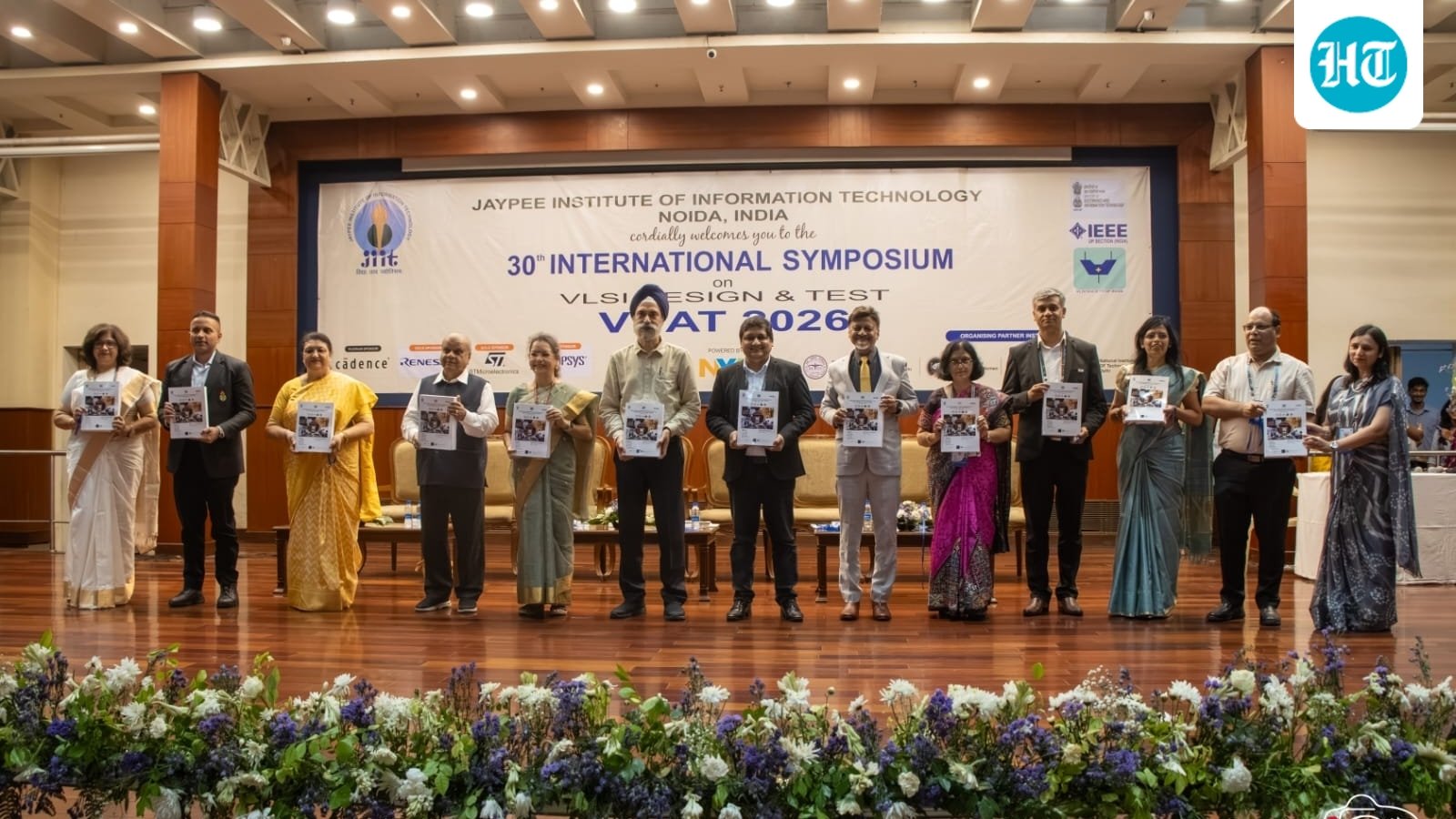
The 30th International Symposium on VLSI Design and Test (VDAT 2026) began at Jaypee Institute of Information Technology (JIIT), Noida, on Thursday, bringing together academicians, semiconductor industry leaders, researchers, policymakers and students to discuss emerging technologies in semiconductor and intelligent computing systems.
The three-day symposium, being held from August 20 to 22, has the theme “Advancing Intelligent, Secure and Quantum-Ready Semiconductor Systems for the Next Era of Computing.”
VDAT enters Uttar Pradesh for the first time
The 30th edition marks the first time that VDAT is being organised in Uttar Pradesh. The symposium is hosted by JIIT in collaboration with Delhi Technological University (DTU), IIIT-Delhi, IGDTUW, NIT Delhi and NSUT, with support from the VLSI Society of India and IEEE Uttar Pradesh Section.
The organisers said the event provides a platform to connect the emerging electronics, semiconductor and advanced-manufacturing ecosystem of the Noida-Greater Noida region with researchers and industry.
VDAT has been organised for three decades as a platform for discussions and research in VLSI design, semiconductor technologies, testing, electronic design automation, embedded systems and emerging computing technologies.
Also read: The next frontier for Indian science on the 80th Independence Day
Focus on India’s semiconductor capabilities
Sunita Verma, Scientist-G and Group Coordinator, R&D Division, Ministry of Electronics and Information Technology, who attended as chief guest, highlighted the need to strengthen capabilities across chip design, fabrication, advanced packaging, testing, materials, equipment and intellectual property.
She also highlighted areas including artificial intelligence, edge computing, hardware security, heterogeneous integration, chiplets, silicon photonics and quantum technologies, while stressing collaboration between government, academia, industry, start-ups and research institutions.
Also read: Building a resilient semiconductor supply chain
Dr Kamaljeet Singh, director general of the Semi-Conductor Laboratory, Mohali, emphasised the importance of building indigenous semiconductor capabilities and a wider ecosystem covering research, design, fabrication and technology deployment.
VLSI Society of India president Satya Gupta said VDAT continues to provide a platform for researchers, industry experts and students to exchange ideas and developments in semiconductor and VLSI technologies.
122 research papers selected from 441 submissions
The symposium received 441 research papers from 78 institutions, of which 122 were accepted, giving an acceptance rate of 27.7%.
The research programme covers seven technical tracks, including circuits and SoC design, embedded systems, AI hardware and design automation, emerging semiconductor devices, advanced integration, hardware security, advanced memory architectures and quantum-ready technologies.
The programme also includes keynote addresses, invited talks, tutorials, a PhD Forum, Startup/Chippreneur activities, poster sessions and industry-academia interactions.
Also read: The AI race: can India turn sunlight into intelligence?
Industry-academia initiatives featured
The inaugural programme also featured the Synopsys-JIIT Tapeout Initiative and the unveiling of the VDAT 2026 proceedings. A Cadence-certified laboratory was also inaugurated during the event.
Representatives from NXP Semiconductors, Cadence Design Systems, Synopsys, STMicroelectronics and Renesas Electronics are among the industry participants in the technical programme.
Also read: The next AI revolution will be won in deployment, not development
The symposium is expected to provide researchers, students and technology professionals with opportunities to interact with experts while strengthening academic and industry connections around semiconductor and emerging computing technologies.


