



TECHNOLOGY & NATIONAL SECURITY
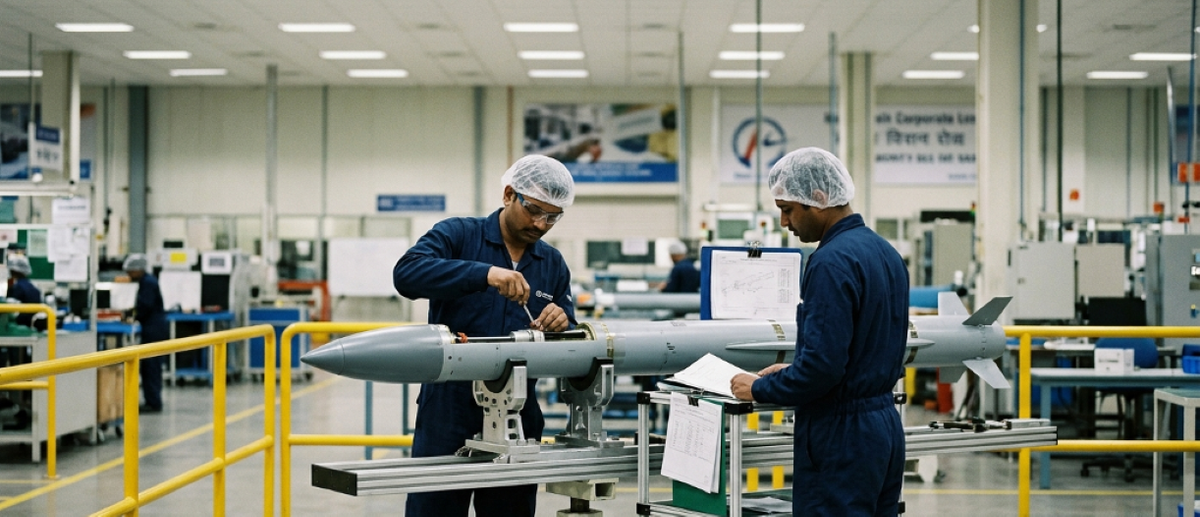
Sometime in the coming weeks, India’s Ministry of Defence is expected to issue a Request for Proposal inviting private companies to build the Astra Mk-2, a beyond-visual-range air-to-air missile with a reach of 180 to 200 kilometres. Adani Defence, Bharat Forge, the Tata Group, Mahindra and ICOMM are reported to be in the running. A frontline Indian missile is about to roll off a private assembly line for the first time.
The logic behind the move is hard to fault. Bharat Dynamics Limited, the state-owned firm that has long held a near-monopoly on tactical missile production, cannot keep pace with demand from the armed forces and export clients. Defence exports touched a record Rs 38,424 crore in the year to March 2026, and Indonesia has expressed interest in the Astra. The order book has outgrown the factory.
The timing, though, carries a problem the announcement cycle has skipped past. India is distributing missile production across corporate India at the precise moment the world’s battlefields have made missile factories the first thing you strike.
What actually changed
Under the incoming Defence Acquisition Procedure 2026, the ministry has ended BDL’s exclusive hold on tactical missiles. DRDO has distributed ten to twelve missile development programmes across public and private firms, and four private companies, Adani Defence and Aerospace, Bharat Forge, ICOMM and Solar Defence and Aerospace, have been designated Development-cum-Production Partners. The projects span an indigenous anti-ship missile, the Rudram series of anti-radiation missiles, a man-portable air defence system, a 1,000 kg glide bomb and a drone-launched precision munition.
The direction of travel is clear. Defence Secretary Rajesh Kumar Singh told the CII Annual Business Summit in May that the time had come to involve private industry in ballistic missile production as well. The Pralay, a tactical ballistic missile with a 500 kilometre range, is widely expected to be the next programme opened up. All of this follows the earlier decision to end Hindustan Aeronautics Limited’s monopoly in aerospace manufacturing. The sequencing is deliberate.
The factory is now the target
Look at what 2026 has done to missile factories elsewhere. Ukraine has struck at least six Russian plants tied to Iskander production since March, part of at least 48 recorded attacks on Russian defence-industrial facilities between January and June. Thirteen came in June alone. Russia has answered in kind. Its June strike on the Lasar Group drone plant caused an estimated 35 million dollars in damage and, by a Russian military analyst’s own assessment, destroyed design documentation that will take longer to replace than the building. In West Asia, the US-Israeli campaign against Iran severely damaged four ballistic missile production facilities, including Khojir and Parchin, within weeks.
The pattern across three separate conflicts is the same. Air defence can intercept a missile in flight. Nothing intercepts the loss of the line that builds it. Production has replaced the launcher as the centre of gravity, and serious military planners everywhere have updated their target lists accordingly.
The exposure gap
A BDL plant sits on defence land behind defence-establishment security, with a vetted workforce and networks built for classified work. A private missile line will sit where private factories sit: in a commercial industrial park, on corporate IT. And it will belong to a company that answers to shareholders.
That last detail matters more than it appears. A listed company has disclosure obligations. Capacity expansion and large defence orders surface in investor presentations and quarterly filings. An adversary assembling a target list no longer needs an intelligence operation. It needs a broking account.
India is dispersing the arsenal without dispersing the armour.
The cyber exposure scales the same way. Reporting around India’s new space cybersecurity guidelines put cyberattack attempts during Operation Sindoor at over 1.5 million, with attacks on government networks rising nearly sevenfold. That pressure was aimed at one hardened government perimeter. Missile production will now live on five or more corporate networks, each with its own vendor tiers, each only as strong as its weakest supplier’s email server.
The case for dispersal, taken seriously
The strongest argument for the reform is the same battlefield evidence read the other way. One BDL is a single point of failure, and a strike on one campus halts national output. Ten production sites across ten firms are far harder to decapitate. Ukraine’s own drone industry has survived four years of Russian targeting partly by scattering itself across small workshops.
That argument is correct as far as it goes. But Ukraine’s dispersal was forced by war, with relocation and secrecy enforced by survival. India’s dispersal is a procurement reform. The forthcoming RFP will assess production capability. No public document so far describes physical hardening standards, air defence cover or mandatory cyber requirements for private missile lines. That gap is my reading of the published record, and I would be glad to be corrected by an annexure nobody has released yet.
Bottom Line
The Astra Mk-2 exists to counter the Chinese PL-15E missiles supplied to Pakistan before Operation Sindoor. India needs it at scale, and private industry is the fastest route to scale. DAP 2026 answers the question of who builds the missile. The question it leaves open is older and harder. The RFP will decide who manufactures the Astra Mk-2. Nothing published so far decides who defends the factory.
(The Author studies Computer Science and Artificial Intelligence at Rutgers University, New Jersey, USA. He is interested in emerging technologies and innovation, and can be reached on LinkedIn at @arssh-kumar14)


