






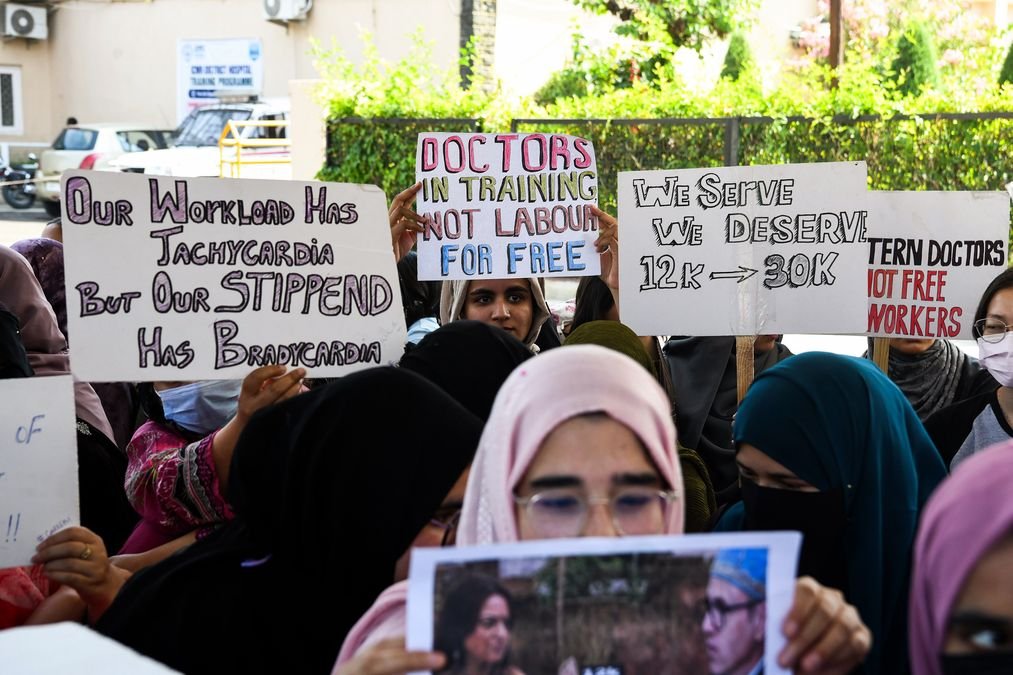
Srinagar, Sep 15: Ahead of the Autumn Session of the Jammu and Kashmir Legislative Assembly, various employees’ associations across the Union Territory have intensified their efforts to press the government for resolution of their long-pending demands, with several groups announcing protests and strikes.
A major demand being raised by employees and workers is regularisation of their jobs and enhancement of monthly stipends, particularly for those engaged under different schemes and on contractual or temporary arrangements.
The associations have geared up to draw attention to their issues and seek intervention from legislators and the administration.
The protests began in Jammu and Kashmir on August 31, 2026, when the medical interns from different government medical colleges and hospitals commenced their strike to press for their demands for an increase in their monthly stipends.
After protesting for nine days, the medical interns called off their strike following a meeting with Health and Medical Education (H&ME) Minister Sakeena (Masood) Itoo, with the government assuring that the long-pending demand for enhancement of their monthly stipend will be resolved within 30 days.
The second protest started in Srinagar by the Jammu Kashmir Casual Daily Wagers Forum (JKCDWF), led by its president Sajad Ahmad Parray, who demanded that the government make public the recommendations made by the government with regard to their long-pending demand for regularisation. However, the protest is still going on as the forum has decided to once again hit the streets for the third time in a month on September 22 in case their demands are not met.
In this regard, Deputy Chief Minister Surinder Kumar Choudhary had stated that the workers had a legitimate grievance but should not allow outsiders or political interests to use their issue.
Furthermore, the agitation by employees of the National Health Mission (NHM) continued across Jammu and Kashmir for the seventh consecutive day on Tuesday, with around 12,000 workers remaining off duty in support of their long-pending demands.
The 72-hour strike by NHM employees commenced on September 9, demanding pay parity with NHM workers in other states, a comprehensive policy for job security and regularisation, besides social security benefits including EPF, ESI, insurance coverage and post-retirement support. The protesting employees, however, extended their strike by a further 72 hours twice and have been pressing for their demands.
With regard to these employees, Minister Sakeena Itoo termed their demands genuine, but said the government would be left with no option but to act against these employees in case they don’t join their duties soon.
Besides, the Veterinary interns of Sher-e-Kashmir University of Agricultural Sciences and Technology-Kashmir (SKUAST-K) also continued to protest, demanding that their monthly stipend should be increased from Rs 6,000 to Rs 23,000.
During their protest, the protesters met Agriculture Minister Javid Dar at the Civil Secretariat. The minister, according to the interns, informed them that the earlier proposal seeking an increase in their stipend had been sent directly to the Finance Department instead of being routed through the Agriculture Production Department (APD). He said a fresh proposal would therefore have to be submitted through the proper channel.
The interns said the minister assured them that action would be taken within 20 days of receiving the fresh proposal. They, however, remained dissatisfied with the response and said they would decide on the continuation of their strike after meeting the university’s Vice-Chancellor.
After the persistent protests, the Anganwadi workers have also joined the queue ahead of the Assembly Session, with the President of Anganwadi Workers Association J&K warning of a strike and road blockade by the workers if issues remain unresolved in the upcoming Assembly session.
These stirs come at a time when the government prepares to take up various legislative and policy matters during the session, providing employee organisations an opportunity to highlight their concerns.
Representatives of different associations said they would intensify their agitation if their demands were not addressed, while appealing to the government to initiate dialogue and resolve the issues through a time-bound mechanism. The employees’ bodies have also urged legislators to take up their concerns during the session.


