






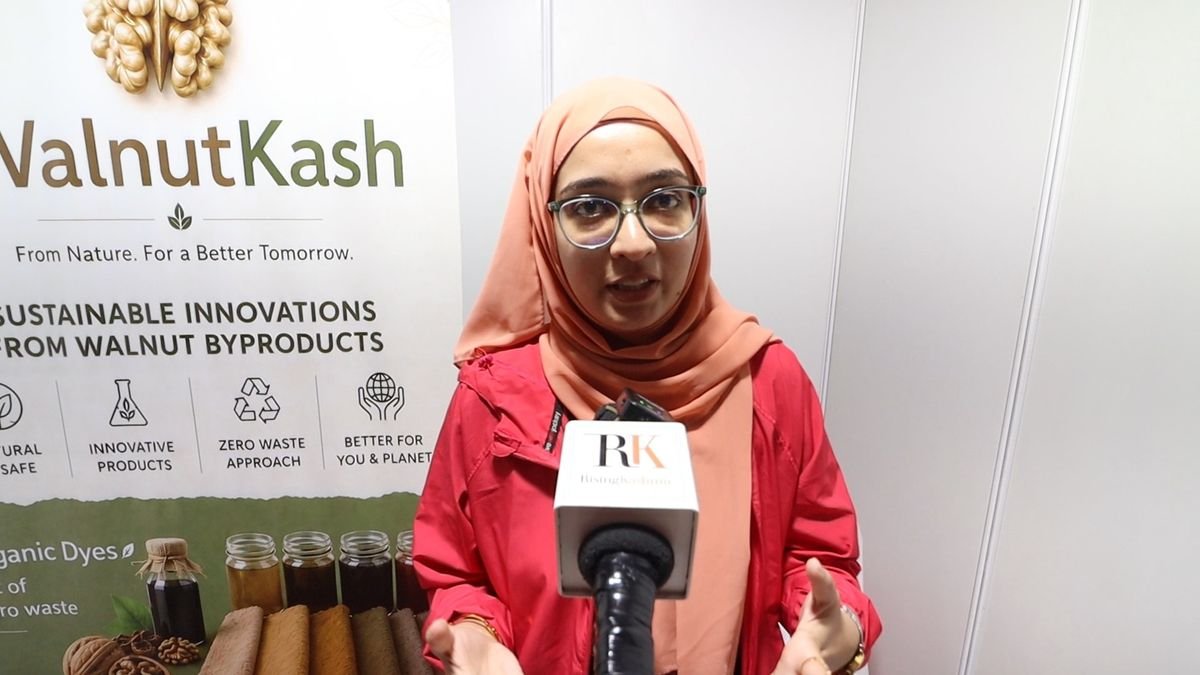
Srinagar, Sep 15: At a time when the world is increasingly waking up to the dangers of plastic pollution, a young Srinagar-based entrepreneur is drawing attention to another silent threat—one that comes wrapped in the clothes we wear every day.
From walnut husks that were once burnt as waste to natural dyes that can colour clothes, Aayrish Sheikh, a Chartered Accountant and entrepreneur, is working to give agricultural waste a new purpose while offering the textile industry a more nature-friendly alternative to chemical dyes.
Her idea stems from a simple but deeply concerning thought: if we worry about the pollution caused by plastic, why do we rarely think about the pollution caused by our clothes?
Speaking to Rising Kashmir, Aayrish said, “The pollution caused by the clothes we wear is a problem that deserves much more attention. The fast-fashion industry generates millions of tonnes of textile waste every year, while conventional textile dyeing is heavily dependent on chemicals.”
She believes the answer lies in connecting two seemingly different environmental problems—agricultural waste and textile pollution.
“I am trying to solve one problem with another problem. We are converting agricultural waste into textile dyes, and our dyes also have antimicrobial properties,” the entrepreneur said.
The initiative has found a special connection with Kashmir, where walnut cultivation generates huge quantities of husks every harvesting season. Much of this waste is traditionally discarded or burnt, adding to environmental pollution.
Instead of allowing the husks to become waste, Aayrish is turning them into a resource.
The initiative also aims to create an alternative source of income for farmers by paying them for the walnut husks that were earlier simply thrown away or burnt. “It is about giving value to something that people considered waste,” she said.
The journey, however, has not been without challenges.
Walnut-based dyes naturally tend to produce shades of brown, ranging from lighter to darker tones. To expand the colour palette, Aayrish has experimented with other natural sources, including turmeric and beetroot, developing shades of yellow and pink alongside the walnut browns.
The natural dyes are currently being explored for use in sensitive textile segments, particularly intimate apparel and children’s wear, where fabrics remain in prolonged contact with the skin.
Aayrish said antimicrobial testing has shown that textiles dyed with their formulations possess antimicrobial properties, while the initiative seeks to provide an alternative to conventional chemically intensive dyeing processes.
At its heart, the initiative is more than a business idea. It is an attempt to look at waste differently—to see value where others see something to be thrown away, and to find a gentler relationship between industry and nature.
From the walnut orchards of Kashmir to the clothes worn close to our skin, Aayrish Sheikh hopes to create a chain where nothing is simply waste and nature does not have to pay the price for fashion.
In a world where convenience often comes at the cost of the environment, her message is simple: perhaps saving Mother Earth can begin with changing something as ordinary as the colour of the clothes we wear.


