



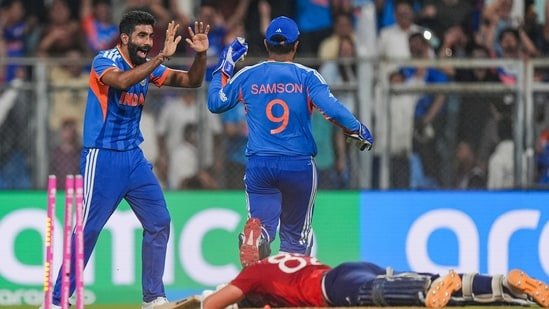
“If he didn’t bowl that way in the death overs, I would not be standing here. All credit goes to him. The world-class, once-in-a-generation bowler… that’s what he delivered today. This (award) should go to him actually.”
Sanju Samson was earnest as earnest can be after receiving his second consecutive Player of the Match award at the T20 World Cup, on Thursday night. His magical 89 was the cornerstone around which India erected 253 for seven, the highest team score in a knockout or playoff match in Twenty20 Internationals. His takedown of pace ace Jofra Archer, who went for two boundaries in the first over of the semifinal and an England record 61 in his four, was a stirring statement of intent and authority, seeing as how Archer had dismissed Samson thrice in a bilateral series in India in January last year, all three times to short-pitched deliveries.
The ‘he’ that Samson was referring to didn’t score a single run in a match that produced 499 bruising, punishing, breathtaking runs. Why, he didn’t get to hold the bat. He also took only one wicket, and even that because of a spectacular catch by Axar Patel, to whom spectacular catches came easily on the night. But he was the only one of the 12 bowlers employed across the sides with an economy of less than 8.3. In a game where the going rate was 12.5! Surely, the award should have been his, right?
Jasprit Bumrah couldn’t care less. Of course, lest we all haven’t figured it out yet, the ‘he’ that Samson was referencing was the magnificent Gujarat pacer who continues to astound and astonish and boggle the imagination. After a decade of international cricket where his every move, every ball, every walk-stride, every release has been dissected threadbare, you’d think Bumrah cannot surprise you anymore. Well, think again.
Let’s not quibble, because that’s what it might seem when we are discussing who should have got the Player of the Match award following a high-octane game where only seven runs separated the protagonists. Where Samson met his match, almost, in the magnetic Jacob Bethell, all of 22 but with a wonderfully mature head on his young shoulders and an all-round game to die for. Where Axar pulled off two of the most incredible catches under pressure, the first (off Harry Brook) to delight and satisfy himself, the second (off Will Jacks) to tilt the balance of a game that seemed to be running away from India despite the mountain of runs at their disposal.
Samson was electric, scarcely recognisable as the hesitant, diffident, uncertain, doubt-ridden batter of the last 13 months. Clearly buoyed by his semifinal-cementing unbeaten 97 against West Indies in the Super Eights on Sunday in Kolkata, he started from nought but not really from nought, if you know what we mean. His first scoring shot was a nonchalant swat off Archer that sailed past mid-on; the second, a ball later, was the most sumptuous of hooks as the express quick went short and into the body, a disdainful stroke that screamed over the fine-leg fence. ‘Bring on the short ‘un,’ Samson dared Archer. The latter obliged, again and again, and Samson tore into him, again and again.
For all that, though, Archer should have had Samson’s number, once more, in the evening’s third over. An ambitious slam nestled in skipper Brook’s huge palms at mid-on, then inexplicably slipped out. Samson was 15, India would have been 24 for two. Instead, once Brook chose generosity of spirit over surety of skill, Samson got on the bike and sped away, invoking the spirit of the gentle giant who makes even a brutal six look aesthetically appealing.
There was a grand tempo to the Samson innings which doesn’t come too frequently, or to too many. Until he was out-thought and outfoxed by off-spinner Jacks, who threw the ball wide outside off from an already wide angle from round the stumps and all Samson did was pick out the off-side sweeper. Samson walked off to a thunderous ovation, 97 not out on Sunday backed up by 89 off 42. When he was dismissed, 41 deliveries still remained in the innings. Just how much could Samson have finished with?
But Samson’s wasn’t a lone furrow. Around him, Ishan Kishan lashed 39 off 18 and Shivam Dube hammered 43 off 25; after him, Hardik Pandya amassed 27 off 12 and Tilak Varma slammed three straight sixes during a 7-ball 21. India’s 253 was a Samson show alright, but it wasn’t a Samson show all the way.
What of Bumrah, you say? He came on in the fifth over, with England 38 for one, looking to get a move on. His first ball was one of many Bumrah specials, off-pace, fingers rolled across the seam. Brook, looking to lord the early exchanges, was foxed in the air but chose to go through with the shot even though the bottom hand came off the handle. He still made decent contact, but Axar ran and ran and ran back from cover to complete a catch for the ages. Such was the quality of the grab that even Bumrah, usually calm and unmoved when he picks up a wicket, charged towards Axar in unsuppressed delight.
Like against West Indies, Suryakumar Yadav kept three Bumrah overs for the second half of the innings. In his first over, Bethell backed away and carted him for a six; when he came back in the 11th, he conceded a four each to Jacks and Bethell, whose 39-ball stand of 77 seemed to have cooked India’s goose.
Like he has for a week or so, Varun Chakravarthy had another terrible night; four overs yielded 64, the last of them – the 15th of the innings – leaking 13. With five overs remaining and Bethell in full cry, England required 69. Not beyond them, not any longer.
In the 2024 final against South Africa, Rohit Sharma got Bumrah back on for the 16th over for control, after Axar had gone for 24 to bring the equation to 30 needed off 30; Bumrah got the job done with a spell of 2-0-6-1. Suryakumar replicated his role model’s tactics, bringing Bumrah in earlier than he would have liked. End result – just eight runs, among them a four that came off an attempted-yorker- turned-full-toss. India marginally ahead.
Arshdeep Singh was taken for 16 off the 17th over which was his last, leaving his colleagues to defend 45 off 18 balls. Suryakumar didn’t think twice before deciding to bowl out Bumrah and leave as many as he could for Pandya and Dube, the favourites to bowl the last two overs in that order. The campaigns of two teams hinged on those six Bumrah balls.
Jasprit Bumrah shows Hardik Pandya, Shivam Dube the way
The first three were searing yorkers that brooked survival rather than attacking stroke-making. The next three were marginally, but only very, very marginally, off target. A dot, four singles and a two later, England suddenly required 39 off 12. After his last delivery, a full ball on leg, was whipped to mid-wicket for a single, Bumrah stood in his followthrough, his hands on his knees, while the crowd roared and cheered, having rediscovered its voice. In a third, and decisive, spell of 2-0-14-0, the genius of Bumrah had expressed itself, giving Pandya and Dube the cushion that they rode on to fashion a seven-run victory. Really, what’s this bloke made of?
This hasn’t been an imprint-stamping tournament for Bumrah, unlike the corresponding edition in 2024 was. But whenever he has been required to step up and transfer pressure, he has done so effortlessly. Thursday night was the prime example of a champion being able to raise his game when his captain and his team needed him the most. 4-0-33-1. Unglamourous, not in the 42-ball 89, 8×4, 7×6 league. But like Samson said, he wouldn’t be standing with the award in his hand if not for Jasprit Bumrah, the eternal crisis-man with nerves of steel and the skill of a virtuoso.


