






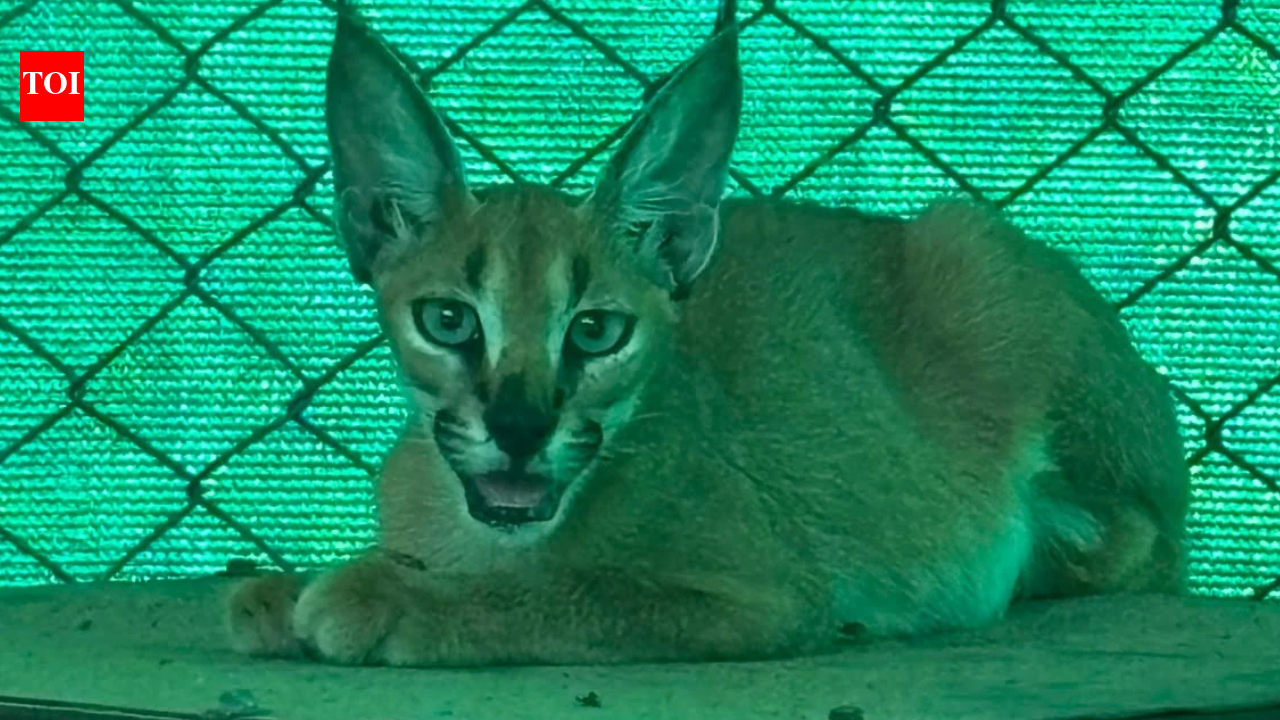
JAISALMER: In a significant wildlife conservation effort, the Rajasthan Forest Department, with the support of experts from the Wildlife Institute of India (WII), on Sunday evening successfully released a rare female caracal back into its natural habitat in Jaisalmer after treatment and recovery. The endangered Schedule I wild cat was fitted with a radio collar before being released.This is reportedly the second instance in the country in which a caracal has been successfully radio-collared and released into its natural habitat by the Rajasthan Forest Department in Jaisalmer. Earlier, on January 25 this year, the department had radio-collared and released a male caracal into the wild.Jaisalmer DFO Kumar Shubham said the female caracal was rescued on September 1 after local villagers spotted it in a weak condition in the border areas of Jaisalmer and informed the Forest Department.A forest team immediately reached the spot and safely rescued the animal before providing it with the necessary treatment and care.Following the rescue, the caracal was kept under round-the-clock monitoring by forest officials and wildlife experts. After continuous observation, treatment and care, the animal was found to have fully recovered and to be fit to survive in natural conditions. It was subsequently fitted with a radio collar and released into its natural habitat on Sunday evening.According to Shubham, the caracal is one of the rare and ecologically important small wild cat species found in the Indian desert ecosystem. The desert landscape of Jaisalmer holds particular significance for the conservation of the species, and the presence of caracals highlights the ecological value and biodiversity of the region.The Forest Department will undertake intensive scientific monitoring of the caracal following its release. Camera traps will be installed in the area, while locations obtained through the radio collar will be analysed along with camera-trap data.The study is expected to provide important information about the caracal’s ecological behaviour, home range, habitat use, feeding and prey preferences, activity patterns and distribution in the region.Forest officials said such scientific monitoring would provide a valuable basis for developing future conservation strategies for caracals in the desert ecosystem of Jaisalmer.The Rajasthan Forest Department has reiterated its commitment to strengthening the conservation of caracals and other important desert wildlife species through scientific monitoring, modern technology and greater participation from local communities. The timely reporting of the animal’s condition by local residents also highlighted the crucial role of communities in wildlife conservation.According to Sumit Dookia, associate professor at Guru Gobind Singh Indraprastha University and honorary scientific adviser to ERDS Foundation, the sighting of a caracal in the Ramgarh landscape of Jaisalmer is encouraging news for both wildlife conservation and local communities.He said, “This elusive desert cat is an important predator, helping maintain ecological balance in the arid ecosystem. Its presence also signals that the landscape still supports suitable habitat and prey. These sightings should strengthen our resolve to protect the caracal’s grasslands, scrublands and open desert habitats from fragmentation, unsustainable land-use changes and other pressures. Protecting these habitats will benefit not only the caracal and other wildlife, but also the pastoral and rural communities whose livelihoods depend on healthy landscapes. Conservation must therefore go hand in hand with community participation and livelihoods.”


