






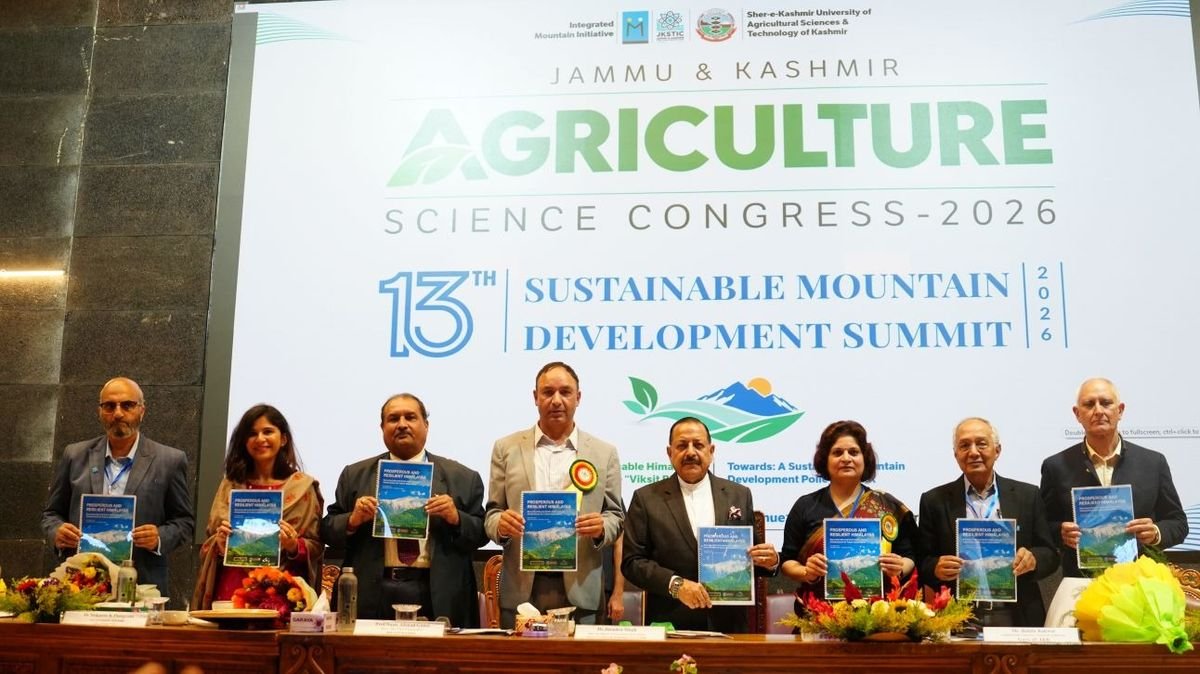
Srinagar, Oct 13: Union Minister of State (MoS) for Science and Technology and Earth Sciences Dr Jitendra Singh on Tuesday called for collective responsibility to protect the fragile Himalayan ecosystem, warning that development in mountain regions must be balanced with ecological safeguards and sustainable livelihoods.
Addressing a special session at the 13th All India Sustainable Mountain Development Summit at Sher-e-Kashmir University of Agricultural Sciences and Technology of Kashmir (SKUAST-K), the minister said safeguarding the Himalayas was a national responsibility extending beyond the government and scientific community to every citizen.
Dr Singh stressed that the Himalayan region was vital to India’s ecological security, supporting glaciers, springs, rivers and water bodies while sustaining agriculture, tourism and livelihoods. Any damage to this fragile ecosystem, he said, could have far-reaching consequences for both mountain communities and the country’s environmental well-being.
The summit, being held from October 12 to 14 under the theme Contouring Sustainable Himalayan Landscapes for Inclusive Viksit Bharat, is jointly organised by SKUAST-K and the Integrated Mountain Initiative (IMI). Discussions include the draft Jammu and Kashmir Sustainable Mountain Development Policy 2026.
The MoS said unauthorised construction, unregulated activities and other human-induced pressures could intensify risks in environmentally sensitive mountain areas. “Ecological considerations will be integrated into development planning, alongside greater public awareness and responsible conduct by local communities and other stakeholders,” he said. The challenge, he said, was to ensure that development created livelihood opportunities without undermining the natural systems on which the region’s long-term prosperity depended.
Highlighting the Centre’s scientific interventions, the Union Minister referred to the National Mission for Sustaining the Himalayan Ecosystem, part of the National Action Plan on Climate Change. “The Department of Science and Technology has identified centres at the University of Kashmir, Sikkim University and Tezpur University to strengthen research on climate change and the Himalayan ecosystem,” he said.
Dr Singh also cited glacier monitoring and field-based studies conducted by the Wadia Institute of Himalayan Geology in Ladakh and Doda since 2015. “The research includes the use of automatic weather stations and seismometers, besides investigations into landslides and past earthquakes. Capacity-building in glaciology in Kashmir is also being undertaken to strengthen scientific understanding of the region’s changing environment,” he said.
Emphasising the importance of early warning and weather preparedness, the minister said India’s weather radar network had expanded from 16 radars in 2014 to 50, with another 50 planned under Mission Mausam. “The expansion is expected to strengthen weather monitoring and preparedness, particularly in areas vulnerable to extreme weather and natural hazards,” he said.
The MoS also referred to a pilot study initiated by the Wadia Institute in 10 villages in Jammu and Kashmir, saying its findings could help develop locally appropriate interventions and inform their possible replication elsewhere. He called for the findings to be considered while examining the draft Sustainable Mountain Development Policy.
Linking conservation with economic opportunity, Dr Singh cited the Aroma Mission and Purple Revolution as examples of science-led livelihood generation in Jammu and Kashmir. Lavender cultivation in areas such as Gulmarg and Padder, he said, had opened avenues for farmers and rural entrepreneurs by promoting crops suited to local conditions.
However, he emphasised that sustainable returns required more than cultivation. “Strong market linkages with the aroma and fragrance industries, access to technology and finance, and support for entrepreneurship were essential to ensure that farmers benefited from these initiatives. Women-led self-help groups and young entrepreneurs, he said, could play a significant role in expanding livelihood opportunities,” he said. The Union Minister said Jammu and Kashmir’s experience demonstrated how scientific interventions and region-specific economic activities could support development while making better use of local strengths.
Secretary, Science and Technology, Babila Rakwal, SKUAST-K Vice-Chancellor Prof Nazir A Ganai, and representatives of academia and the mountain development community attended the session.
Reiterating the need for coordinated action, Dr Singh said government programmes and scientific research had to be complemented by responsible decisions on the ground. Protecting the Himalayas, he said, was essential not only for the people who depend on the mountains but also for India’s long-term ecological security.


