









Srinagar, Oct 11: Jammu and Kashmir raises only about Rs 30 from its own resources for every Rs 100 the government spends, leaving much of its expenditure dependent on central assistance and borrowing, according to a newly published economic study whose findings are broadly supported by the Union Territory’s latest budget estimates.
The study, published in the journal Social Science & Humanities International, highlights the gap between Jammu and Kashmir’s revenue-generating capacity and its expenditure commitments, even as the economy is projected to grow and the government seeks to reduce its fiscal deficit.
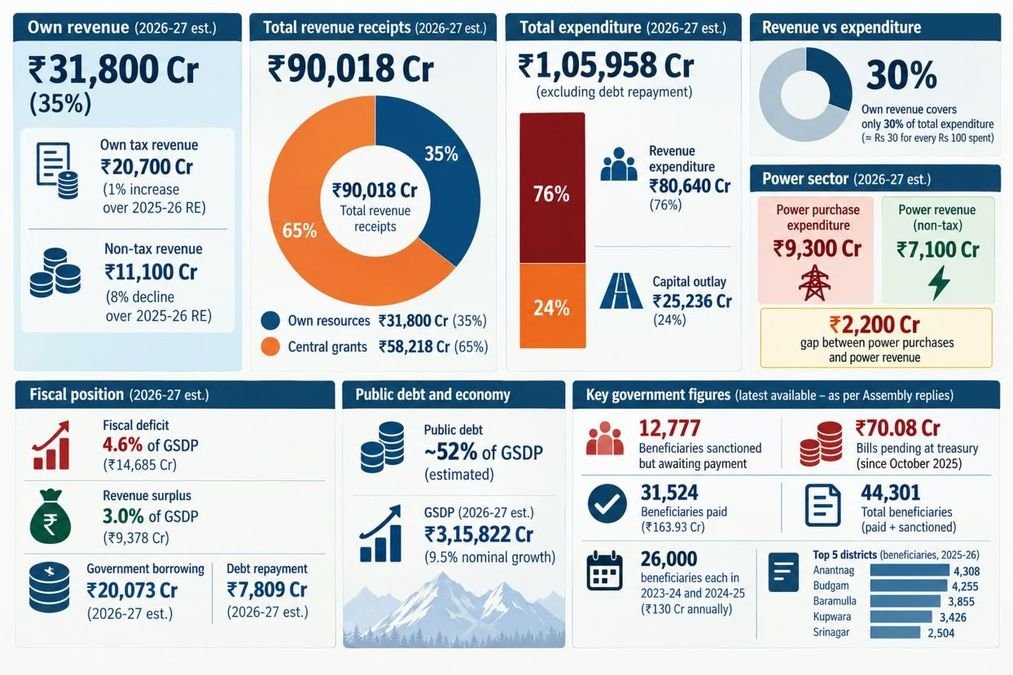
An examination of the 2026-27 Budget shows that the Union Territory expects to generate Rs 31,800 crore from its own tax and non-tax sources against expenditure of Rs 1,05,958 crore, excluding debt repayments. This means locally generated revenue would cover approximately 30 per cent of planned expenditure, with the remaining requirement met through central grants, other receipts and borrowing.
The figures, independently cross-checked with the 2026-27 Budget analysis prepared by PRS Legislative Research, underline the scale of Jammu and Kashmir’s dependence on financial support from outside its own revenue base.
The research paper, titled “Jammu & Kashmir Economic & Development Outlook: Growth Momentum, Fiscal Consolidation, and Seasonal Tourism Performance (June–August 2026)”, has been authored by Firdous Ahmad Malik, Jaskaran Singh, Naveed Ahmad Lone, Iram Sabha, Owais Ismaeil and Gowhar Ahmad Wani.
Examining the region’s economic performance, public finances and development priorities, the researchers identify limited revenue mobilisation and continuing expenditure obligations as significant constraints on fiscal flexibility.
The report notes that Jammu and Kashmir’s fiscal adjustment remains dependent on transfers, observing that only about Rs 30 of every Rs 100 spent comes from its own revenue. The researchers argue that reducing the fiscal deficit, while important, does not by itself eliminate this dependence.
The scale of central assistance becomes clearer from the composition of Jammu and Kashmir’s expected revenue receipts for 2026-27.
According to PRS Legislative Research, the government has estimated total revenue receipts of Rs 90,018 crore for the financial year. Of this, Rs 31,800 crore, or 35 per cent, is expected to come from the Union Territory’s own resources, while Rs 58,218 crore, or 65 per cent, will come through grants from the Centre.
The two figures explain why the government remains heavily dependent on central financial support even though it collects taxes and earns income through various departments and public services.
Own revenue includes taxes collected within Jammu and Kashmir and non-tax receipts such as departmental fees, charges and income from government services. Central grants, on the other hand, are funds received from the Union government to support expenditure and development programmes.
The difference between the 35 per cent share of revenue receipts and the 30 per cent share of expenditure is important. The first measures how much of the government’s revenue income is generated locally; the second compares locally generated income with the much larger amount it plans to spend.
For 2026-27, the government’s own tax collections are estimated at Rs 20,700 crore, while non-tax revenue is projected at Rs 11,100 crore.
The Budget estimates that own tax revenue will increase by just one per cent over the revised estimates for 2025-26, while non-tax revenue is expected to decline by around eight per cent.
These projections suggest that Jammu and Kashmir’s revenue base is not expected to expand substantially during the financial year, despite an increase in the overall size of the economy.
The fiscal challenge is not confined to revenue collection. A substantial part of government expenditure is committed to recurring obligations, including salaries, pensions, interest payments, subsidies and the purchase of electricity.
For 2026-27, revenue expenditure has been estimated at Rs 80,640 crore, compared with capital outlay of Rs 25,236 crore.
Revenue expenditure largely covers the day-to-day functioning of government and the cost of delivering existing services. Capital outlay, by contrast, is used to create assets such as roads, buildings and other infrastructure.
The researchers identify committed expenditure as one of the factors limiting the government’s ability to finance additional development programmes from its own resources.
PRS figures show that capital outlay is expected to increase by four per cent over the revised estimates for 2025-26. However, the analysis also notes that capital outlay during 2025-26 was estimated to be 10 per cent below the amount originally budgeted.
The electricity sector presents another major concern in Jammu and Kashmir’s public finances.
The 2026-27 Budget estimates Rs 7,100 crore in non-tax revenue from power, accounting for approximately 64 per cent of the government’s total non-tax income.
Against this, expenditure on power purchases is estimated at Rs 9,300 crore, leaving a difference of Rs 2,200 crore between the two budgeted amounts.
The difference is not, by itself, a complete measure of the power sector’s financial losses, since other costs and receipts must also be considered. Nevertheless, it illustrates the pressure that electricity purchases place on the public exchequer.
Power purchases alone account for approximately 12 per cent of the government’s projected revenue expenditure.
The study also identifies electricity distribution losses and inadequate recovery of power costs as longer-term fiscal risks.
It argues that borrowing and government support used to cover under-recoveries in the power sector can increase the financial burden beyond the amounts immediately visible in annual expenditure.
The researchers consider improvements in electricity revenue recovery important to the Union Territory’s wider efforts to strengthen its finances.
Despite these pressures, the 2026-27 Budget projects an improvement in Jammu and Kashmir’s fiscal deficit.
According to PRS, the fiscal deficit has been targeted at Rs 14,685 crore, equivalent to 4.6 per cent of the projected Gross State Domestic Product (GSDP).
This compares with a deficit of 4.9 per cent of GSDP under the revised estimates for 2025-26.
In simple terms, the fiscal deficit represents the amount by which government expenditure exceeds its receipts other than borrowings. It indicates the additional financing the government needs to meet its expenditure commitments.
The Budget also projects a revenue surplus of Rs 9,378 crore, or three per cent of GSDP, for 2026-27.
A revenue surplus means that the government’s revenue receipts are expected to exceed its revenue expenditure. It does not, however, mean that the government can finance all its spending without borrowing.
The study draws attention to this distinction, noting that an improvement in the fiscal deficit does not necessarily indicate a corresponding improvement in the government’s own revenue-generating capacity.
The researchers describe fiscal consolidation as modest and dependent on transfers, pointing out that continued central support remains central to the government’s financial position.
Their assessment also discusses differences between fiscal deficit figures cited in some budget commentary. For the current comparison, however, PRS’s published 2026-27 Budget analysis provides a consistent basis: a revised deficit of 4.9 per cent for 2025-26 and a budgeted deficit of 4.6 per cent for 2026-27.
The government has budgeted borrowings of Rs 20,073 crore during 2026-27, while Rs 7,809 crore is scheduled for debt repayment.
The two amounts serve different purposes. New borrowings provide funds during the financial year, while repayments settle liabilities incurred in earlier years.
The Budget also estimates Rs 3,000 crore in loans under the Centre’s Special Assistance to States for Capital Investment scheme, compared with Rs 3,587 crore under the revised estimates for 2025-26.
Such assistance can support infrastructure investment, but it does not remove the need to manage future repayment obligations.
The study estimates Jammu and Kashmir’s public debt at around 52 per cent of GSDP and cautions that debt sustainability depends on more than the size of the debt alone.
The researchers identify economic growth, borrowing costs and the government’s fiscal position as important factors in determining whether debt remains manageable.
Their findings do not establish that Jammu and Kashmir faces an immediate debt crisis. Rather, they point to the longer-term importance of increasing revenue and controlling recurring expenditure.
The concerns over public finances come at a time when Jammu and Kashmir’s economy is projected to expand.
The 2026-27 Budget estimates GSDP at Rs 3,15,822 crore, representing nominal growth of 9.5 per cent over the revised estimates for 2025-26.
The study notes that economic growth has been supported by infrastructure investment and services, but argues that the expansion has not fully addressed weaknesses in the industrial base and employment market.
This creates a distinction between growth in the overall economy and the government’s ability to generate additional revenue from that growth.
A larger economy can provide opportunities for higher tax collections, but the outcome depends on the composition of economic activity, the tax base and the efficiency of revenue collection.
The report also points to unemployment and limited industrial development as wider economic concerns, suggesting that stronger private-sector activity could help expand both employment and the government’s revenue base over time.
However, the researchers do not provide a quantified estimate of how much additional revenue could be generated through the reforms discussed in the paper.
The figures present two related challenges for Jammu and Kashmir: financing the government’s existing expenditure and creating sufficient financial space for new development priorities.
Central grants remain the largest component of projected revenue receipts, while the government continues to rely on borrowing to finance the gap between expenditure and non-borrowing receipts.
The study does not argue that central assistance is inherently undesirable. Transfers are a regular feature of India’s fiscal system and help governments meet expenditure responsibilities that exceed their local revenue capacity.
Its concern is the extent to which Jammu and Kashmir depends on such assistance and the limited flexibility that follows from a relatively small own-revenue base.
The researchers identify revenue mobilisation, expenditure management and improvements in the financial performance of public utilities as important to the Union Territory’s longer-term fiscal position.
For the current financial year, the official projections show that Jammu and Kashmir expects to collect Rs 31,800 crore locally while spending more than Rs 1.05 lakh crore, excluding debt repayments.
That gap is the central finding behind the study’s Rs 30-for-every-Rs 100 assessment.
The figures are budget estimates, not final audited accounts for 2026-27, and the eventual position will depend on actual revenue collections, central releases, borrowing and expenditure during the year.
Nevertheless, the comparison establishes the scale of the financing challenge: Jammu and Kashmir’s economy is expected to grow, but its government will continue to depend substantially on central assistance to fund public services and development.


