



What does it take to change the world?
A book, a song or a poem can do it. A great leader or mass campaign, a lot of guns or a lot of money tend to be even more effective.
What about neat rows of stitching?
We don’t often give fashion its due.
Over 125 years, clothes that emerged on the catwalk have moulded economies, altered societies, helped liberate women, reflected… angst, exuberance, new dreams, old fears, rebellion against war, and a yearning, over and over, for peace.
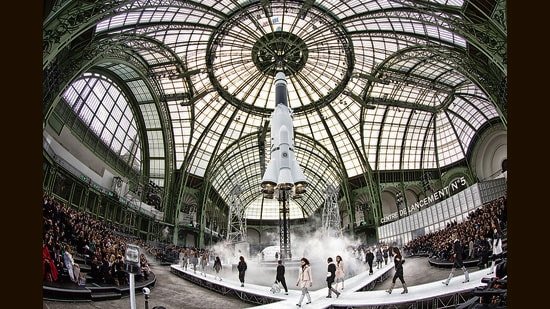
Catwalks have been canvases for art, platforms for new technology and vocal proponents of climate and human rights. They have been stages for some grand questioning: Who are we? What else can fashion be? Who is this for?
And there has been the dark side: racism, sizeism, anorexia, abuse. An industry that often seems to ask: Are you really going to go through life looking like that? Or: Do you really think you can get away with wearing that again?
So how has it shaped us, how was it born, and how has the fashion show changed?
For one thing, it can now be anywhere: in a river’s flowing waters, inside a giant snowglobe, underground in a wine cellar. (Click here for more on this.)
Last year, the Parisian brand Coperni hired a sports arena, hosted a ’90s-style LAN party, and showcased its Fall/Winter collection as gamers played Fortnite and Rocket League. Guests were served hot dogs and popcorn amid tangled cables. Models in cyber-grunge-inspired boots and jackets and puffy sleeping-bag dresses, wearing smart glasses and carrying handbags with built-in Tamagotchis, walked around.
The show wasn’t wooing the elite; it was aiming to make headlines and grab the attention of a new generation. Which may seem like a fresh twist. But as is so often the case in history, we’ve been here before.
Fashion has been changing who it caters to, since the dawn of modern trade.
For thousands of years, for instance, fine clothes were the preserve of royalty and nobility. Then, as economies grew, colonialism and the industrial revolution kicked in, and traders began to get seriously rich, boutiques started to cater to them.
In one small example of how, the little dolls that dressmakers had ferried from mansion to mansion, all dressed up in miniature clothes and hats so that queens and duchesses could see what the newest collections looked like, began to appear in store windows. The nobility didn’t visit stores, so they’d never been needed there before. Then, by about the 1750s, there they were, a precursor to the mannequins of the mass-manufacturing age.
Fast-forward a bit and, in 1901, the catwalk was born in London. Designer Lucy Duff-Gordon trained live models to perform choreographed routines on an elevated platform, at elaborate events with printed programmes and exclusive invitation lists. These events remained the preserve of the elite for about half a century.
Until, in the Swinging Sixties, eager for brand visibility in an era of mass-media, elite labels began to hold fashion shows in places the young considered cool: cafes, wine cellars, nightclubs.
This was not a generation aspiring to get into closed rooms for multiple fittings. It was, in fact, a generation defined by social and cultural rebellion. So, in 1966, Yves Saint Laurent launched Rive Gauche, the first pret-a-porter or ready-to-wear boutique line by a major couture house. Other brands soon followed.
Something else was happening at this time that altered fashion further: The space race.
The idea of a man on the moon became one of the great intersections of science and popular culture. Mary Quant, at her boutique Bazaar, launched the miniskirt (iconic in itself) but also began to use PVC as a textile. The French label Courrèges tapped into the space-age aesthetic with boxy silhouettes, angular minidresses, bright whites and silvers, and PVC boots.
***
The intersection of the catwalk and popular culture — movies, music, everyday technology — would soon shape clothes, diets, size charts, and not always for the better.
“Size zero” entered the lexicon in the ’60s, to describe the body type of the British supermodel Twiggy. It was eventually adopted by US size charts; these are clothes designed for women with a 23-inch waist.
By the turn of the century, a battle had begun for wider representation of the human form.
Then, in 2006, 22-year-old model Luisel Ramos died from complications linked to anorexia. That year, the Madrid and Milan fashion weeks banned size-zero models. In 2007, Luis’s sister, the 18-year-old model Eliana Ramos, died from complications linked to malnutrition. That year, the British Fashion Council framed guidelines that urged designers to be more mindful of models’ wellbeing.
In 2009, Kate Moss famously insisted: “Nothing tastes as good as skinny feels.”
Most of the models who walk the ramp for the world’s most coveted fashion houses remain extremely slender. Meanwhile, the idea of “size zero” persists, its legacy an ongoing struggle with body dysmorphia. Women who have publicly spoken about this struggle include the popstar Ariana Grande and model Bella Hadid.
“Despite a degree of inclusion that’s been hard-won, the catwalk promotes an image that excludes most women,” says Maria Costantino, a lecturer in fashion culture and histories at the University of the Arts London. “And of course, couture is only accessible to a tiny number of wealthy people, so it remains exclusionary in that sense too. “
Meanwhile, the events themselves went viral. Amid a boom in consumer culture, disposable incomes and the entertainment industry (movies, TV, magazines), the fashion show was democratised, says Kirsty Hassard, a fashion historian and curator of an exhibition on this history, titled Catwalk, on at the V&A Dundee in Scotland until January. “Consuming fashion became a part of entertainment, even when you couldn’t own the actual pieces.”
***
How else has fashion shaped our reality?
For about 100 years, rebels within this industry have used their platform to demand more of the world.
Coco Chanel’s famous 1920s tweed suit deployed a fabric used in men’s sportswear to create a chic, sleek, practical silhouette for the post-war working woman. She even tested it to ensure models could comfortably climb stairs and board an imaginary bus.
Vivienne Westwood turned her runways into stages for environmental activism and the anti-establishment punk-rock aesthetic, in the 1980s. Long before gender-fluid clothing became a buzzword, her designs featured men in skirts, dresses and pearl necklaces. She normalised and popularised slashed trousers, shirts held together with safety pins and insisted one “buy less, choose well and make it last”.
In recent years, the focus has shifted to the climate crisis, identity, war — and the massive waste and humongous carbon footprint of the fashion industry itself. (Click here to read about a story on shows themed on war, set in a giant snowglobe, or staged with “corpses” floating down a river.)
***
Through it all, something else has shifted too. The fashion show’s front rows continue to be occupied by the elite, but how we define that word has changed. Princesses and wives of noblemen first gave way to heiresses, wives of magnates, editors and entertainers. Lately, stars of TikTok, Instagram and reality TV have joined their ranks.
Exclusive access isn’t what it used to be either. Getting in may still be difficult or expensive (VIP passes to certain Paris Fashion Week shows can cost as much as $7,000), but events are also live-streamed and live-tweeted.
“The fashion show was built on exclusivity: To keep people out so as to create desire. But now independent designers and major fashion houses will need to once again rethink who they are,” says Costantino of University of the Arts London. “Rethink how they can create without being as exclusive, and what they want to leave behind.”
There’s a restless new generation headed their way, and the zero they’re most interested in is net-zero emissions. A doll in the window already doesn’t work quite as well as it used to.


