



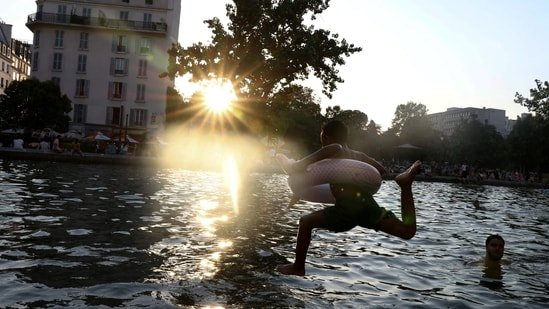
Police in the French capital this week banned public drinking and takeaway liquor sales as a heatwave across parts of Europe pushes hospitals towards their limits.


Paris police prefect Patrice Faure said the city was “reaching a saturation point in hospital facilities”, and the city’s fire brigade call-outs had topped 2,500 on Thursday, AFP reported. Faure told broadcaster BFM TV that drinking alcohol with the sun beating down “can have a devastating effect”.
The temporary ban, which excludes licensed bars and restaurants, comes amid a heatwave that has broken national records across Western Europe. Germany hit 41.3 degrees Celsius near Saarbrucken on Friday, after Britain, France and Switzerland also set June records.
Dozens of deaths have already been reported in France, and scores more across countries. Europe, according to the World Health Organization, has more liquor drinkers than any other region in the world.
Also read: Warm air from Africa compressed in a dome: The ‘Omega block’ that’s causing Europe heatwave
Diuretic that can worsen dehydration
Alcohol is a diuretic, which means it makes the kidneys expel more fluid than the body takes in, and it interferes with the body’s ability to regulate its own temperature, leading to dehydration, says UK-based charity Drinkaware, which studies alcohol consumption patterns and recommends policies to the country.
Dehydration, if not addressed with water consumption, can worsen if more liquor is consumed.
US’s National Weather Service also advises drinking plenty of water in a heatwave and avoiding alcohol altogether, warning that it worsens heat’s effect on the body. Red Cross’s hot-weather guidance similarly lists alcoholic drinks among those to avoid.
Also read: Europe can’t stand the heat
Added strain on the heart
When exposed to warm weather, blood vessels near the skin widen to release heat, lowering blood pressure and forcing the heart to work harder to keep oxygen flowing to the brain.
Alcohol intensifies that effect, Helmut Seitz, a professor at Heidelberg University, told The Guardian.
“Alcohol magnifies this effect, causing the blood vessels to widen even further,” he said.
The accompanying loss of sodium, potassium and magnesium can trigger irregular heartbeats, Seitz said, and in severe cases can starve the heart of blood, raising the risk of heart attacks among vulnerable populations.
In Paris, 25 cases of cardiac arrests were reported the day before the alcohol ban was implemented, an increase from 10 on average during this period, The Guardian reported.
Also read: The next heatwave will be won at night
What studies say
There’s limited epidemiological research on the causal link between liquor consumption and heat illness. A scoping review published in the journal Environmental Health in September 2024 examined eight existing trials and found the available evidence suggests liquor use does not necessarily impair the body’s physiological response to heat in young, healthy men.
Nonetheless, it is not a clean bill of health for drinking liquor during a heatwave. All 93 participants studied were young, healthy men tested for under two hours at lower-than-recreational alcohol doses. The review did not examine chronic drinking, which has been linked to higher risks of heat-related illness.
More importantly, dehydration and alcohol’s effects on an individual’s decision-making and awareness skills can make it harder to notice early signs of a heatstroke such as slurred speech, headache, a racing pulse, experts have warned.
That same effect can be more dangerous near water. Citing UK’s Water Incident Database (2018-2023), Drinkaware says that about a quarter of adult drowning victims, and nearly half of those aged 16-25 who drowned accidentally, had alcohol in their bloodstream.
With the heatwave driving Europeans to rivers and water bodies to cool off, multiple drownings have already been reported across France and other countries.
(With inputs from agencies)


