



From little dolls to “corpses” floating down a river, tour 12 milestone events in the 125-year history of the fashion show.
PANDORA FIGURINES
In the beginning, it was dolls that showcased designs. From about the 1300s through the 1800s, the flare of a skirt, delicacy of stitching, trimmings of a veil or tilt of a hat were displayed by creating miniature versions and placing them on figurines nicknamed Pandora or Pippen dolls, which were about 8 inches tall.
Everyone from Mary, Queen of Scots in the 1500s to France’s Marie Antoinette in the 1700s used them for reference.
By the mid-18th century, as newly wealthy traders began to dress and live aspirationally, the dolls began to appear in dressmakers’ store windows. They fell out of fashion with the rise of illustrated magazines, but would return, of course, as full-sized mannequins, in the era of mass-manufacture.
THE HOUSE OF WORTH
By the 1850s, the modern era had set in. Machines were chugging, trains were tooting. People were dreaming big, and chasing those dreams.
One of these was Charles Frederick Worth (1825-1895), a teenager working at textile stores in London, who decided to seek his fortune and, at 21, left England for Paris, where he more or less single-handedly pioneered key elements of haute couture.
He set up House of Worth in 1858. There, he replaced dolls with live models and held soirees where the wives of the wealthy elite could watch these models walk about in his new designs.
He also sewed tags bearing his name into all the clothing he produced, pioneering the idea of a fashion label.
“Worth really understood the importance of showing clothing on a moving body,” says fashion historian Kirsty Hassard, co-curator of a sprawling exhibition titled Catwalk that traces this history at the V&A Dundee (and is on display until January).
Eventually, Worth became dressmaker to women ranging from Empress Elisabeth of Austria to trendsetter Alice Vanderbilt (wife of American railroad millionaire Cornelius Vanderbilt II). “His intimate presentations became a reflection of the circles in which these exclusive clients of his moved,” Hassard says. Laying the ground for what remains the fashion week’s front row.
THE WORLD’S FIRST FASHION SHOW
Worth’s salon presentations were fairly simple. By the 1890s, a British designer named Lucy Duff-Gordon was changing that.
She tended to do things her way, with spectacular results. In 1895, she divorced her first husband and began to support herself and her daughter by serving as dressmaker to the elite in London.
To promote her boutique, she trained “professional models” to perform a choreographed walk on a raised platform, amid elaborate sets, special lighting and live music. Her first such event was held in 1901 and is considered the birth of the fashion show. Here’s why.
These events were only open to those who received an invitation.
Guests were met with detailed programmes, and the show was followed by a high tea. In addition to potential buyers, celebrities, magazine editors and aristocrats were invited.
Duff-Gordon went on to marry a baronet, survive the sinking of the Titanic (in 1912), and open branches in multiple cities, including Paris, New York and Chicago.
OUT INTO THE CITY
The catwalk caused such a sensation that it soon spilled out of the closed salons. To meet public interest and demand, events began to be held in department stores, ballrooms and hotel courtyards.
Duff-Gordon began to hold “parades” in gardens. French couturier Paul Poiret staged shows amid elaborate balls. From Wanamakers in Philadelphia to Selfridges in London, department stores began to host catwalk events too.
Before the adoption of the walk-in-a-straight-line-and-pose format, models often waltzed between diners at cafes, or sauntered in large circles, stopping to give interested clientele a closer look at the outfits they wore.
A POST-WAR REIMAGINING
We’re now in the 1920s. The Great War has ended and so has the influenza pandemic. Amid a sense of exuberance, women who took to work amid the war are staying in the workplace, commuting, looking for ease and comfort over flounces and frills.
In a dramatic reflection of this, the Parisian seamstress-turned-designer Coco Chanel uses a fabric generally used in men’s sportswear — tweed — to launch a breath-taking new silhouette.
The Chanel tweed suit was sleek, chic, durable and comfortable. Launched in 1923, it featured no shoulder pads, and the skirt was made for easy movement (Chanel ran tests with models, ensuring they could easily climb stairs, step into imaginary buses or bend as if getting into a car). Versions of it are still in production.
DIOR’S NEW LOOK
Fast-forward to the 1940s and a horrific second world war has finally ended.
A year later, Christian Dior — who spent years designing dresses for the wives of Nazi officers in occupied France, while donating part of the proceeds to the French resistance — decided to set up his own fashion house in Paris.
In 1947, he unveiled his first collection: suits, skirts, dresses, jackets with cinched waists, rounded shoulders, a lavish use of fabric that underlined what had been so missed amid the strictures of war: luxury, femininity, fun.
The collection was a massive hit. Harper’s Bazaar editor Carmel Snow famously exclaimed, “Your dresses have such a new look!” And that is the name by which his first collection is still known.
PRET-A-PORTER
By the 1960s, a generation has come of age that knows nothing of war. They grew up amid an economic boom, and entered the Swinging Sixties exuberant.
As markets and mindsets shifted to accommodate them, a new culture was born via magazines, movies, Beat poetry, the hippie movement and rock music. It was a culture defined by cultural and social rebellion.
In a reflection of this, Mary Quant and her boutique Bazaar give the world miniskirts (as well as hotpants, and short tunic dresses worn over brightly coloured tights). Window displays go from opulent and formal to whimsical.
Fashion shows began to be held in places the young considered cool: cafes (a show by the brand Chloe), wine cellars (Pierre Cardin), nightclubs (Paco Rabanne). Models danced as they walked the ramp.
This was not a generation aspiring to get into closed rooms, for multiple fittings.
By 1966, Yves Saint Laurent had launched Rive Gauche, the first pret-a-porter or ready-to-wear boutique line by a major couture house. Brands such as Carven and Nina Ricci soon followed.
PARIS FASHION WEEK
New York did it first, to promote its homegrown fashion industry, in 1943. But it is the Paris Fashion Week, launched in 1973, that remains the gold standard.
The first edition of this elite event — open only to those who had been invited, or had paid a fairly large sum for a pass — was organised by the French Fashion Federation to raise funds for the restoration of the Palace of Versailles.
It turned into a friendly showdown between five French design houses (Yves Saint-Laurent, Emanuel Ungaro, Dior, Pierre Cardin and Givenchy) and five visiting American couturiers (Bill Blass, Oscar de la Renta, Anne Klein, Halston and Stephen Burrows).
The designers pulled out all the stops. “The Yves Saint-Laurent show featured a Bugatti luxury vehicle, while Dior had a huge pumpkin carriage,” says Maria Costantino, a lecturer in fashion culture and histories at University of the Arts London. “The American line-up was deemed to have ‘won’ overall because it featured a series of live performances by Liza Minnelli and Josephine Baker.”
WINGED BODICES, RIBBON TOPS
What else could fashion be? By 1999, Alexander McQueen was answering that question in spectacular fashion.
His Spring/Summer collection that year featured fashion fused with machinery fused with art.
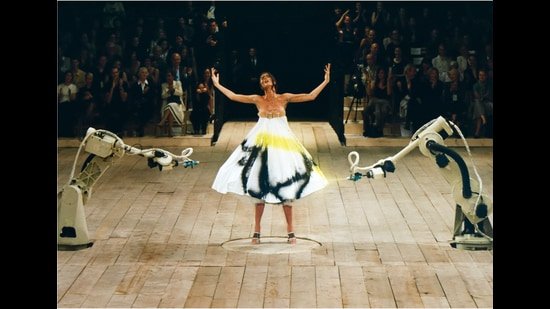
The British icon held his show at a warehouse in London, and used the event to celebrate craftsmanship and the industrial aesthetic of the machine age. On display were winged bodices, fan skirts, ribbon tops, and belts, buckles and straps made from wood. The set resembled a stark factory floor. But it was the finale that took the crowd’s breath away.
As model Shalom Harlow stood on a rotating platform, in a white dress, two industrial robots sprayed black and yellow paint onto her garment, taking it from canvas to art in real time.
“WALKING” ON WATER
In 2004, new concerns, new statements. Carol Christian Poell’s Mainstream Downstream Spring/Summer collection uses a river to make a point.
On a quiet afternoon in Milan, 17 men begin to silently drift down the polluted Naviglio Grande canal. Eyes closed, bodies limp, they are carried forward on invisible inflatable rafts.
They wear items from Poell’s collection. More pieces from it float around them like debris.
“It was creepy yet poetic,” says Livia Grigori, who runs the research project and Instagram page Atlas of Shows, with her partner Dan Ricciardi. “It was a haunting critique of consumerism, the endless cycle of fashion trends, and the industry’s own wastefulness.”
TRUDGING THROUGH SNOW
The Balenciaga Fall/Winter 2022 show by Demna (now creative director at Gucci), seated its audience around a glass-encased arena, while inside a blinding snowstorm raged.
Inside the dome, models wore pre-wrinkled trench coats and carried oversized luxury trash bags, as they trudged through piles of deep snow.
The show, Demna said, was meant to force the audience to reflect on the war being waged by Russia in Ukraine (which had then just begun) and on the larger themes of displacement and climate anxiety.
OUT OF THIN AIR
The Parisian brand Coperni packed a range of surprises into its Spring/Summer 2023 showcase: cropped bomber jackets, silk dresses covered in pieces of jagged glass, a swipe bag coated in 18-karat gold.
But the show’s finale is the bit that really made headlines. A homage to McQueen’s 1999 robot-spray-paint outfit, it saw model Bella Hadid walk onto stage in nude innerwear, to have a fabric named Fabrican sprayed onto her body. It dried instantly, creating a custom-fit ivory-silver sheath dress that even moved as she walked.
Fabrican, incidentally, is a fashion-tech startup experimenting with new materials for apparel as well as breathable bandages and casts.


