



India’s manufacturing ambitions are entering a more demanding phase. As the country seeks to deepen its role in global supply chains, attract new investments and build globally competitive manufacturing ecosystems, the challenge is no longer simply about creating policies and incentives. The harder task is making those policies predictable, consistent and easier to implement on the ground.
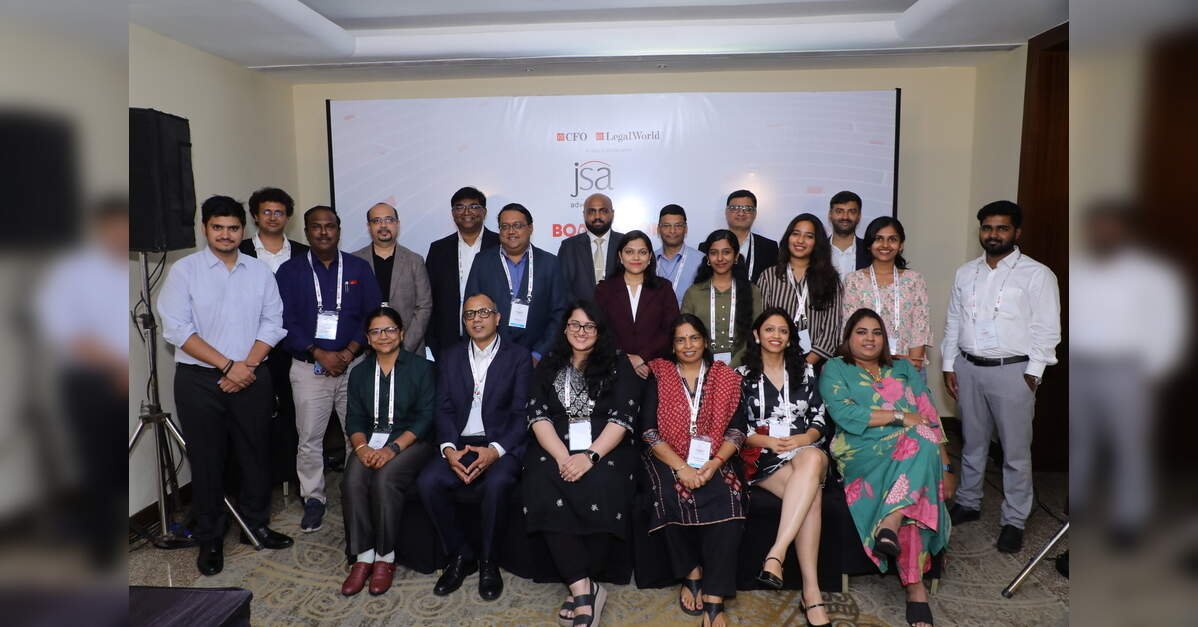
This emerged as a central theme at the recently concluded “JSA Boardroom Connect — Chennai Edition”, an executive roundtable on “The Indian Manufacturing Paradigm: The Evolving Regulatory & Governance Landscape”, hosted by ETLegalWorld and ETCFO, in association with JSA Advocates & Solicitors.
The CXO-level discussion brought together industry and legal leaders, including Avinash Jain, Karthik Narayanadoss, Gandhimadhy Varadarajan, Karthika Valakumaresan, Aravind Kumar S R, Srinivasan N, Jeevan Prakash, Sherwin Timothy Samuel, K Sathish Kumar, alongside Vishnu P Sudarshan, M. Arun Kumar and Varun Sriram, Partners, JSA Advocates & Solicitors.
The discussion highlighted a paradox at the heart of India’s manufacturing push: the country has accumulated a substantial policy architecture, but the last mile of implementation continues to determine how effectively businesses can operate.
From single window to single process
India has made significant progress in creating single-window portals and simplifying approvals. Yet, for manufacturers, the experience on the ground can still involve multiple departments, authorities, state-level processes and overlapping compliance requirements.
The distinction is important. A digital portal may bring several departments onto one platform, but if a company still has to navigate different processes, documentation requirements and interpretations across jurisdictions, the promise of a single window remains incomplete.
For manufacturers setting up or expanding facilities, this fragmentation translates into additional time, manpower and compliance costs. Legal and regulatory compliance is still frequently viewed as a cost centre rather than an investment that enables predictable business operations.
The larger opportunity, therefore, lies in moving from single-window access to single-process implementation.
A manufacturer should ideally be able to understand, upfront, what approvals are required, which authorities are involved, what documents need to be submitted and how long each stage should take.
The real gap is implementation
India’s regulatory challenge is not necessarily a lack of policies. In many sectors, there is already a substantial policy framework covering manufacturing incentives, investment, infrastructure, exports, environmental approvals and emerging technologies.
The friction often begins when those policies move from paper to the factory floor.
Implementation can vary significantly between states—and sometimes even between districts within the same state. Two locations with broadly similar policy frameworks can offer very different experiences in terms of approvals, permits, timelines and regulatory interpretation.
This makes predictability particularly important for companies making long-term manufacturing investments.
The solution need not necessarily be a completely uniform national framework. Manufacturing ecosystems have evolved differently across states, and local economic and industrial conditions require some flexibility. A more workable approach could be a common central framework or model legislation, with states adapting it to their specific requirements while retaining broad consistency in principles and implementation.
That would preserve state-level flexibility without forcing businesses to navigate fundamentally different regulatory philosophies across jurisdictions.
Ease of doing business needs an agile regulatory framework
The conversation also moved beyond the conventional definition of “ease of doing business”.
India has come a long way from its earlier baseline, particularly with the emergence of PLI-led manufacturing, new industrial investments and the diversification of global supply chains. But competing with established manufacturing hubs requires a higher ambition.
The next phase calls for an agile regulatory framework—one that can respond quickly to changes in technology, business models, supply chains and global markets.
The manufacturing economy itself is changing. The traditional factory is increasingly connected to software, data, digital services and technology-enabled solutions. As businesses move from simply manufacturing products to offering products combined with services, software and integrated solutions, regulatory systems will also need to evolve at the same pace.
The question, therefore, is not merely whether India has an ease-of-doing-business framework, but whether that framework is agile enough to help the country become a preferred global manufacturing destination across multiple sectors.
Local participation remains a missing piece
Another challenge lies in ensuring that Indian businesses—particularly local manufacturers and suppliers—can fully participate in the opportunities created by schemes such as PLI.
Investment incentives can create significant opportunities, but entry barriers, eligibility conditions and public procurement rules can sometimes make it difficult for businesses with Indian operations, including foreign-owned Indian companies, to participate seamlessly in the broader “Made in India” ecosystem.
Lowering unnecessary entry barriers and creating clearer pathways for local suppliers could help expand the manufacturing base beyond a limited set of large players.
This becomes increasingly important as India seeks to build deeper domestic supply chains rather than simply assemble products for global markets.
Logistics has improved—but the last mile still matters
India’s investment in logistics infrastructure, multimodal parks, hubs and digital systems has changed the landscape considerably. Yet, the efficiency gains have not been uniform.
The manufacturing sector continues to face challenges around movement of goods, access to ports, connectivity with markets and the time taken at various entry and exit points.
The improvement in transportation timelines over the years is significant, but the remaining delays can still have a disproportionate impact on inventory, working capital and supply-chain competitiveness.
This makes digitisation a critical next step—not just within factories, but across customs, logistics, ports, approvals and regulatory interfaces.
The opportunity is to use technology to remove friction across the entire manufacturing journey rather than digitising individual parts of an otherwise fragmented process.
Incentives work only when the money reaches manufacturers on time
For emerging sectors such as electric mobility, the effectiveness of government incentives is closely tied to the speed of implementation.
Schemes can offer meaningful financial support to manufacturers, but delays in document verification, approvals and reimbursement can undermine the very objective of the incentive.
For capital-intensive and rapidly scaling businesses, particularly startups and newer manufacturing companies, delayed incentives can directly affect working capital.
The lesson is straightforward: an incentive announced on paper has limited impact if the reimbursement cycle does not match the financial realities of the business.
Faster processing, clearer documentation requirements and predictable timelines could make existing schemes significantly more effective without necessarily requiring additional incentives.
Manufacturers need a regulatory playbook
One of the strongest ideas emerging from the discussion was the need for location- and sector-specific regulatory playbooks.
For a company setting up an automotive facility in a particular industrial cluster in Tamil Nadu, for example, the regulatory journey should be mapped in advance: approvals required, departments involved, documentation, expected timelines and compliance obligations.
The same framework could then be adapted for another sector or industrial location.
Such playbooks could convert regulatory complexity into a predictable implementation roadmap.
They would also reduce the dependence on informal, person-to-person government interactions to understand what a business needs to do next.
For an investor evaluating India, this kind of transparency could become an important competitive advantage.
A national digital compliance layer could change the equation
The discussion also pointed towards a larger technology opportunity: creating an integrated digital interface that brings together regulatory and compliance information across states and sectors.
A prospective investor could enter the platform, select the state, location and industry, and receive a consolidated view of the approvals, licences, permits, incentives and compliance requirements applicable to that project.
The same platform could potentially evolve into an ongoing compliance dashboard for companies and boards, allowing them to monitor regulatory obligations and measure their compliance performance.
India has already demonstrated that large-scale digital public infrastructure can bring disparate systems together. Extending that thinking to manufacturing regulation could create a much more transparent investment environment.
Such a system could also introduce comparability and accountability. If states and districts could be evaluated on the speed and ease with which they enable manufacturing investments, regulatory performance itself could become a competitive metric.
Policy consistency matters as much as policy intent
The EV sector offered a useful illustration of the problem.
On one side, government policy is encouraging electric vehicle manufacturing through incentives and production-linked schemes. On the other, gaps in areas such as charging infrastructure can create bottlenecks for the same ecosystem.
This points to a broader issue: manufacturing policies cannot operate in isolation.
A successful manufacturing ecosystem requires coordination across production incentives, infrastructure, logistics, energy, land, taxation, environmental approvals and market development.
When one part of the ecosystem moves faster than another, the resulting bottleneck can dilute the impact of the overall policy.
The biggest regulatory challenge may be the gap between law and practice
Perhaps the most fundamental concern emerging from the discussion was the distance between what the regulation says and what businesses are practically expected to do.
Companies can comply with the formal requirements of an Act and still encounter additional interpretations, administrative directions or local requirements during implementation.
For businesses operating across multiple states, this creates uncertainty that is difficult to factor into investment timelines.
The problem becomes even more pronounced when requirements differ between districts within the same state.
This is where the distinction between government and governance becomes critical. Having laws, policies and departments in place is only one part of the equation. The quality, consistency and transparency of implementation ultimately determine the business experience.
Regulatory certainty is critical for global suppliers
For Indian manufacturers seeking to become global suppliers, regulatory predictability is not merely an administrative convenience. It can influence investment decisions, supply-chain commitments and the willingness of global companies to integrate Indian facilities into their networks.
The challenge is broad-based and varies by sector and location. Land and permits remain significant concerns in some regions, while environmental approvals and enforcement can create uncertainty in others.
The issue is therefore less about the absence of regulation and more about consistency of enforcement and clarity of interpretation.
Unexpected compliance requirements emerging through administrative directions or local interpretations can create additional uncertainty for companies that have already planned investments around an existing regulatory framework.
For global manufacturers, predictability is as important as the underlying cost advantage.
Building trust into India’s manufacturing story
The roundtable ultimately brought the conversation back to a larger opportunity.
India has the policy ambition, a growing manufacturing base, a large domestic market, a strong talent pool and increasing interest from global companies looking to diversify their supply chains.
The next competitive advantage could come from making the regulatory experience as predictable as the investment opportunity.
That means moving beyond announcing policies to measuring how effectively they are implemented; beyond creating portals to creating genuinely integrated processes; and beyond digitising individual approvals to building a connected regulatory ecosystem.
For India to move from being an attractive manufacturing destination to becoming a globally preferred manufacturing hub, the next reform frontier may well be governance itself.
A more agile regulatory framework, integrated digital compliance infrastructure, transparent scorecards, sector- and location-specific playbooks and greater coordination between the Centre and states could collectively reduce the friction between policy intent and business execution.
The manufacturing opportunity is already visible. The next step is to make the path from investment decision to operational factory faster, clearer and more predictable.
Governance cannot be an afterthought in family-led manufacturing partnerships
The discussion on regulatory complexity naturally led to another question confronting India’s manufacturing businesses: what happens when family-owned companies begin looking outside the family for growth?
As manufacturers pursue joint ventures, strategic partnerships, private equity investments and acquisitions, the transaction itself is only the beginning. The real test lies in how the relationship is structured, governed and eventually unwound if things do not go as planned.
The roundtable underscored that good partnerships are built not only around what the parties hope to create together, but also around what happens when expectations diverge.
Look beyond the headline valuation
A partnership may appear attractive on the basis of capital, technology, market access or a strong brand. But these headline considerations can sometimes overshadow the finer contractual details that determine whether the relationship survives.
Technology partnerships offer a telling example. When one partner brings critical intellectual property or manufacturing technology, both sides may assume that the commercial terms are self-evident. They are not.
Questions around IP ownership, licensing rights, royalty payments, transaction fees, technology transfer and future use of intellectual property need to be settled before the partnership begins.
Several difficult JV experiences have shown that terms which appear secondary during negotiations can become the centre of a dispute years later.
The lesson is simple: anything that could eventually affect economics or control should be negotiated upfront, rather than left to assumptions.
Reserved matters can make or break a partnership
For family-owned businesses, the challenge can become even more complex when ownership, family interests and professional management overlap.
This is where reserved matters become critical.
These provisions determine which decisions require the consent of particular shareholders or partners and can become especially important when there is disagreement over strategy, capital allocation, management changes, expansion plans or an eventual exit.
The negotiation can be lengthy because reserved matters effectively define the boundaries of control.
And there is no universal template.
The rights required by a strategic investor in one manufacturing business may be completely different from those required by a financial investor in another. The nature of the industry, transaction structure, ownership pattern and strategic objectives all have a bearing on what should require shareholder approval.
Copy-pasting a reserved-matters schedule from an earlier transaction can therefore create more problems than it solves.
Cultural due diligence is as important as financial due diligence
One of the strongest takeaways from the discussion was that companies often conduct extensive legal, financial and operational due diligence before entering into a partnership, but overlook another critical dimension: cultural due diligence.
Before taking money from a private equity fund, family office or strategic partner, promoters need to understand how that counterparty behaves after the transaction.
How have its previous investments performed? How does it deal with portfolio companies? How involved does it become in management? How has it handled disagreements? What do former partners say about working with it?
These questions can reveal more about the future relationship than a transaction document alone.
A partnership that looks compelling financially may still struggle if the two sides have fundamentally different approaches to decision-making, risk, management autonomy or long-term value creation.
Conversely, a strong cultural fit can evolve into a relationship that lasts well beyond the original transaction.
The right advisers need to enter before the term sheet
Another practical lesson was the importance of bringing experienced advisers into the process before the term sheet is signed.
Once commercial terms have been committed, trying to correct an inappropriate structure becomes considerably harder.
Family members may know the business better than anyone else, but that does not necessarily mean they should manage every aspect of a complex acquisition or JV negotiation.
As family enterprises become more institutional in their approach to growth, they increasingly need a transaction team that brings together legal, financial, operational, tax and strategic expertise.
The objective is not to take decision-making away from the family. It is to ensure that the family has the right information and expertise before making decisions that can shape the business for years.
Every transaction needs its own architecture
There is also little value in treating JVs and acquisitions as template-driven exercises.
Every transaction has its own commercial logic, ownership structure, sectoral considerations and risk profile.
The documentation therefore needs to answer very specific questions:
- Who controls strategic decisions?
- Which decisions require investor consent?
- What happens if the partners disagree?
- Who appoints management?
- What happens if additional capital is required?
- Can either party sell its stake?
- When can a partner exit?
- How will the business be valued at exit?
- What happens if one party wants to sell and the other does not?
These questions may appear uncomfortable at the beginning of a partnership. They become far more uncomfortable if they are being answered for the first time during a dispute.
Deadlock is not the same as a dispute
A particularly important distinction raised during the discussion was between a deadlock and a dispute.
A disagreement between JV partners does not necessarily mean that one party has breached an obligation or that the matter needs to immediately move into arbitration.
Sometimes both sides simply have legitimate but opposing views.
That requires a mechanism for breaking the deadlock rather than merely resolving a legal dispute.
Depending on the transaction, the parties can build in escalation mechanisms, mediation and other structured approaches before resorting to more adversarial processes. Exit mechanisms such as call and put options, drag-along provisions and other agreed buy-sell mechanisms can also provide a defined route when the relationship becomes untenable.
The broader principle is that the parties should decide how they will disagree before they actually disagree.
Separate ownership, governance and execution
For family businesses, perhaps the most significant governance shift is the need to distinguish between ownership, governance and management.
Being a promoter does not necessarily mean being involved in every operational decision.
Family members can retain ownership and define the long-term vision and capital strategy while professional directors and executives take responsibility for governance and execution.
Indian business groups already demonstrate different versions of this model. Some continue to retain significant family involvement at both ownership and governance levels, while others have increasingly professionalised their boards and operating companies.
There is no single model that works for every family business. What matters is that the roles are consciously defined rather than allowed to evolve through informal family arrangements.
“The rules of divorce” need to be discussed before the marriage
The most practical way to look at a JV may be to plan for the possibility that it could eventually come apart.
Exit provisions, valuation mechanisms, transfer restrictions, put and call options, drag and tag rights, deadlock mechanisms and dispute-resolution processes can be uncomfortable topics when partners are still enthusiastic about the deal.
But that is precisely when they need to be discussed.
Once a relationship breaks down, the bargaining environment changes completely.
What looks like a straightforward exit clause during a negotiation can become highly contested when significant capital, jobs, intellectual property and family interests are at stake.
The objective, therefore, is not to create a contract that assumes the partnership will fail. It is to create one that protects the relationship when the unexpected happens.
No contract can eliminate every risk
The roundtable also brought a dose of realism to the governance conversation.
No transaction document or corporate structure can anticipate every possible problem. The objective is not absolute protection, but risk mitigation.
Experienced advisers can help businesses identify potential fault lines, model possible scenarios and create mechanisms to deal with them before they become disputes.
That makes governance an ongoing process rather than a document that is signed and filed away after closing.
For India’s family-owned manufacturing businesses, this shift could become increasingly important as companies move from promoter-led expansion to institutional capital, strategic partnerships and cross-border collaborations.
The next generation of manufacturing growth will therefore require more than capital and capacity. It will require family businesses to become more institutional without losing the entrepreneurial character that made them successful in the first place.
And perhaps the most important governance principle to emerge from the discussion is this: a good partnership agreement should not merely explain how two parties will work together when everything goes right; it should also provide a credible roadmap for what happens when things go wrong.
Investors are looking beyond the balance sheet
As Indian manufacturing companies move beyond promoter-led growth and increasingly seek private equity, strategic partnerships and public market capital, the definition of an “investment-ready” business is changing.
Financial performance remains fundamental, but investors are increasingly examining what sits underneath the numbers: internal controls, reporting discipline, board effectiveness, risk management, decision-making structures and the ability of the organisation to function beyond an individual promoter.
This emerged as another key theme at the “JSA Boardroom Connect — Chennai Edition”, hosted by ETLegalWorld and ETCFO, in association with JSA Advocates & Solicitors.
The message from the roundtable was clear: governance is no longer something companies build after attracting institutional capital. It is increasingly a prerequisite for attracting that capital in the first place.
Governance needs to be built before the investor arrives
For manufacturing companies preparing to bring in institutional or foreign capital, the basics still matter enormously.
A robust internal-control framework, clearly defined delegation of authority, disciplined compliance processes, transparent financial reporting and clean audit outcomes form the foundation of investor confidence.
But the discussion went beyond a checklist of governance requirements.
Investors want to see whether these systems actually work inside the organisation.
Who has authority to approve what? Are controls documented? Are they consistently followed? How much of the control environment is automated? Can management generate reliable information quickly? Is the board genuinely overseeing risk, or merely fulfilling a statutory requirement?
For companies approaching investors, these questions can be just as consequential as revenue growth or profitability.
The governance architecture cannot be an afterthought
One recurring concern was the imbalance between the time companies spend preparing business projections and the attention given to preparing the organisation itself.
A five-year financial model may be meticulously developed, but if the underlying governance architecture is weak, investors will still see risk.
Institutional investors typically want to understand whether the company has:
- a functioning and accountable board;
- clearly defined decision-making authority;
- robust compliance and risk-management systems;
- reliable financial reporting;
- appropriate internal controls;
- transparent related-party transactions; and
- a governance structure that does not depend entirely on one promoter.
These are increasingly becoming the basic hygiene factors for investment readiness.
Automation is becoming a governance signal
The quality of internal controls is important, but so is the way those controls are executed.
Companies are increasingly being assessed on how much of their control environment has been embedded into ERP, SAP and accounting systems rather than relying entirely on manual intervention.
Automation can make controls more consistent, auditable and less dependent on individuals.
For a prospective investor, that provides another layer of confidence: the organisation is not merely claiming that a control exists; it can demonstrate how the control operates within its systems.
Clean up the books before opening them to investors
Private companies often carry years of inter-company balances, group transactions and legacy arrangements.
While these may have been manageable within a promoter-led ecosystem, they can become a significant area of scrutiny when an external investor enters.
Cleaning up related-party transactions, outstanding balances and legacy accounting issues before approaching investors can therefore make the investment process considerably smoother.
The same applies to accounting standards.
Adopting recognised reporting frameworks such as Ind AS or IFRS, where appropriate, and having credible statutory and audit processes can help international investors develop greater confidence in the numbers they are evaluating.
The promoter is part of the investment thesis
Investors do not simply invest in a company’s balance sheet. They also invest in the people behind the business.
The promoter’s track record, reputation, previous business decisions, approach to governance and ability to build an organisation can therefore influence investment decisions.
This becomes particularly relevant for family-owned manufacturing businesses where the promoter’s role can span ownership, management, strategy and key operational decisions.
Institutional capital increasingly asks a broader question: can the business continue to perform if its dependence on one individual is reduced?
That brings succession, professional management and business continuity into the investment conversation.
Business continuity has moved from the risk register to the boardroom
Business continuity planning was once often treated as an ESG or risk-management requirement sitting somewhere in the background.
The experience of COVID-19 accelerated that thinking.
For long-term investors, particularly family offices and mature private equity funds, the question is no longer simply what the company’s growth plan looks like. It is also what happens if the promoter, a critical executive, a plant, a supplier or another essential component of the business suddenly becomes unavailable.
A credible business continuity plan (BCP) therefore provides investors with visibility into the resilience of the organisation beyond its current leadership.
The question has shifted from “Who is running the business?” to “Can the business keep running if that person is no longer available?”
ESG is becoming an investor-led operating standard
ESG has also moved steadily from the margins of investment discussions into mainstream transaction diligence.
For many unlisted companies, ESG adoption may still be driven primarily by investors, multinational customers or contractual requirements rather than voluntary adoption.
But that distinction is becoming less important.
When private equity funds and global institutions are themselves governed by ESG frameworks, those requirements inevitably travel down into their portfolio companies, suppliers and business partners.
As a result, companies can increasingly encounter ESG requirements that go beyond what Indian law formally mandates.
In practice, ESG is becoming contract-driven and investor-driven.
The ripple effect is particularly visible among suppliers to multinational companies, where environmental, labour, anti-bribery, governance and supply-chain standards can become conditions of doing business.
Small compliance gaps can become big transaction risks
Perhaps one of the most useful takeaways from the discussion was that companies should not focus only on headline governance issues such as ESG, FEMA or major regulatory obligations.
Some of the most disruptive findings during due diligence can emerge from seemingly insignificant legacy issues.
An incorrectly issued qualification share, an overlooked local-body tax obligation or an old compliance requirement that has disappeared from management’s radar can suddenly become a transaction issue when the company is being sold, merged or receiving a new investor.
For a CFO, this means governance cannot be viewed as a list of the biggest risks alone.
It requires a complete risk inventory, including the small and seemingly insignificant obligations that may have accumulated over the years.
Family governance and business governance must evolve together
For family-owned manufacturing companies, institutional readiness also requires clarity between family governance and business governance.
A business can have strong financial controls and still struggle with governance if family members do not have clarity on who represents the promoter group, how decisions are taken and where ownership ends and management begins.
This becomes particularly complex when several family members are part of the promoter group.
Investors increasingly want a clear point of accountability rather than a loosely defined collective promoter structure.
One emerging solution is to formally designate a promoter-group representative, giving the family a defined mechanism for communicating decisions and exercising shareholder rights.
This does not necessarily diminish the family’s influence. Instead, it can make that influence more structured and predictable.
Professionalisation does not mean removing the family
The transition towards professional management does not necessarily require family members to disappear from the boardroom.
The more sustainable model appears to be one of balance.
Family members can continue to play an important role in ownership and strategic governance while professional executives take greater responsibility for operations, execution and specialised functions.
Indian business groups offer different versions of this model, with family representation at the governance level combined with professional leadership across operating companies, subsidiaries and joint ventures.
The appropriate balance will differ by sector, ownership structure and stage of the business.
The important shift is from family control of everything to clearly defined family ownership and professional accountability.
Succession planning is a process, not an event
The conversation eventually moved to one of the most sensitive issues for family-owned manufacturing businesses: succession.
The strongest takeaway was that succession planning cannot be treated as a document to be prepared when the founder reaches a certain age.
It is a long-term process of transferring wealth, responsibility, decision-making authority and, equally importantly, the family’s aspirations for the business.
That process can take years.
The earlier it begins, the more opportunity there is to develop the next generation, clarify roles, establish governance structures and gradually transfer responsibility without disrupting the business.
The analogy is similar to estate planning. A will is not something that should be considered only when a person reaches retirement. Families increasingly recognise the value of having a clear plan much earlier in life.
The same thinking is now beginning to enter business succession.
What if the next generation wants to take the company in another direction?
This is where succession becomes more complicated.
The next generation may not necessarily want to replicate the founder’s strategy. It may want to pursue acquisitions, technology-led businesses, international expansion, new sectors—or move away from the legacy business altogether.
The answer cannot always be “the founder decides”.
Family constitutions and family charters can provide a framework for navigating such differences.
These structures can establish the family’s core values, principles of ownership, decision-making processes, conflict-resolution mechanisms and expectations around participation in the business.
They create a framework within which future generations can make different strategic choices without destabilising the family-business relationship.
From promoter-led companies to institution-ready enterprises
The broader message emerging from the roundtable is that professionalisation is not simply about hiring a professional CEO or appointing independent directors.
It is about creating an organisation that can operate through systems rather than personalities.
For manufacturing businesses preparing for institutional capital, that means getting the fundamentals right well before an investor enters the room.
Clean books. Reliable MIS. Automated controls. Clear authority structures. Independent oversight. Business continuity. Professional management. Family governance. Succession planning.
These may not appear on the front page of an investment pitch deck, but they increasingly determine how investors read the rest of it.
The manufacturing companies best positioned to attract long-term capital may ultimately be those that can demonstrate not only how fast they can grow, but how well they can govern that growth.
AI-generated intellectual property and contractual accountability
The discussion then moved into a broader question around AI-generated intellectual property and contractual accountability. One participant pointed out that businesses are increasingly using AI tools through third-party vendors, but the contractual allocation of risk remains unclear.
Interestingly, one participant shared a recent contracting experience with an advertising agency. The agency had specifically included a clause stating that if any content was generated using AI, the agency would not be responsible for any claims arising from that content. The example highlighted a growing gap between the rapid adoption of AI and the ability of companies to clearly define ownership, liability and accountability.
The conversation brought out a larger concern: while organisations are increasingly comfortable deploying AI tools, the contractual frameworks governing these technologies are still evolving. Questions around who owns AI-generated IP, who bears liability for infringement, how data submitted to AI platforms is protected, and how responsibility is divided between the enterprise, technology vendor and underlying AI provider are becoming increasingly important for boards and legal teams.
For manufacturing companies, participants noted that these questions become even more consequential as AI moves beyond office applications and into connected factories, industrial automation, predictive systems and production decision-making. A failure or unauthorised intervention in such systems could potentially affect not only data and IP, but also production continuity, product quality, worker safety and customer liability.
The discussion therefore pointed towards the need for companies to move beyond simply approving AI budgets and start building a more comprehensive AI governance architecture—one that clearly identifies ownership, accountability, data controls, cybersecurity requirements, vendor obligations and incident-response mechanisms.
The panel also underscored that AI governance cannot remain confined to the IT or legal function. As manufacturing becomes increasingly connected, technology risk is becoming a board-level business risk, requiring oversight at the same level as financial, operational and legal risks.
The conversation also raised an important question for the insurance industry: whether existing cyber and technology-risk products are sufficient to cover emerging operational technology (OT) risks in smart factories, connected vehicles and AI-enabled industrial systems. Participants noted that while cyber insurance products are evolving, the specific risks associated with connected industrial machinery and AI-driven operational decisions remain an area that requires greater clarity.
This led to a broader takeaway from the discussion: as manufacturing moves from automated factories to intelligent and increasingly autonomous factories, governance will need to evolve at the same pace as technology. The ability to deploy AI may no longer be the differentiator; the ability to deploy it responsibly, securely and with clearly defined accountability could become the real competitive advantage.
The discussion then moved deeper into the data protection implications of AI and connected technologies, particularly around personally identifiable information (PII), confidentiality and contractual safeguards.
One participant noted that AI usage is increasingly becoming an explicit consideration in professional services engagements, with overseas clients in particular asking service providers to disclose what AI tools are being used, for what purpose and what kind of information is being fed into those systems. In some cases, clients have gone a step further and restricted the use of AI altogether for certain categories of work.
This, the panel noted, is changing the way contracts and engagement letters are being drafted. Questions around AI usage are increasingly finding their way into contractual discussions, including what information can be shared with an AI system, whether that information is anonymised, where it is stored, who can access it and what happens to the data after the engagement ends.
The participants also highlighted that even prompts could eventually become an area of intellectual property and copyright consideration, particularly as organisations increasingly use proprietary prompts and workflows to generate business outputs.
The conversation around AI also connected naturally with the growing use of telematics and connected vehicles. One participant recalled working on a telematics transaction at a time when India’s data protection framework was still evolving. The company involved deliberately designed its business model to collect only data that did not contain personally identifiable information.
The approach reflected a broader principle that companies are increasingly adopting: the safest data to protect is often the data that you never collect in the first place.
Participants said this principle is also influencing transaction documentation and confidentiality arrangements. Rather than simply agreeing to protect all information received from a client or counterparty, organisations are increasingly defining upfront what information is actually required for a particular transaction or engagement.
One participant explained that in confidentiality agreements and transaction documents, legal teams are increasingly seeking to ensure that counterparties do not provide more personal or sensitive information than is necessary for the specific purpose.
The rationale is straightforward. Once personal information enters an organisation’s systems, it potentially creates an entire chain of obligations around collection, processing, storage, access, retention and deletion.
For manufacturing companies, this becomes particularly relevant as factories and products become increasingly connected. Data generated through machines, sensors, connected vehicles, employees, customers and suppliers can increasingly flow across multiple platforms and third-party systems. The challenge for boards, therefore, is not merely to secure that data, but to establish clear boundaries around what data should be collected in the first place, why it is being collected and who is permitted to use it.
The discussion reinforced a larger theme emerging from the roundtable: digital transformation is increasingly becoming a governance issue, not merely a technology issue. As manufacturing companies deploy AI, IoT, telematics and connected industrial systems, data minimisation, contractual controls, IP ownership and accountability will need to become integral to the design of these initiatives rather than issues addressed after deployment.


