





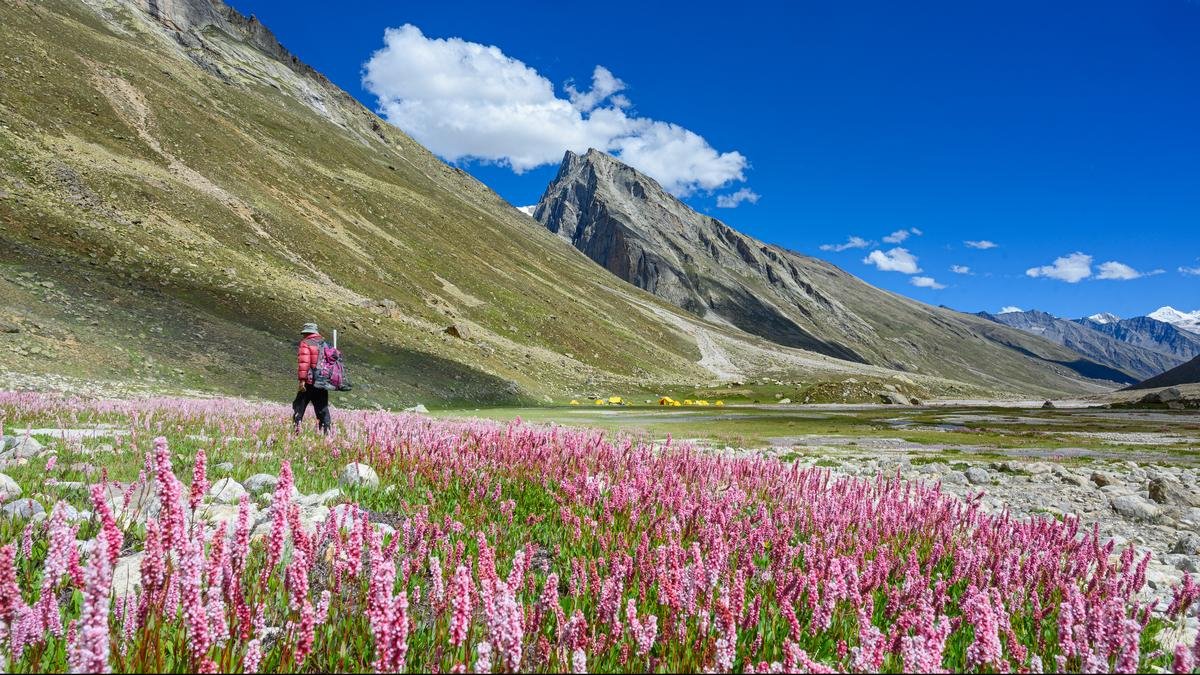
The mountains are in full bloom. From marigold fields and rhododendron blooms to valleys laden with the Dzukou lily and violets, we bring you the best trails to embark on this season.
Read more |India’s best farmstays for immersive rural experiences in 2026
A group of people walking along a path of lilac flowers at Kaas Plateau
| Photo Credit:
Getty Images
AUGUST: Kaas Plateau, Maharashtra
Come August, and Maharashtra’s ‘Valley of Flowers’ comes alive with over 170 species of wildflowers. Located 25 kilometres from the northern part of the Koyana Sanctuary, the Kaas Plateau is listed as a UNESCO World Heritage Site and is home to a range of butterflies, birds, and reptiles.
Randhir Jaya Naidu of Pune-based heritage travel outfit Deccan Drifts has been organising trips to the region, also known as ‘Kas Pathar’, since 2022. “We did a lot of research before starting this day trip. I had been to Kaas for the first time in 2011 with my mother, and I had the privilege of seeing it untouched,” says Randhir, who also conducts heritage, food, and Nature walks in Pune.
The karvi flower seen at Kaas Plateau
| Photo Credit:
Getty Images/iStockphoto
Elaborating on the day trip, he says private vehicles drop visitors off at the designated parking area from where the Forest Department’s shuttle takes them to the entrance gates of the zones. “From the gates, you have to walk on pathways made on flat ground on top of the fossilised volcanic plateau,” he says, adding that the guided tour takes visitors on foot across the region’s three zones.
Read more | In defence of the Indian traveller: Are we judged more harshly than we deserve?
Randhir says Kaas Plateau has changed “a lot” since it received international attention with the UNESCO tag. “Crowds started coming in after that, and barricades and pathways were added. The number of blooms has dropped sharply since. Flowers bloom from mid-September, when the rains slow down, and stay till mid-October. Due to recent climate changes and rains continuing all through September, it has affected the flowering season,” he says, adding that people pluck flowers, litter the area with plastic, and walk on flower beds to take photos. “All these factors have hampered the growth rate. I have never seen Kaas Plateau like my first visit ever again.”
₹2,400 per head. For bookings, call 9130641707
Do
Visit early in the morning to skip the crowds and get your entry pass (wherever required) for the trails in advance.
Use local guides and support the local economy.
Immerse yourself in the culture, not just for sightseeing, but prioritise local connections.
Prepare well for treks by including a mix of cardio and strength training.
Carry your own cutlery, homemade snacks, and fruits, and avoid packaged food on the trek.
Hope for the best, prepare for the worst. Having high expectations for clear views may sometimes lead to disappointment. While every weather has something to offer, it requires a bit of acceptance to go with the flow.
The Dzukou lily is in full bloom from June to early August
| Photo Credit:
Special Arrangement
JUNE-AUGUST: Dzukou Valley, Nagaland
Khriebu Zhasa’s fondest childhood memories were the winter treks she took with her family to Kohima’s Shürho peak. “There was a small rest house where we would take a pit stop. My parents would rest there and prepare lunch, while we cousins and nephews would make our way to the top of Shürho. Our knees would get wobbly on the trek down, and I remember my father would walk in front and hand me the other end of his walking stick and tell me to focus on the next step and sing along with him,” says Khriebu, 38, managing director of travel outfit Explore Nagaland.
Rhododendron blooms in Nagaland’s Kipfuzha Sector
| Photo Credit:
Special Arrangement
Here, Khriebu, along with her sister Nino Zhasa, offers custom tours in the Northeast and a range of flower treks. “The village youth has popularised many flower trails in the region via social media. Akule Potato (Kigwema) for beautiful hydrangeas in June and July, Mosen View Point in October-November for cosmos, to name a few. However, maintenance is a communal effort,” says Nino, the founder, adding that Japfu Peak (October-April) is great for rhododendron blooms. Located at an elevation of 3,048 metres, it takes trekkers five hours uphill and three hours downhill.
A rhododendron tree on Shürho Peak
| Photo Credit:
Special Arrangement
Khriebu says the Dzukou Valley trek is open year-round, and the Dzukou lily is in full bloom from June to early August. This was launched by the duo in 2002 when Nino was hosting her first British visitors to Nagaland. “We didn’t do much research, as it was popular to do the trek locally. So, we were guided by my country cousins, and we camped out in the Valley,” says Khriebu, adding, “Nowadays, camping out in the Valley is no longer allowed; there’s a designated campsite where guests can register and pitch tents, sleep in the dormitory, or book a cabin. We offer day hikes and overnight treks as well.”
All trails are customised. For bookings, call 9089948353, 8787396634
Wildflowers at Annapurna Base Camp
| Photo Credit:
Ashish Thapa
JUNE TO SEPTEMBER: Wildflowers
OCTOBER TO DECEMBER: Marigolds
@ Nepal
“The monsoon is perhaps Nepal’s most underrated trekking season,” says Prashan Poudyal, founder and trekking guide, Waves of Nature. He calls it the season of wildflowers, and explains how many travellers avoid the mountains because of the rains, but the monsoon “breathes life into the landscape”. “Meadows erupt into colour, forests become lush, and countless alpine flowers bloom across the highlands. Among the flowers that make their appearance are Himalayan balsam, Himalayan bistort, Himalayan blue poppies, a variety of Himalayan orchids, and hundreds of other wildflowers,” says Prashan, adding that rewarding regions during this season include Khaptad National Park, Dhorpatan, Panch Pokhari, and the Langtang Valley.
Rhododendrons in full bloom on the Manaslu Circuit Trek
| Photo Credit:
Prashan Poudyal
Clear mountain views characterise autumn (October to December) and the season is all about “flowers woven into everyday life”. “Marigolds in particular hold deep cultural significance during Dashain and Tihar and can be seen adorning homes, temples, courtyards, and village pathways throughout Nepal. Along the trails, dahlias, Himalayan asters, edelweiss, and delicate late-season wildflowers continue to add colour to the landscape,” says Prashan, adding that experiences can range from short two-day hikes to expeditions lasting over two weeks.
A trekker on the Panch Pokhari Trek in Nepal
| Photo Credit:
Prashan Poudyal
Trekking in Nepal, especially with a focus on flowers, is in many ways more about the season rather than the destination itself, he shares. “Nepal is home to an estimated 6,000 species of flowering plants, nearly 3% of the world’s total, with around 246 species believed to be endemic to the country.”
Rhododendron blooms spotted in the Annapurna region on the Kokhe Danda trek
| Photo Credit:
Travel with Sundip
Prashan, who has been offering guided treks for the last five years, says one trend he has observed the growing interest among younger travellers. “In the past, I encountered a large number of trekkers from West Bengal, Delhi, and regions closer to the Nepal border. More recently, I have noticed a significant increase in visitors from southern and western India as well, particularly from Kerala and Maharashtra.” For first-time visitors hoping for classic Himalayan panoramas, Prashan says autumn or spring may be ideal seasons to visit. “But for travellers who have already experienced the mountains and are willing to embrace uncertainty, the monsoon can offer one of Nepal’s most magical and rewarding adventures.”
Fully organised guided treks range upwards of ₹4,000 per person, per day, including accommodation, transportation, full-board meals, certified trekking guides, and permits. Details on wavesofnature.com
Don’t
Rush, and fit everything into a tight itinerary. Rushing through high-altitude regions significantly increases the risk of Acute Mountain Sickness (AMS).
Take unknown routes, even if you are an avid trekker.
Litter your surroundings.
Carry wet wipes; use tissue paper instead.
Play music on the trail or use any form of loudspeaker.
Smoke, consume alcohol or any intoxicating substance.
Flowers at Hampta Pass
| Photo Credit:
Special Arrangement
JUNE TO SEPTEMBER: Wildflowers @ Hampta Pass
In Himachal Pradesh’s Kullu-Manali region, Indiahikes offers several treks to Chandrakhani Pass, Bhrigu Lake, Beas Kund, Miyar Valley trek, the Chandrabhaga glaciers trek, and Hampta Pass. The latter, in particular, “is one of the country’s most beautiful crossover treks,” says Ravi Ranjan, chief of experience and safety, Indiahikes.
Starting from the lush green valleys near Manali, he explains that the trail gradually climbs to the Hampta Pass at around 14,000 feet before descending into the starkly different landscapes of Lahaul. “This transition is perhaps the trek’s most defining feature. On one side, trekkers experience dense forests, mist-covered slopes, streams, and vibrant greenery. On the other side lies an arid, rugged landscape almost completely devoid of vegetation. Witnessing this sudden shift in geography and ecology over the course of a single trek is a remarkable experience,” he shares.
Tents at Hampta Pass
| Photo Credit:
Ravi Ranjan
As this is a valley trek, Hampta Pass also allows trekkers to walk alongside flowing rivers for much of the journey. “During the monsoon season, particularly from mid-July onward, the valley comes alive with wildflowers, turning the trail into a colourful corridor. The campsites are set in exceptionally scenic locations, where almost every direction offers postcard-worthy views,” says Ravi, who adds that Indiahikes has operated this trek since 2011.
He explains how the valley turns into a “spectacular alpine flower garden” during the season, with the diversity of flowers varying with altitude, terrain, and the timing of the monsoon, but several species stand out. “One of the most striking and abundant flowers is the Himalayan bistort. These pink flower spikes carpet entire meadows, especially around the campsites of Jobra, Jwara, and Balu Ka Ghera.” Other prominent species include the bright yellow Himalayan groundsel (Senecio), the blue-violet Himalayan geranium that thrives in moist meadows near streams, and the delicate Himalayan anemone with its white, pale blue, or violet blooms. “Among the most beautiful flowers found on the trail are the primulas, or primroses, which grow on a single stem topped by clusters of vibrant blossoms.”
A view of Hampta Pass
| Photo Credit:
Ravi Ranjan
One of the highlights of the trek is the Shea Goru campsite that is situated beside a gently flowing river. “The soothing sound of the water, combined with panoramic views of the entire Shea Goru valley, creates an unforgettable camping experience. The changing weather patterns between the Kullu region and the Lahaul region further add to the trek’s charm,” adds Ravi.
The final campsite at Chatru introduces trekkers to an “entirely different world”. Surrounded by barren brown mountains and vast open spaces, the landscape is breathtaking. “The optional visit to Chandratal Lake enhances the experience further. Taken together, Hampta Pass offers an unusually complete Himalayan experience, lush valleys, river trails, flower-filled meadows, mist, a dramatic mountain pass crossing, stark desert-like terrain, and a high-altitude lake.”
₹12,950 + GST for a six-day trek. Details on indiahikes.com
Blooms at Miyar Valley
| Photo Credit:
Special Arrangement
JUNE TO AUGUST: Rolling meadows @ Miyar Valley
Located deep within the Lahaul region near Udaipur in Himachal Pradesh, Miyar Valley offers trekkers a glimpse of a lesser-known Himachal. The trek begins at around 12,000 feet and remains largely between 12,000 and 13,000 feet throughout. Unlike Hampta Pass, where the landscape changes dramatically, Miyar Valley is defined by its vastness and continuity, says Ravi. “The valley is considerably wider than most Himalayan valleys in Himachal and remains largely dry because it lies on the leeward side of the Pir Panjal range, which divides the Kullu valley from the Lahaul valley,” he says, of the trek Indiahikes has operated since 2021.
What makes Miyar Valley unique is the absence of dense vegetation
| Photo Credit:
Ravi Ranjan
What makes Miyar Valley unique is the absence of dense vegetation. “Unlike many Himalayan valleys that are lined with forests, rhododendrons, or alpine vegetation, Miyar’s landscape is dominated by open grasslands, shrubs, and rocky terrain. Towering snow-clad peaks rise on both sides of the valley, while numerous streams and waterfalls descend from glaciers high above,” says Ravi, adding that this trek is easy on the legs when compared to other treks in Lahaul-Spiti, Pin Bhaba Pass, Kanamo Peak, for instance. As the valley lies in a relatively drier region of Lahaul, the flowers are generally less conspicuous than those found in Hamta Pass. Having said that, dominant species include Himalayan bistort and Himalayan geranium, with extensive patches of yellow flowering plants appearing across the grasslands. “Marsh marigolds create beautiful yellow highlights within the meadows, while the rare Himalayan blue poppy can occasionally be found in some locations. Unlike Hamta Pass, where flowers often dominate the landscape visually, Miyar Valley’s flowers tend to remain closer to the ground and blend into the vastness of the terrain. However, this subtlety is part of their charm.”
A snapshot of Miyar Valley
| Photo Credit:
Special Arrangement
Another defining aspect of Miyar Valley is its cultural character, as the region carries a strong Buddhist influence. This, he says, is reflected in the presence of many gompas and cultural landmarks along the trek’s route. “Because the altitude gain is gradual and the trail involves very little strenuous climbing, the experience feels less like a mountain ascent and more like a journey through a vast natural sanctuary. Walking across endless meadows with the Miyar River accompanying the trail creates an almost pilgrimage-like feeling.” Highlights of Miyar Valley include the expansive meadows of Gompa, the grasslands and water channels around Palpu, and the crystal-clear glacial lakes at the Miyar River’s origins.
Trekkers are offered accommodation, meals, essential camping gear, safety gear, a trek leader, and local guides.
₹14,950 + GST for a week-long trek. Details on indiahikes.com


