



History has many hiding places. In West Bengal’s Chandannagar, it settled inside sandesh. This old French river town entrusted its memory to a sweet no larger than the palm of a hand. It looks ordinary but beneath its unassuming exterior lies a trick worthy of a magician: a pocket of fragrant syrup that somehow refuses to escape.
Surjya Modak , creator of the Jalbhara
| Photo Credit:
Shreya Banerjee
On June 26, 2026, the jalbhara was awarded the Geographical Indication (GI) tag. The sweet, made by Surjya Modak and his son Siddheshwar Modak, has officially been acknowledged as a confection inseparable from the town where they imagined it nearly 220 years ago.
It has outlived empires, survived the departure of the French, the fading of the zamindars, shortages of sugar, changing tastes, refrigeration, express couriers and global migration. It has travelled folded into luggage, packed into tin boxes, tucked between clothes on journeys to Kolkata, to Delhi and to the world.
But for nearly two centuries, jalbhara has left every first time visitor wondering the same thing: How can a sweet hold liquid without letting it escape?
To unravel this mystery, we drive 45 kilometres from Kolkata to Surjya Kumar Modak in Chandannagar, the birthplace of the jalbhara. Off-shoots of its popularity and fame, Chandannagar teems with several other Surjya Modaks. The main shop is located at 247, Grand Trunk Road East, Barasat Chandannagar, in the Hooghly district of West Bengal. Alongside the new shop is the old shop where Surjya along with his son Siddheshwar created the sweet circa 1843-1844. Their only legitimate branch in Kolkata is in New Town Eco Park’s Misti Hub at Gate number 3.
Surjya Kumar Modak in Chandannagar
| Photo Credit:
Shreya Banerjee
The story of the sweet
In the year 1250 of the Bengali calendar (approx. 1843-44), in the Telinipara neighbourhood of Chandernagore, Surjya received a call from the wife or ‘grihini’ of the Telinipara’s zamindar’s home. Her request? To create a sweet unlike anything anyone had seen or tasted before for the newlywed groom and to playfully surprise him when he took his first bite.
Images of Sachindranath Modak on the left, (fourth generation descendant) and Siddheshwar Modak (son of Surjya Modak) at Surjya Modak in Chandannagar
| Photo Credit:
Shreya Banerjee
To fulfill the zamindar babu’s wife’s request, Surjya and his son Sidhheshwar deftly applied their craft. They created a mould that resembled the ‘talshansh’ or the translucent pulp of the ice apple. In the mould, they added chhena (cottage cheese made by curdling cow milk). At the heart of the chhena they mixed aromatic rose extract with jaggery reduced to a sticky consistency (called ‘dolo’ ). They named this new creation “jalbhara” (water-filled) and sent it to the Telinipara household. When the unsuspecting groom bit into the sweet, the hidden syrup burst forth, spilling down his panjabi (traditional kurta worn by men). The women of the household erupted in peals of laughter. The prank had worked.
This marked the beginning of a new chapter for the Modak family. The fame of the jalbhara spread far and wide.
Its history is inseparable from the larger story of Bengal’s sweets. The arrival of the Portuguese in nearby Bandel introduced the widespread use of curdled milk in confectionery, fundamentally reshaping Bengali dessert-making. Local moiras (sweet makers) adopted the technique with remarkable ingenuity. Among them, Surjya Kumar Modak transformed a relatively new ingredient into one of Bengal’s most enduring culinary inventions.
Running for 700 metres along the Hooghly River, the Chandannagar Strand is where French colonial architecture meets Bengali architecture, making it one of the town’s most distinctive public spaces.
| Photo Credit:
The Hindu Archives
But Surjya was more than a sweet maker. He was also a man of letters. His poetry collection, Geet Gobindo, survives today in the French Museum in Chandannagar a reminder that 19th-century Bengal often refused to separate craft from culture. A confectioner could also be a poet; a sweet shop could also preserve literature.
The Tagore connection
Today, that inheritance is carried forward by the family of fifth generation owner Saibal Kumar Modak.
Saibal Kumar Modak
| Photo Credit:
Special Arrangement
His wife Madhuri Modak and their two daughters Bhagyasree Modak and Gitasree Modak, the sixth generation, help preserve recipes and the 220 year old legacy of Surjya Modak.
Gitasree tells us that Rabindranath Tagore, frequently stayed at Chandannagar’s historic Patal Bari overlooking the Hooghly. During one such visit the poet sampled several sweets from the Modak household. Jalbhara delighted him, but another preparation especially caught his attention. Its delicate grains of chhena reminded him of tiny pearls or moti. He christened it motichur sandesh, a name that survives to this day and has no connection to the motichoor ladoo.
Fifth generation owner Madhuri Modak and her daughter Gitasree Modak stand beneath images of Sachindranath Modak (Gitasree’s grandfather and Madhuri’s father in law) and Siddheshwar Modak (son of Surjya Modak) at their Chandannagar shop.
| Photo Credit:
Shreya Banerjee
Explaining the mystery of the sandesh, Gitasree explains, “The outer shell has such a consistency that it never absorbs the liquid inside. Even during summer, it can remain intact for four or five days without refrigeration.” Winter brings a version of jalbhara made entirely with fragrant nolen gur, where both the filling and the shell acquire the deep amber colour of fresh date palm jaggery.
Freshly made hot rossogollas
| Photo Credit:
Shreya Banerjee
Gitasree points out rows of mango jalbhara filled with alphonso mango pulp, alongside strawberry, black currant, green mango, and even Cadbury inspired versions. Among them, Gitasree says, the mango variety remains the favourite during summer. While the original jalbhara is priced at ₹65, the mango jalbhara is ₹90.
Sourcing ingredients and export
Gitasree says the milk, sugar, and chhena are procured from trusted suppliers in the surrounding suburbs, preserving the consistency that generations of customers have come to expect.
What has changed dramatically is the distance the sweets now travel. Gitasree notes that every week, consignments leave Chandannagar for Bengaluru, Hyderabad, Delhi and Mumbai, reaching customers within a day. Overseas demand is also high.
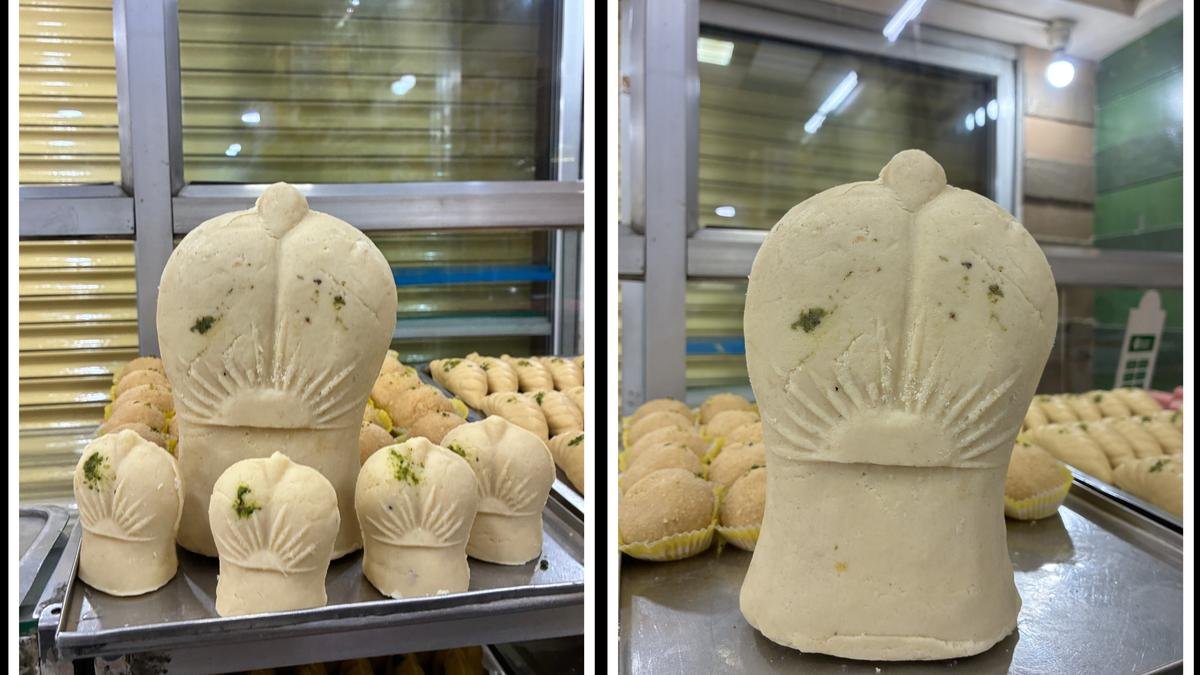
Sweets on display at the shop
| Photo Credit:
Shreya Banerjee
She says, “We export through DHL according to the regulations of each country. There is especially strong demand in the United States, where one of our vendors distributes our products across America. In India every week we send at least six or seven dispatches to Bengaluru, Delhi, Hyderabad, and Mumbai.”
The jalbhara is meant to stand upright, not lie flat.
| Photo Credit:
Shreya Banerjee
What the GI tag means to the shop
The recent Geographical Indication (GI) tag recognises Chandannagar’s jalbhara as a product rooted in the town’s unique history and craftsmanship.
“For international business, we needed official recognition. Earlier, everyone knew it as Surjya Modak’s jalbhara. Now it has become Chandannagar’s jalbhara. It places Chandannagar on the global map, and that makes us very happy,” Gitasree smiles.
The GI tag may have arrived in 2026, but the jalbhara had long ago escaped the need for official endorsement.
As another tray empties across the counter, the jalbhara performs the oldest trick in Chandannagar once again. A brittle shell yields, sweetness spills where none seemed possible and a stranger laughs in astonishment.


