






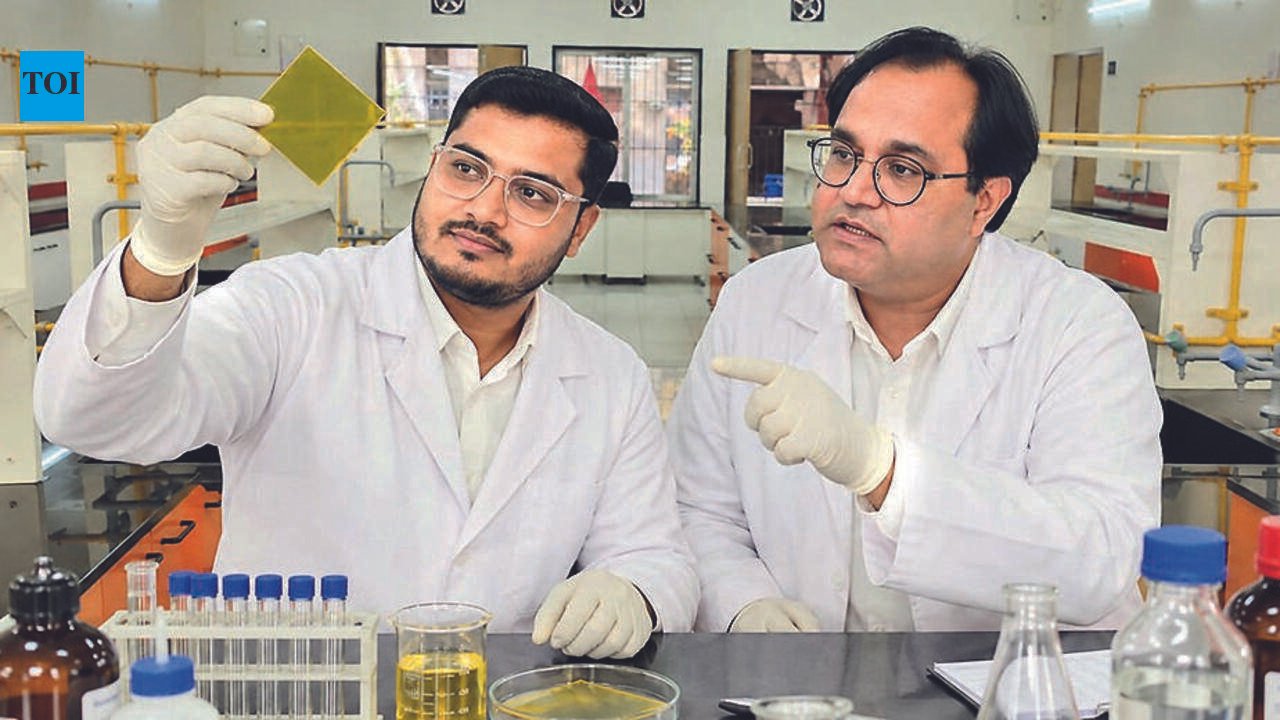
Vadodara: From kitchen turmeric to discarded rice husk, researchers at Maharaja Sayajirao University (MSU) are finding new value in natural ingredients to develop antibacterial materials that could make packaging, healthcare surfaces and textiles more sustainable.Dr Rakesh K Sharma and Dr Vikash M Ganvit of MSU’s Department of Applied Chemistry, Faculty of Technology and Engineering, have secured a patent for bio-based polyurethane coating materials made using non-edible castor oil, rice-husk-derived nanosilica and curcumin, the natural compound that gives turmeric its yellow colour.The innovation combines three ingredients for distinct purposes: castor oil serves as a renewable raw material for synthesising polyurethane, nanosilica extracted from rice husk strengthens the material, and curcumin lends it antibacterial properties.The material can be applied as a liquid that solidifies into a thin film, opening up possibilities for coatings in applications where bacterial growth needs to be controlled.Conventional polyurethane materials, widely used in packaging, coatings and textiles, largely rely on petrochemical-based raw materials. The MSU innovation explores an alternative by replacing some of these inputs with renewable resources and agricultural by-products, potentially reducing dependence on fossil-based feedstocks.The use of non-edible castor oil also offers an avenue to increase demand for a crop-based industrial raw material without competing directly with edible oils. Meanwhile, rice husk, an abundant agricultural residue, can be converted into a value-added component rather than being discarded or put to limited use.The researchers subjected the films to physicochemical and structural characterisation to examine their morphology, structure and thermal behaviour.Antibacterial tests showed promising activity against the bacterial microorganisms tested, indicating the potential of curcumin as a natural antibacterial agent in the polymer films.Potential applications include food-packaging materials, biomedical products, healthcare-related surfaces and protective textile coatings. The use of bio-based ingredients could also offer a more sustainable route to developing multifunctional polymer materials.However, further evaluation will be necessary before the films can be adopted for specific food-contact or biomedical applications. This would include testing their toxicity, migration characteristics, durability, long-term stability, mechanical performance and compliance with relevant regulatory standards.The patented technology brings together agricultural waste, a non-edible oil and a natural plant compound, highlighting how locally available resources could contribute to the development of functional materials with potential industrial applications.


