


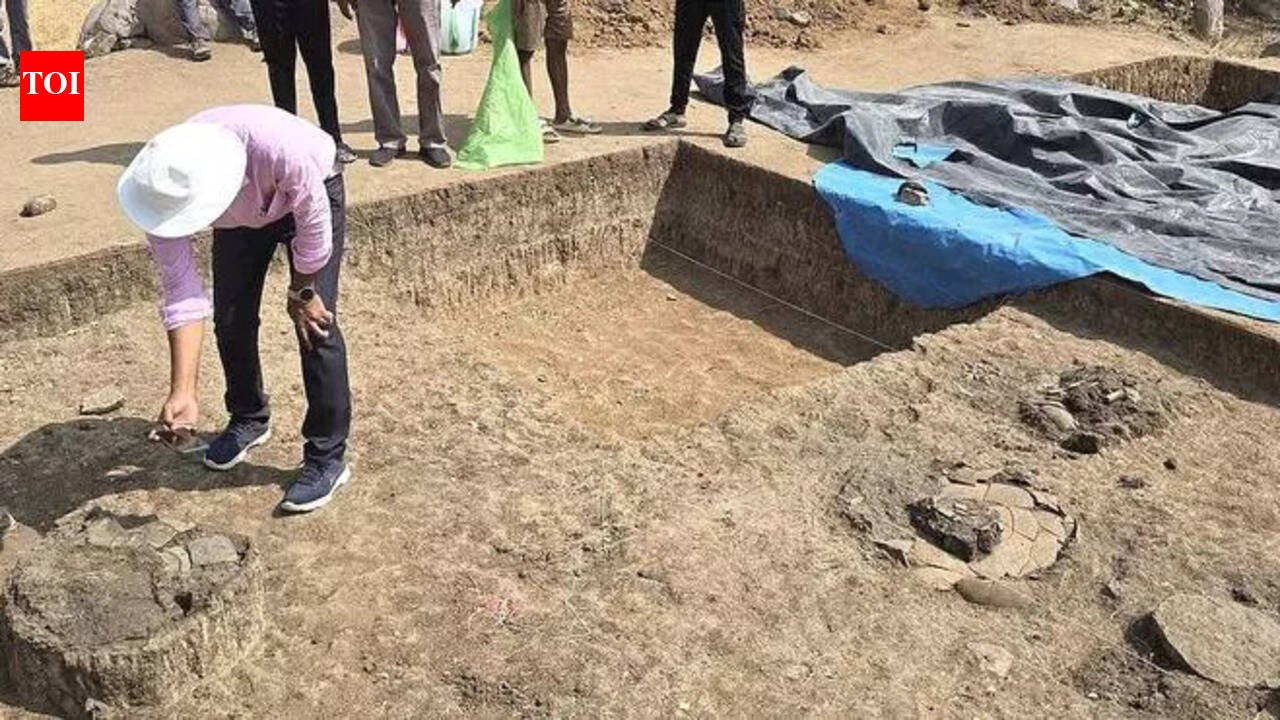
Ballari: After Lakkundi in Gadag district, Tekkalakote in Siruguppa taluk has emerged as a major archaeological hotspot, following the discovery of multiple prehistoric human skeletons and ancient artefacts.Hundreds of visitors — villagers, students, researchers and history enthusiasts — are thronging Gaudara Moole Hill, raising concerns about possible disruption at the site where excavations have been under way since the first week of July 2025. The excavation is being led by Prof Namita S Sugandhi of Hartwick College, New York, who is serving her third field season at the site. Though work was briefly halted due to the monsoon, it has resumed.Human bones were first noticed beneath the soil last week. Subsequent digging revealed two complete human skeletons, each about 5.5 feet long, lying side by side in a burial pit. A third skeleton was later unearthed. The remains are estimated to be between 3,500 and 5,000 years old, possibly from the New Stone Age (Neolithic) period, with indications of older Mesolithic layers. The skeletal remains will be sent for carbon dating to determine their precise age.“A massive stone was found placed over the chest of one skeleton. Removing it could damage the remains, so it was left undisturbed,” Prof Sugandhi said.The burial method points to a distinctive funerary practice. Pottery burials, early historic pottery fragments, microlithic tools, sharp-edged stone implements and hand axes were also recovered, suggesting tool-making activity and an organised settlement.Dr R Shejeshwar, director of Karnataka State Department of Archaeology, Museums and Heritage, Kamalapura-Hampi, said the findings indicate a long sequence of human occupation, possibly continuing from the Mesolithic phase into the Early Historic period.Renowned archaeologist Prof Ravi Korishettar said the discoveries shed light on a predominantly agrarian New Stone Age community with unique burial customs, where elders and prominent individuals were interred in house pits using large pots.Tekkalakote was earlier identified as a Neolithic settlement during excavations led by M S Nagaraja Rao in 1963-65, with artefacts now displayed at the Deccan College Museum in Pune. Experts say nearly 17 sites in and around Tekkalakote require systematic documentation and protection, stressing that preserving this rare heritage is a collective responsibility. Photo: 11-Tekkalakote


