



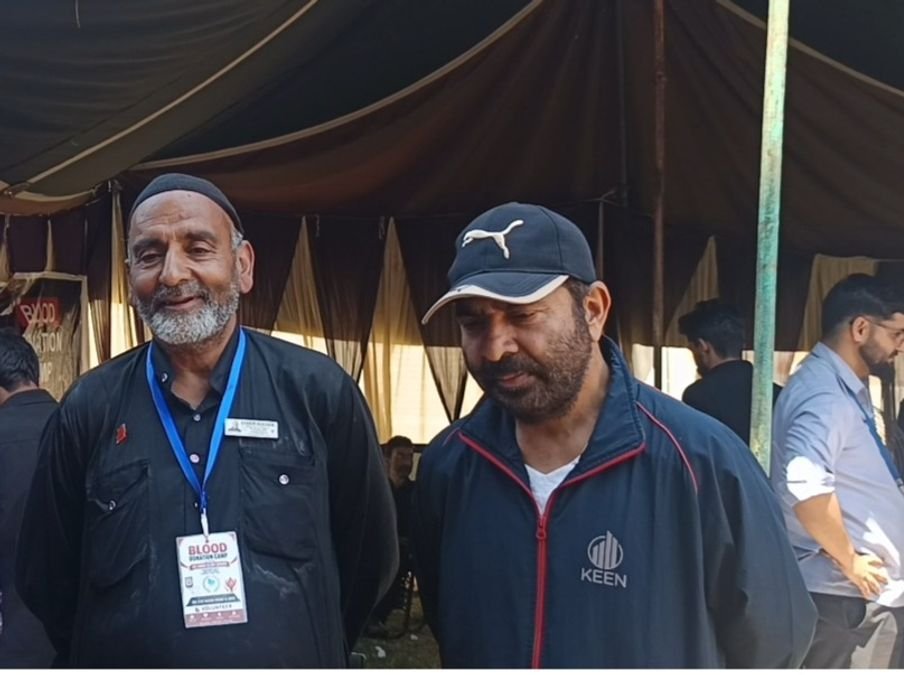
Shabir Hussain Khan – ‘Blood Man of Kashmir’ – donates 194 pints, organises 1,200 camps; Humanity above everything, says Sajad Hussain
Srinagar/Budgam, Jun 27: In a world often divided by differences, two men from Kashmir have spent decades quietly proving that humanity still flows strongest through compassion.
For Shabir Hussain Khan of Srinagar, blood donation is not merely an act of charity—it is a lifelong mission to save lives, inspire society and build a culture of compassion and discipline among youth. Known widely as the “Blood Man of Kashmir”, Khan has donated an astonishing 194 pints of blood and has organised more than 1,200 blood donation camps across Jammu and Kashmir over the years.
Yet, despite the recognition, Khan says the true pain and struggle behind blood donation are only understood by those families who desperately search for blood during emergencies.
“There are many blood donors in Kashmir, but only those who have suffered and faced difficult situations understand its real value,” Khan told Rising Kashmir. “During accidents, surgeries and medical emergencies, a single unit of blood can save an entire family from heartbreak.”
Khan believes Kashmir urgently needs a stronger and more organised blood donation network, particularly for rare blood groups such as O-negative and B-negative, which are often difficult to arrange during emergencies.
“We need online donor systems where blood donors are available just a click away. Plasma donors and rare blood group donors should be easily accessible to hospitals and patients,” he said.
He stressed that blood donation should become a social movement rooted in awareness, discipline and regular medical screening.
“Blood donors should increase day by day. A healthy society is one where people voluntarily come forward to save lives without expecting anything in return,” Khan added.
Equally inspiring is the journey of Sajad Hussain from Magam in central Kashmir’s Budgam district, whose blood donation journey began nearly four decades ago in 1987 after a neighbour’s mother urgently required blood.
“That was my first blood donation point,” Sajad recalled. “I saw a family in distress and realised that humanity is above everything else.”
Since then, Sajad has donated around 100 blood pints and continues to remain active in blood donation awareness campaigns across Kashmir.
“This service is for humanity irrespective of religion, caste, creed or gender,” he said. “The spirit of helping others is deeply connected with the teachings and sacrifice of Hazrat Imam Hussain (AS), who stood for humanity, compassion and justice.”
Sajad believes awareness about blood donation must begin at the school level so that future generations grow up understanding its importance.
“I urge Education Minister Sakeena Itoo and the Director School Education to include lessons about blood donation in the syllabus from Class 5 onwards,” he said.
According to him, educational institutions can play a transformative role in creating socially responsible citizens who are prepared to help others during emergencies.
He called upon media organisations and social media influencers to actively promote voluntary blood donation campaigns.
“The media has a huge responsibility. Social media can especially motivate thousands of young people. Youth must come forward and donate blood to save lives,” he said.
Doctors and healthcare workers say voluntary blood donors remain the backbone of emergency healthcare systems, especially in regions vulnerable to accidents, surgeries and medical crises.
As Kashmir continues to witness rising road accidents and increasing healthcare needs, the stories of Shabir Hussain Khan and Sajad Hussain stand as powerful reminders that saving lives does not always require wealth or power—sometimes, it simply requires the willingness to give a part of oneself for another human being.


