



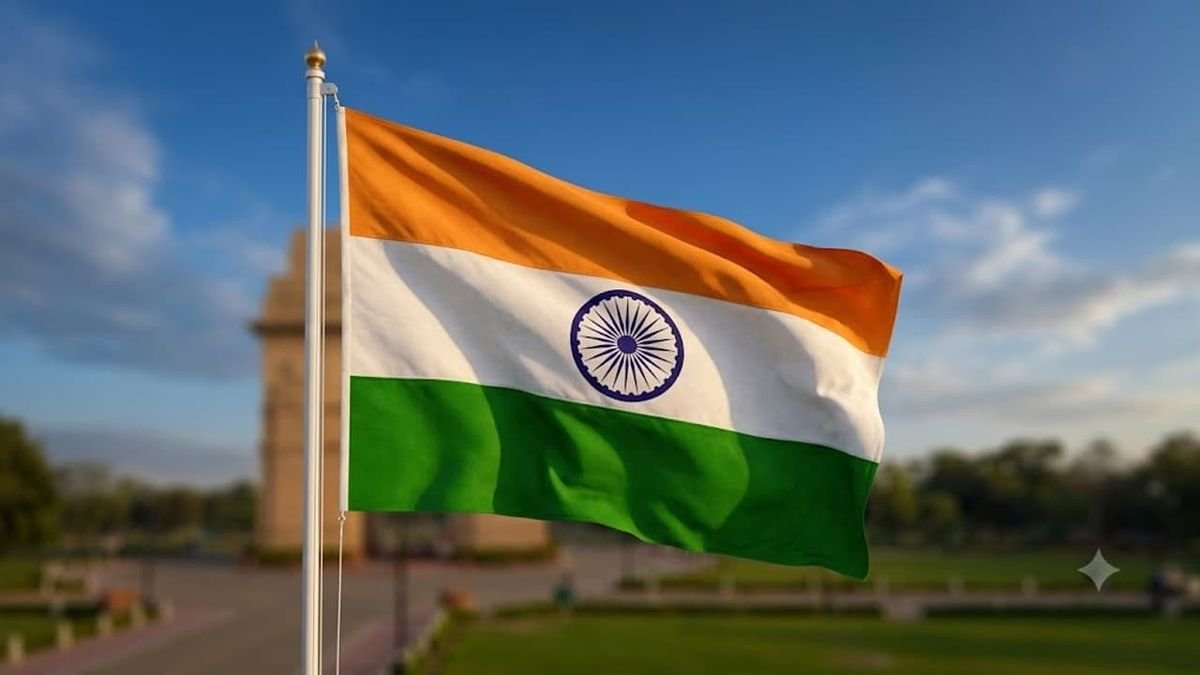
On 15 August 1947, India awoke to freedom after a long and difficult struggle. The lowering of the Union Jack and the unfurling of the Tricolour marked the birth of an independent nation, but Independence was not the end of India’s struggle. It was the beginning of a much larger responsibility—the responsibility of transforming political freedom into social and economic freedom, and of building a nation capable of providing dignity, opportunity and security to all its citizens.
The India inherited in 1947 faced enormous challenges: widespread poverty, low literacy, inadequate healthcare, food shortages, limited industrialisation, weak infrastructure, scarce electricity and poor connectivity between villages, towns and cities. Partition had brought displacement and immense human suffering. Yet, against these odds, India chose democracy, constitutionalism and inclusive nation-building.
The first generations of independent India began constructing the institutions and infrastructure that would ultimately become the foundation of modern India. Eight decades later, as the country approaches its 80th Independence Day in 2026, the distance travelled is extraordinary. The India of 2026 is not the India of 1947—not because the challenges have disappeared, but because the scale of India’s capabilities, aspirations and confidence has fundamentally changed.
One of the most profound transformations has taken place in education and human capital. At Independence, education was available to only a relatively small section of the population, literacy was low and opportunities for higher and technical education were severely limited. Independent India understood early that political freedom could not be sustained without an educated citizenry.
Institutions of national importance were therefore established to create the intellectual foundations of a modern country. The establishment of AIIMS New Delhi in 1956 became a landmark in medical education and healthcare, while the IITs, IIMs, universities, scientific institutions and research establishments created generations of engineers, doctors, scientists, administrators, entrepreneurs and professionals.
The journey from one AIIMS to a network of AIIMS across the country is symbolic of the wider expansion of higher education and medical capacity. At the school level too, India has moved from a situation where millions of children were outside the education system to one of the world’s largest school education networks.
The nature of the challenge has consequently changed. In 1947, the question was how to bring children into schools and create institutions; in 2026, the challenge is how to ensure quality, skills, innovation, research and global competitiveness. Education is no longer simply a social sector—it is the foundation of India’s knowledge economy and perhaps the most important investment in the India of 2047.
The transformation in healthcare tells a similar story. The early Republic inherited a health system with limited hospitals, doctors, medical colleges and public-health infrastructure. Over the decades, India expanded medical institutions, district hospitals, primary healthcare, specialised treatment and public-health programmes.
The expansion of AIIMS and medical colleges has increased the country’s capacity to produce doctors and provide specialised healthcare. The development of national health programmes and financial protection schemes has sought to ensure that illness does not push vulnerable families into financial distress. But healthcare, like education, must ultimately be judged by the last mile.
A world-class hospital in a metropolitan city is important, but so is a functioning health facility in a remote village. A medical institution in Delhi matters, but so does the ability of a citizen in Ladakh, the Northeast, a tribal area or a border village to access timely medical care. The real measure of India’s healthcare transformation is therefore not merely institutional expansion but access, affordability, quality and dignity. The India of 2047 must aspire to a healthcare system where geography and income do not determine the quality of care a citizen receives.
If education and healthcare represent the development of India’s people, infrastructure represents the physical transformation of the nation. The India of 1947 had limited roads, inadequate rural connectivity and enormous geographical barriers. Over the decades, roads became one of the most powerful instruments of integration.
National highways, expressways, rural roads, bridges and tunnels have brought villages closer to markets and cities and have transformed the movement of people and goods. A road is much more than a strip of asphalt. It allows a farmer to take produce to the market, a student to reach an institution, a patient to reach a hospital and an entrepreneur to access a larger market.
In the Himalayan and border regions, infrastructure has an additional strategic and social significance: it connects communities that historically remained isolated and strengthens their integration with the rest of the country. The infrastructure story has also moved beyond roads. Airports have expanded, ports have been modernised, logistics networks are developing and multimodal connectivity is increasingly becoming a central part of India’s economic strategy. The result is an India where distance is gradually becoming less of a barrier to opportunity.
The railway story perhaps provides one of the strongest metaphors for India’s journey. The railways were largely inherited from the colonial era, but independent India transformed them into a national lifeline connecting almost every part of the country. Electrification, modern signalling, upgraded stations, new trains, dedicated freight corridors and major bridges have progressively modernised the network. The expansion of rail connectivity into Kashmir is particularly symbolic.
The Udhampur–Srinagar–Baramulla Rail Link, together with the engineering achievement of the Chenab Railway Bridge, represents the determination to overcome some of the most difficult geographical barriers in the country. The vision of an increasingly connected India—from Kashmir to Kanyakumari—is not simply about transportation. It is about national integration, commerce, tourism, employment, mobility and a common economic space.
When a citizen can travel across regions more easily, when goods can move faster and when remote areas become connected to national markets, infrastructure becomes an instrument of social transformation. The journey of Indian Railways therefore reflects the larger journey of India itself: from inherited infrastructure to an increasingly modern, integrated and technologically advanced network.
The story of power and energy is equally significant. At Independence, electricity generation capacity was extremely limited and large parts of rural India had no access to reliable electricity. The decades after Independence saw the construction of large dams, thermal power plants, hydroelectric projects, transmission systems and later nuclear facilities. Rural electrification gradually expanded, transforming agriculture, industry, education and household life.
Today, India possesses a vastly larger and more diversified power system and is simultaneously pursuing energy security and a transition towards cleaner sources. Solar and wind power have expanded rapidly alongside hydro and nuclear energy. This marks a fundamental change in the nature of India’s energy challenge.
The question is no longer simply how to bring electricity to people; it is how to provide reliable, affordable and sustainable energy for a rapidly growing economy. Energy will be critical to India’s manufacturing ambitions, digital economy, electric mobility, urbanisation and quality of life. The India of 2047 will require an energy system that is not only larger, but smarter, cleaner and more resilient.
India’s transformation cannot, however, be understood without its farmers and agricultural economy. In the early decades after Independence, food security was one of the country’s most pressing challenges. The Green Revolution, agricultural research, irrigation, improved seeds, procurement systems and institutional support fundamentally changed India’s food-production capacity.
India moved from dependence and vulnerability towards greater food self-sufficiency and became a major agricultural producer. But the agricultural challenge of 2026 is different from that of 1947. The question is no longer only how to produce enough food. It is how to make the Annadata prosperous. Farmers require better irrigation, storage, processing, market access, technology, crop diversification, insurance, credit and value addition.
Cooperatives, farmer-producer organisations and modern agricultural supply chains can play an important role in ensuring that the farmer receives a greater share of the value generated from his produce. The future agricultural revolution must therefore be an income and productivity revolution—one that combines technology with sustainability and traditional knowledge with modern markets.
The transformation of industry and the economy has been equally significant. Independent India had a relatively limited industrial base. The early decades focused on creating basic industries, steel plants, heavy engineering, public-sector enterprises and scientific and technical capabilities. The economic reforms of 1991 opened another decisive chapter, bringing greater competition, private investment and integration with global markets.
The growth of services, information technology, pharmaceuticals, automobiles, telecommunications and other sectors demonstrated India’s capacity to compete globally. Today, the national ambition is increasingly moving towards becoming a major manufacturing and innovation hub.
Electronics, semiconductors, defence manufacturing, renewable energy, pharmaceuticals, automobiles and advanced technologies represent areas where India seeks not merely to consume but increasingly to design, manufacture and export for the world. This economic transformation has created a new aspiration: an India that is not simply a large market, but a productive, innovative and globally competitive economy.
Perhaps nowhere has the change been as rapid as in telecommunications and digital technology. There was a time when obtaining a telephone connection could take years. Today, mobile phones and internet connectivity have become integral to everyday life. Digital payments have transformed commerce; Aadhaar and digital identity have enabled new models of service delivery; direct benefit transfers have reduced the distance between government and beneficiary; and digital platforms have opened new possibilities in education, healthcare, banking and governance.
India’s digital public infrastructure has emerged as one of the country’s distinctive capabilities. Technology has also begun to transform the concept of the last mile. A citizen living hundreds of kilometres from a district headquarters can increasingly access banking, information, government services and digital payments without physically travelling to an office. This is a remarkable change in the relationship between citizen, State and economy. The digital revolution has therefore complemented the physical revolution in roads, railways, power and connectivity.
Alongside physical and economic development, India has built an expanding architecture of social security and basic services. Housing, sanitation, drinking water, electricity, financial inclusion, food security, healthcare protection, insurance and direct benefit transfers have increasingly become part of the development framework. The objective is gradually shifting from welfare as temporary relief to welfare as a pathway towards empowerment.
Development must ensure that poverty does not determine a person’s destiny. A woman should have the opportunity to become an entrepreneur; a young person should have access to skills and employment; an elderly citizen should have social protection; a worker in the unorganised sector should not be invisible to the formal systems of support; and a poor family should not be forced into financial ruin because of illness or lack of basic services. The most important measure of any government programme is therefore not the number of beneficiaries listed on paper, but whether the intended benefit actually reaches the person for whom it was created. Last-mile delivery is the true test of development.
This is also where India’s cooperative and community-based institutions can play an important role in the next phase of development. India’s villages, farmers, artisans, weavers, dairy producers and small producers cannot all participate in modern markets individually. Cooperatives and producer organisations can aggregate production, improve bargaining power, provide access to finance and technology, create value chains and connect local products with national and global markets.
This is particularly relevant for traditional sectors such as handloom, handicrafts, wool and Pashmina. When local producers become organised and connected to markets, development becomes participatory rather than merely distributive. The future of Viksit Bharat must therefore include not only large corporations and major cities, but also cooperatives, artisans, farmers, women-led enterprises and small producers in villages and remote regions.
As India stands in 2026, the destination of Viksit Bharat @2047 lies twenty-one years ahead. The centenary of Independence will be more than a commemorative milestone; it represents a national deadline for transforming the foundations built over the first century of the Republic into a developed, inclusive and confident India. The vision places Yuva, Garib, Mahilayen and Annadata at the centre.
India’s youth must become the engines of innovation, entrepreneurship, research and productivity. The poor must receive not only welfare but opportunity, dignity and pathways to prosperity. Women must become equal partners and leaders in India’s economic and social transformation. Farmers must become more prosperous, technology-enabled and integrated with modern markets. These four pillars represent a simple truth: Viksit Bharat will not be built only through infrastructure; it will be built through empowered citizens.
But there is another ingredient without which national development remains incomplete—a shared sense of belonging. A nation is not held together only by roads, railways, institutions and economic statistics. It is also held together by symbols, memories and emotions. The Tiranga represents that collective identity.
The Har Ghar Tiranga movement has helped transform the National Flag from something primarily seen at official ceremonies into a people’s expression of patriotism. The flag has entered homes, schools, villages, workplaces and public spaces. It has become an emotional bridge between the citizen and the nation. Its influence becomes particularly powerful when it reaches the remote landscapes of India.
The Tiranga Yatra at Pangong Lake in Ladakh is a striking example. Against the backdrop of the high Himalayas, the National Flag becomes a symbol not only of patriotism but also of India’s geographical diversity and national unity. When the flag is hand-knitted by local women weavers, another layer of meaning is added. Here, patriotism meets Swadeshi, women’s empowerment, traditional craftsmanship and local livelihood. The hands that preserve India’s traditional skills also create a symbol of the Republic.
A Tiranga at Pangong therefore tells a much larger story: the story of an India where remote regions are not peripheral to national development but are active contributors to it; where local communities are not merely beneficiaries but partners; and where cultural heritage and economic opportunity can reinforce each other.
This is perhaps the most important lesson of India’s journey from 1947 to 2026. Development is not simply about making India richer; it is about making India more capable, more connected, more secure and more confident. It is about ensuring that a child in a remote village has the same aspiration to become a doctor, engineer, scientist, entrepreneur or public servant as a child in a metropolitan city.
It is about ensuring that a farmer, artisan or weaver can connect with markets. It is about ensuring that the citizen living in the mountains, on an island, in a tribal region or near the international border feels equally included in India’s national story. It is about ensuring that the benefits of technology and infrastructure reach the last mile.
The India of 1947 had to fight for freedom. The India of 2026 has to build the future that freedom made possible.
The first generation of independent India built institutions. The next generations expanded infrastructure and economic capacity. Today’s generation has inherited a country with enormous capabilities and even greater aspirations. The responsibility now is to convert those capabilities into a developed India by 2047.
The journey ahead must be measured not only by the size of the economy or the height of bridges, but by the quality of life of ordinary citizens. It must be an India where every child can learn, every young person can dream, every woman can lead, every farmer can prosper, every worker can live with dignity, every village can be connected, and every citizen can access the benefits of development.
That is the real meaning of Viksit Bharat @2047.
The Tiranga that was unfurled at the dawn of Independence in 1947 today flies over a vastly transformed India. From the first AIIMS to a nationwide health ecosystem; from limited roads to expressways; from power scarcity to a diversified energy system; from isolated regions to connectivity from Kashmir to Kanyakumari; from food insecurity to agricultural strength; from limited telephones to a digital India; and from welfare delivery to an ambition of last-mile empowerment—the journey has been extraordinary.
But the journey is not over.
2026 is a moment to reflect on how far India has come. 2047 is the destination towards which we must now work.
From Swatantra Bharat to Viksit Bharat.
From freedom to empowerment.
From infrastructure to opportunity.
From Har Ghar Tiranga to Har Dil Tiranga.
And ultimately, from the promise of development to its delivery to the last person.
The Tiranga is not only a reminder of where we came from.
It is a promise of where we are determined to go.
Jai Hind. ����
(The Author is a columnist and can be reached at: [email protected])


