



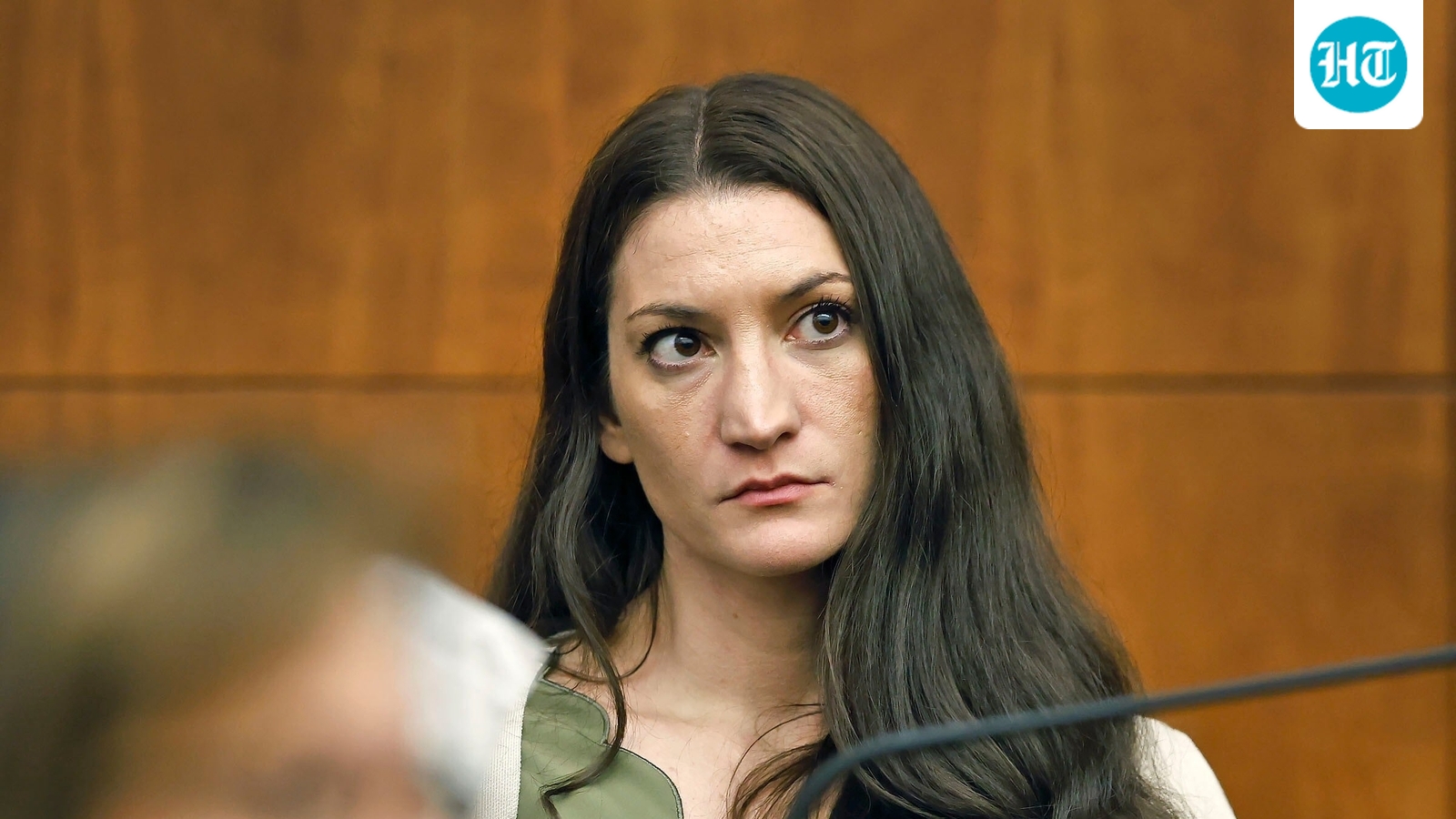
In the third week of the murder trial involving Connecticut resident Lindsay Clancy, who is accused of murdering her three children, testimony consistently undermined the prosecution’s assertion that the murders were premeditated.

Lindsay Clancy faces three murder charges in connection with the deaths of her children: 5-year-old Cora, 3-year-old Dawson, and 8-month-old Callan. The children were discovered unresponsive by their father, Patrick Clancy, who had left to retrieve food on the evening of January 24, 2023.
Following the act of strangling her children, Lindsay Clancy inflicted wounds on her wrists and neck before leaping from a second-story window, resulting in her paralysis from the waist down, according to police reports. She now appears in court using a wheelchair.
Her defense attorney, Kevin Reddington, asserts that she was experiencing postpartum psychosis and was excessively medicated at the time she strangled the children with exercise bands.
Here’s what Lindsay Clancy’s prosecutors said
Nonetheless, Assistant District Attorneys Shanan Buckingham and Jennifer Sprague contend that she exhibited “controlling” and “manipulative” behavior, which is inconsistent with that of an individual suffering from severe mental illness in the days and months preceding the murders.
To date, the assistant district attorneys have called numerous healthcare providers, law enforcement officials, and close friends of Lindsay Clancy to testify.
Last week, multiple friends and colleagues provided consistent testimony regarding Lindsay Clancy, describing her as “a wonderful mother” who had a deep affection for her children.
Her ex-husband, who was the initial witness to take the stand, echoed these sentiments during cross-examination by Reddington.
All the witnesses stated that they were aware of Lindsay Clancy’s mental health struggles, yet none observed her acting strangely, as if she had disconnected from reality or was unable to articulate coherent thoughts.
In the third week of the trial, potential weaknesses in the prosecution’s argument emerged, notably the possibility that Patrick Clancy was the one researching “suicide methods” while investigating the death of a musician, and the fact that law enforcement did not examine her cellphone for indications of her mental health issues.
Lindsay Clancy case: Here are key points from this week of the trial:
The testimony of psychiatrist Dr. Jennifer Tufts, who previously treated Lindsay Clancy, was rigorously challenged by the defense on Monday. Attorney Reddington conducted an extensive cross-examination, focusing on Dr. Tufts’ experience with postpartum patients, her use of telehealth services, and the choices she made concerning Clancy’s medication in the months leading up to the tragic events.
Reddington concentrated on Lindsay Clancy’s response to the antidepressant Zoloft, which was prescribed by Tufts in September 2022 to address her anxiety and depression. After Lindsay Clancy raised her dosage a month later, she informed Tufts that she felt “awful,” and that her anxiety, insomnia, and depression had intensified, as noted in Tufts’ records. The psychiatrist advised Lindsay Clancy to discontinue Zoloft but continued to prescribe other medications in an effort to alleviate her symptoms.
Reddington also questioned Tufts regarding Lindsay Clancy’s reports of suicidal thoughts and ideation, specifically asking why Tufts did not suggest a hospital evaluation during their final appointment on January 23, 2023 — the day preceding the tragic events. Tufts testified that during the January 23 meeting, Lindsay Clancy denied experiencing any suicidal or homicidal thoughts, and there were no indications of psychosis throughout their appointments.
In a tense moment towards the conclusion of Tufts’ testimony, Reddington focused on the phrasing of an October 21 note concerning whether Clancy exhibited “pressured speech,” which could indicate mania. The note stated, “Not hyper, pressured speech,” as per the testimony.
Reddington contended that the phrasing indicated Tufts had indeed noted pressured speech from Clancy. However, Tufts firmly disagreed, clarifying that she intended to convey “not hyper, not pressured speech.”
Upon reading the note aloud, Reddington inquired if he had interpreted it accurately. Tufts responded, “Yes, but your interpretation is incorrect.”
“As opposed to yours?” Reddington hit back.
Inquiry into who searched for ‘suicide methods’ continues
On Thursday, prosecutors presented testimony regarding a search for “suicide methods” discovered during a forensic analysis of Patrick Clancy’s computer. This search took place between 9:40 and 9:48 a.m. on August 23, 2022, several months prior to the tragic events, and was linked to musician Tom Hall, a country singer who took his own life in 2021.
Massachusetts State Police Sgt. Kyle Pavao, who analyzed the forensic data from the computer, testified that the search was associated with a song by Tom Hall, but it was impossible to determine who performed the search.
During the first week of the trial, while Patrick Clancy was undergoing cross-examination, Reddington raised the topic of the search. Patrick Clancy acknowledged his admiration for Tom Hall but did not definitively state whether he had conducted a search on the musician who had tragically taken his own life.
In the course of cross-examining Pavao, Reddington inquired whether the sergeant was aware that Patrick Clancy was a fan of Tom Hall.
He inquired of Pavao whether he was aware that one of the boys had a scheduled appointment to address an infection at 10:15 a.m. on the day the term was searched online. Pavao responded negatively to both inquiries.
During cross-examination, Massachusetts State Police Trooper Timothy Chiappini, who was providing testimony regarding the data retrieved from Lindsay Clancy’s cellphone, concurred with Reddington that Clancy’s calendar showed doctor appointments for Dawson at 9:45 a.m. and for Callan at 10 a.m. on August 23, 2022.
Prosecutors examining potential visits of witnesses with Lindsay Clancy
Psychologist Dr. Paul Zeizel was among the limited people, apart from medical personnel, who were permitted into Lindsay Clancy’s hospital room while she received treatment for her injuries, as stated in the testimony provided by state police on Wednesday.
However, during cross-examination, the mental health professional faced scrutiny when Reddington raised questions regarding the speculation that Zeizel had instructed Lindsay Clancy to use his cellphone to inform her husband that she was hearing “voices” on the day of the tragic events.
Massachusetts trooper Dan Lawlor stated that he had never discussed that theory with a prosecutor and mentioned that he had overheard a fellow trooper speculating about Zeizel, but he clarified that this particular aspect of the case had not been investigated.
On Thursday, following a short discussion, Judge William Sullivan announced that he would permit the prosecution to access the court security records pertaining to Zeizel’s visits to Lindsay Clancy in the court lockup during the trial.
Buckingham contended that Zeizel might be summoned as a witness, which raises ethical concerns regarding his repeated visits with Lindsay Clancy. Buckingham requested to review the security logs to identify who was visiting Clancy at court, including the times Zeizel was present, along with any other possible witnesses.
Zeizel is anticipated to be summoned as a witness for the defense.
Lindsay Clancy’s cellphone search revealed
Lindsay Clancy conducted searches for the terms ‘psychosis’ and ‘hallucinations’ prior to the tragic events.
Chiappini also provided testimony on Thursday regarding his forensic analysis of Lindsay Clancy’s cellphone. He detailed the information contained in his report, including dates, times, contacts that were called or texted, the phone’s usage, downloaded content, and search queries.
He noted that the searches revealed a downloaded request for a medical leave form on Lindsay Clancy’s phone.
On January 20, 2023, a search was conducted regarding the query “can you treat a sociopath,” according to his report.
However, during Chiappini’s testimony for the prosecution, he was not questioned about any additional searches pertaining to Lindsay Clancy’s mental health that were found on her phone.
It was during Reddington’s cross-examination that Chiappini disclosed the presence of multiple searches on Lindsay Clancy’s phone related to medical terminology and advice, which included specific medications she was using as well as terms like “schizophrenia,” “psychosis,” and “insomnia” in the days and weeks leading up to the children’s deaths.
Chiappini confirmed that the report regarding Lindsay Clancy’s cellphone included those search terms, notably a search for “bipolar” that took place on December 29, 2022, and January 13, 2023, as demonstrated by evidence presented during cross-examination.
On January 20, she conducted a search for “psychosis” and had earlier searched for “postpartum depression,” as stated by Reddington in the report.
According to the report, on January 19, 2023, she was looking up “hallucinations.”
Chiappini mentioned that he could not remember if the analysis of Lindsay Clancy’s phone showed that she had searched for “carotid artery,” “how to slit your throat,” and “how to turn off an airbag in a Kia Sorento.”
Reddington stated that a report says her phone had searched for those topics and that she possessed a Kia Sorento.


