



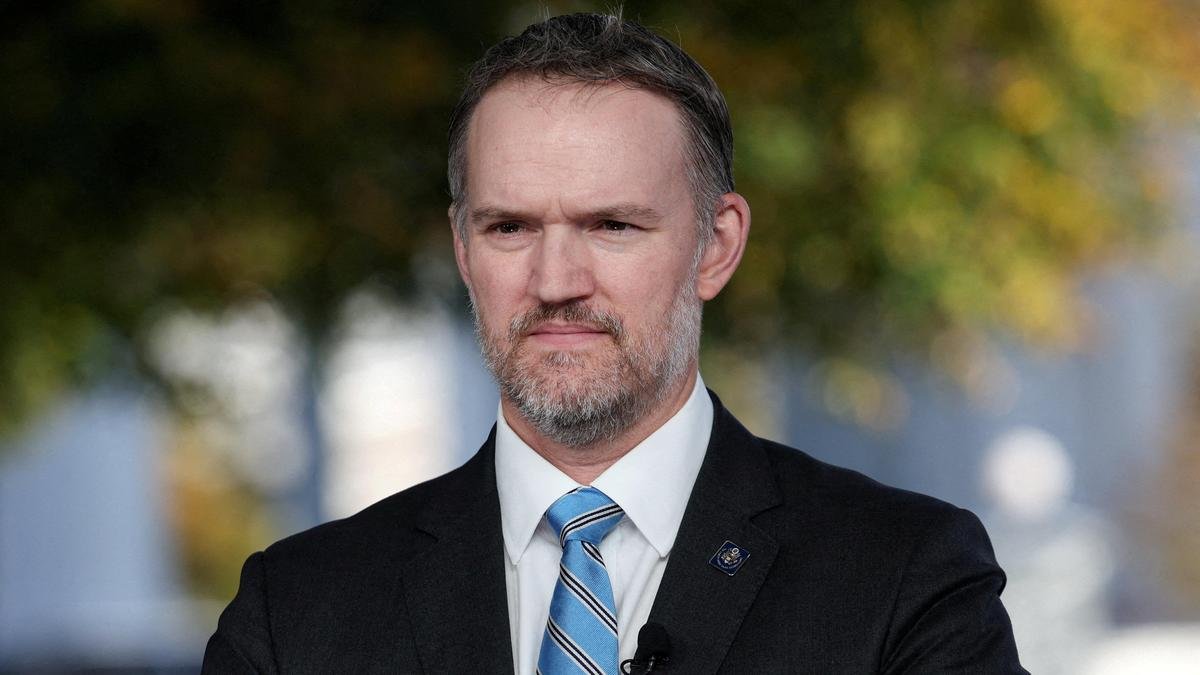
U.S. Trade Representative Jamieson Greer will visit India on June 23-24, officials in the Ministry of Commerce said. File
| Photo Credit: Reuters
In the run up to U.S. Trade Representative (USTR) Jamieson Greer’s visit to meet officials in the Commerce Ministry, including Commerce Minister Piyush Goyal, on June 23-24, two separate sources in the government have told The Hindu that an interim deal on trade only requires “final touches” and that the U.S. is keen to see a deal in place.
However, while the provisions of the deal are nearing completion, Mr. Goyal has indicated that the deal’s implementation would still require the U.S. to first finalise various tariffs.
Also Read | India, U.S. may execute first phase of bilateral trade pact by middle of next month: Goyal
“The USTR Jamieson Greer is scheduled to visit India on June 23 and 24,” a senior official in the Ministry of Commerce has confirmed, adding that Mr. Greer would meet Mr. Goyal and that the discussions would be centred around “giving final touches to the framework deal”.
This comes soon after a visit by Assistant USTR Brendan Lynch to New Delhi on June 1-4.
Mr. Goyal on Saturday (June 20, 2026) indicated that recent investigations and fresh tariff announcements were a major reason for the delay in finalising the deal with the U.S.
“We cannot implement the FTA [free trade agreement] until we secure a competitive advantage,” Mr. Goyal told reporters. “The issue currently pending is that our duties need to be lower compared to those of competing nations; once this is settled, the trade agreement will be implemented.”
Trump calls PM Modi a good friend, says India and the U.S. will get to trade deal
Stop and start
The two countries in February issued a joint statement saying they had agreed on a framework for an interim deal on trade that was expected to be signed over the next few months. Under the framework, the U.S. was supposed to impose an 18% tariff on imports from India, placing it at an advantage compared to most of its competitors.
However, later that month, the U.S. Supreme Court invalidated the reciprocal tariffs imposed by President Donald Trump, which slowed down the finalisation process of the trade deal.
“The negotiations have reached an advanced stage,” a second source in the government, closely associated with India’s trade deals, confirmed to The Hindu. “Several issues and details have been settled. The U.S. seems serious about finalising an agreement.”
Amit Shah meets Gor, two hold ‘detailed discussions’ on terrorism, narcotics
‘India’s advantage, amidst tariffs’
Further, the office of the USTR had, in March this year, launched an investigation under Section 301 of the U.S. Trade Act of 1974 to look into whether its trade partners, including India, were taking enough steps to stop the import of goods that are made using forced labour.
As part of this investigation, the USTR in June had proposed a 12.5% tariff on 54 countries, including India, that it said had “failed to impose and effectively enforce” prohibitions on the import of goods produced using forced labour. The final hearing under the case will take place on July 7.
“The Section 301 investigation is legal and is following due process,” the Commerce Ministry official said. “India has made its submissions to the U.S. The trade deal covers the entire gamut of trade relations and whenever a deal is signed we will have clear answers on Section 301 investigations.”
The second official, too, said that they expect U.S. tariffs to remain “in one form or another” as they are part of a politically and strategically sensitive issue of bringing manufacturing and strategic sectors back to the U.S. However, they added that the trade deal would still provide India an advantage over its competitors.
“The government believes that the U.S. will continue to offer preferential treatment to countries with which it has a trade agreement over those with which it does not,” the official said.
Published – June 21, 2026 06:51 pm IST


