








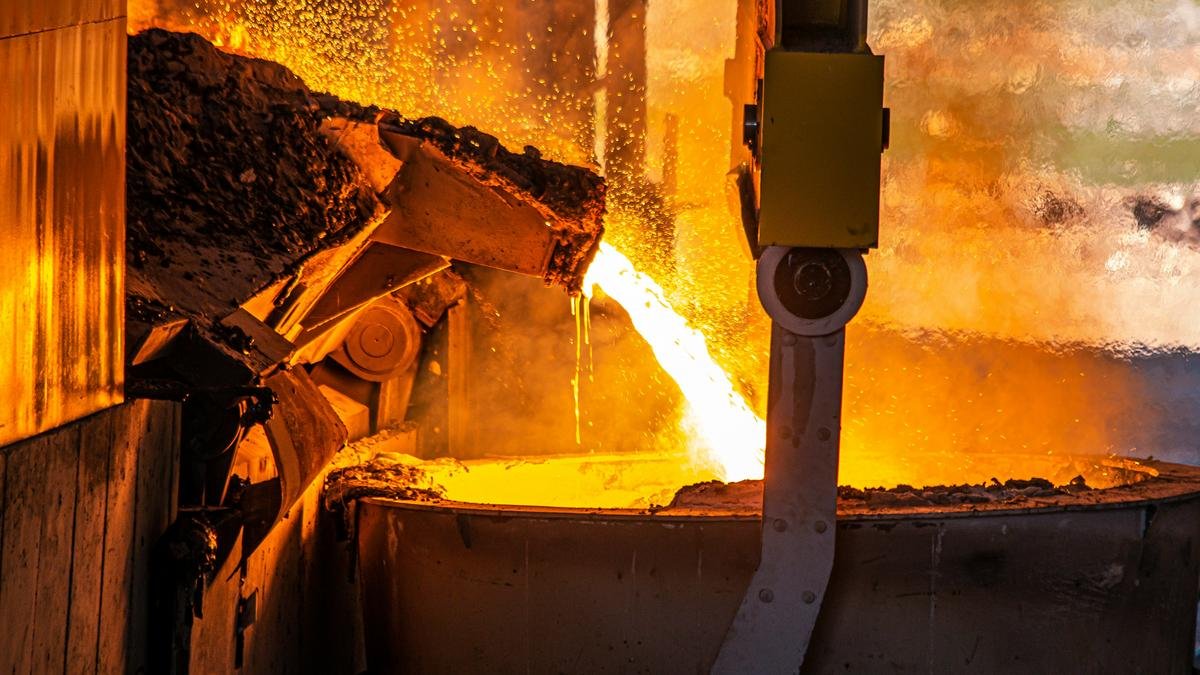
A slew of announcements over the last few months from the Indian government have placed steel sector decarbonisation high on the agenda of the country’s steelmakers, including a ₹5,000-crore scheme announced last year to accelerate steel sector decarbonisation in the country that is set to launch in the coming months.
India’s steelmaking emissions are among the highest in the world, roughly 32% higher than the global average, and account for nearly 12% of the country’s total greenhouse gas emissions. Driven by strong demand from infrastructure development, construction, and automotive manufacturing, India’s steel production in FY 2025-26 was the second-highest in the world, at around 160 million tonnes, behind only China.
India is also planning to increase its crude steel capacity to 300 million tonnes by 2030-31 and 400 million tonnes by 2035-36, making it crucial for the steel industry to control its emissions in order to achieve net-zero by 2070, a target to which the government has committed.
However, steel is a notoriously hard-to-abate industry, and India has its own set of challenges in bringing steelmaking emissions down to zero.
Carbon-intensive method
The government’s ongoing National Mission on Green Steel aims to lower steelmaking emissions intensity from the current 2.55-2.65 down to 2.2 tonnes of carbon dioxide-equivalent (tCO2e) per tonne of crude steel by 2029-30. A certification scheme it launched under the Mission in 2024 said any steel manufactured with an emissions intensity of less than 2.2 tCO2e will be considered “green” and the greenest steel could still have an intensity of up to 1.6 tCO2e. Globally, the average emissions from steelmaking hover around 1.85 tCO2e, making India’s greenest steel still highly carbon-intensive.
“India is a developing economy, and we do not have much scrap available. If we have old steel available, we can recycle that scrap to produce new steel, which reduces our costs and emissions associated with reducing iron ore,” Anubha Aggarwal, an analyst at the Centre for Research on Energy and Clean Air, an independent research organisation, said. “Our [steel manufacturing] is also heavily BF-BOF (blast furnace-basic oxygen furnace) dependent, and because of this, our emissions from steel sectors are so much higher.”
The traditional way to make steel involves burning coal to provide intense heat in a blast furnace, where iron ore is smelted into liquid form using coking coal to strip oxygen. The carbon-rich liquid is then treated with pure oxygen at high speed in a basic oxygen furnace to convert it into high-quality steel by burning away all the impurities. This method, called BF-BOF, is widely used worldwide, and it is highly carbon-intensive.
Reducing emissions to produce green steel will involve skipping the first step entirely, when possible, by reusing steel scrap to produce new steel and replacing coal-powered blast furnaces with electric arc furnaces (EAFs), which use electricity to produce steel from scrap, or direct reduced iron (DRI). Steel with a near-zero carbon footprint (excluding scope-3 emissions) could also use green hydrogen instead of natural gas to reduce iron ore and be powered by clean electricity generated from renewable sources.
However, 70.4% of global steelmaking still uses BF-BOF, according to a Nature Reviews Clean Technologyanalysis. The remaining uses the EAF method, which has less than half the emissions intensity of BF-BOF steel.
An electric arc furnace pouring out steel into a small ladle car, c. 1941. The transformer vault can be seen at the right side of the picture. For scale, note the operator standing on the platform at upper left.
| Photo Credit:
Public domain
‘Just a redirection’
In India, the steel industry is relatively more heterogeneous: per an India Steel Association report, 43% of total crude steel is produced at BF-BOF plants, 22% from EAF units, and 35% from electric induction furnaces (which use electromagnetic fields to process small batches of scrap or DRI and are known to be energy-efficient). Given the growing demand for steel and several planned steel plants, BF-BOF capacity is projected to increase to 56% by 2030.
In these circumstances, India essentially has a large window of opportunity to become one of the biggest players in green steel and iron production — if India decides to go the extra mile and invest in greener pathways rather than in coal-based steel, Clara Bachorz, a researcher working on steel sector decarbonisation at the Potsdam Institute for Climate Impact Research, Germany, and lead author of a recent paper investigating pathways to avert future emissions from steel industry through strategic green investments, said.
“And this [greener pathway] also has high potential for emission reductions compared to the cost of reducing those emissions later, mostly using bioenergy with carbon capture and storage or carbon dioxide removals,” she added.
According to the paper, published in Nature Climate Change, avoiding new BF-BOFs and not relining young furnaces that are due for one, and diverting the investments to building EAFs, could almost halve global committed steel emissions.
“We find that since the majority of these BOF plants in India have not broken ground, you could redirect investments already towards DRI-EAF, and this would not require additional investments. It would just be a redirection,” Dr. Bachorz said.
India’s steel plants are indeed headed for relining blast furnaces, a capital-intensive but essential maintenance task done every two decades that can extend a plant’s lifetime by another 15-20 years — but while locking in coal-based steel production and high carbon emissions for that time. More than 43 million tonnes per annum of blast furnace capacity is due for relining before 2030, according to an analysis by Reclimatize, an independent research body examining India’s decarbonisation efforts in hard-to-abate sectors.
Switching to hydrogen
In their study, Bachorz et al. modelled two global steel sector transition pathways aligned with 1.5°C of warming by the end of the century, with overshoot of up to 1.7 °C. They found China and India dominate the dynamics of the fast-transition scenario, driven by their near-term BF-BOF investments that far exceed those of other regions. In the slow-transition scenario, young blast furnaces are relined and announced BF-BOF plants are developed as planned, locking in emissions for decades and relying significantly more on currently nascent carbon dioxide removal technologies in future, in addition to deep emission cuts in other sectors to compensate for steel sector emissions.
In effect, the team’s analysis showed early investment shifts — particularly in rapidly growing economies such as India — can substantially reduce future emissions at comparably low costs, making early action in steel a high-leverage climate mitigation opportunity, as in the fast transition scenario.
“Since scrap EAF is not possible for India [due to the unavailability of steel scrap], the best alternative is DRI EAF,” Dr. Bachorz said. “Today, it is the most mature green steelmaking technology that you operate, either with natural gas, which still has emissions of around 1.2 tCO2 per tonne of steel or with green hydrogen, which is then almost zero emissions.”
According to the team’s model, India first operates these DRI EAF plants primarily with natural gas until 2040-2045, after which it switches to hydrogen as green hydrogen becomes sufficiently cost-competitive. “If you wanted to operate such a plant with green hydrogen today, my feeling is that this would be a lot more expensive,” she continued. “We find that it is more cost-effective to first operate on natural gas and then switch to hydrogen.”
In conclusion, the researchers suggested steel is less a ‘hard-to-abate’ sector than a sector facing a ‘hard-to-abate barrier’ that can be overcome at relatively moderate costs through timely investment decisions.
Defining ‘green steel’
“When you compare a sector like steel with aviation, for example, it is relatively much easier to abate because the technology is already there, even though it is more expensive,” Dr. Bachorz said. “So you need to pay the green premium and basically go over this investment barrier. But once you commit, it is one of the easiest hard-to-abate sectors.”
“If we invest in EAF now, it would be much easier for us to make it cleaner later rather than investing in BF-BOF now and it becoming a stranded property later,” Ms. Aggarwal said. “Because we have already seen this with thermal power plants, where it becomes really difficult to close them down, as a lot of investment has gone into them, and you want a return on your investments. We do not want to repeat the same story with steel.”
However, she warned that natural gas-based EAFs also carry the risks of fuel shortages, import dependence, geopolitical shocks, and stranded natural gas infrastructure (when used as a bridge fuel to reduce steel emissions).
ArcelorMittal Nippon Steel India became the first integrated steel producer to receive green steel certification in February this year. According to government data, 89 steel units had been awarded the same certification as of March 31, covering a production volume of 12.34 million tonnes.
“You may have your doubts about whether [India’s ‘green steel’] is really green, and the brackets for green steel certification are too large not to be very effective, but then at the end of the day, we have taken that initiative of defining what ‘green steel’ is, unlike anywhere else in the world,” Ms. Aggarwal added. “What we have not done is create the kind of market where there is also demand for green steel.”
‘Future-proof pathway’
This January, the European Union’s Carbon Border Adjustment Mechanism came into effect, imposing steep penalties on carbon-intensive imports, including India’s high-emission steel, which is exported to several European countries. In response, India has been seeking alternative markets and boosting domestic consumption, while the market and compliance obligations may be forcing the steel industry to rethink investment decisions and adopt steel production technologies with lower emissions intensity.
In March, the Union Ministry of New and Renewable Energy funded three pilot green hydrogen projects totalling more than Rs. 400 crore to pursue innovation and validate the technical feasibility of using 100% green hydrogen in furnaces and other stages for low-carbon steel production. Last year, JSW Energy commissioned its first, and India’s largest, commercial-scale green hydrogen plant in Karnataka’s Vijayanagar to supply 100% green hydrogen to adjoining JSW Steel’s DRI unit. ArcelorMittal Nippon Steel India, in the meantime, is promoting its green steel to buyers interested in slashing their scope-3 emissions.
India’s green steel journey is still nascent but recent developments and policies have indicated that this hard-to-abate sunrise industry is rising up to the net-zero challenge. However, balancing growing demand with climate goals remains a formidable challenge for now, with a lot riding on green hydrogen availability and affordability.
“Investing in EAFs offers a future-proof pathway — one that can increasingly utilise domestic scrap today and cleaner DRI technologies tomorrow. This approach strengthens both industrial competitiveness and long-term decarbonisation,” Ms. Aggarwal said.
Neelima Vallangi is an independent journalist and filmmaker covering climate change in the Himalayan region and South Asia.


