






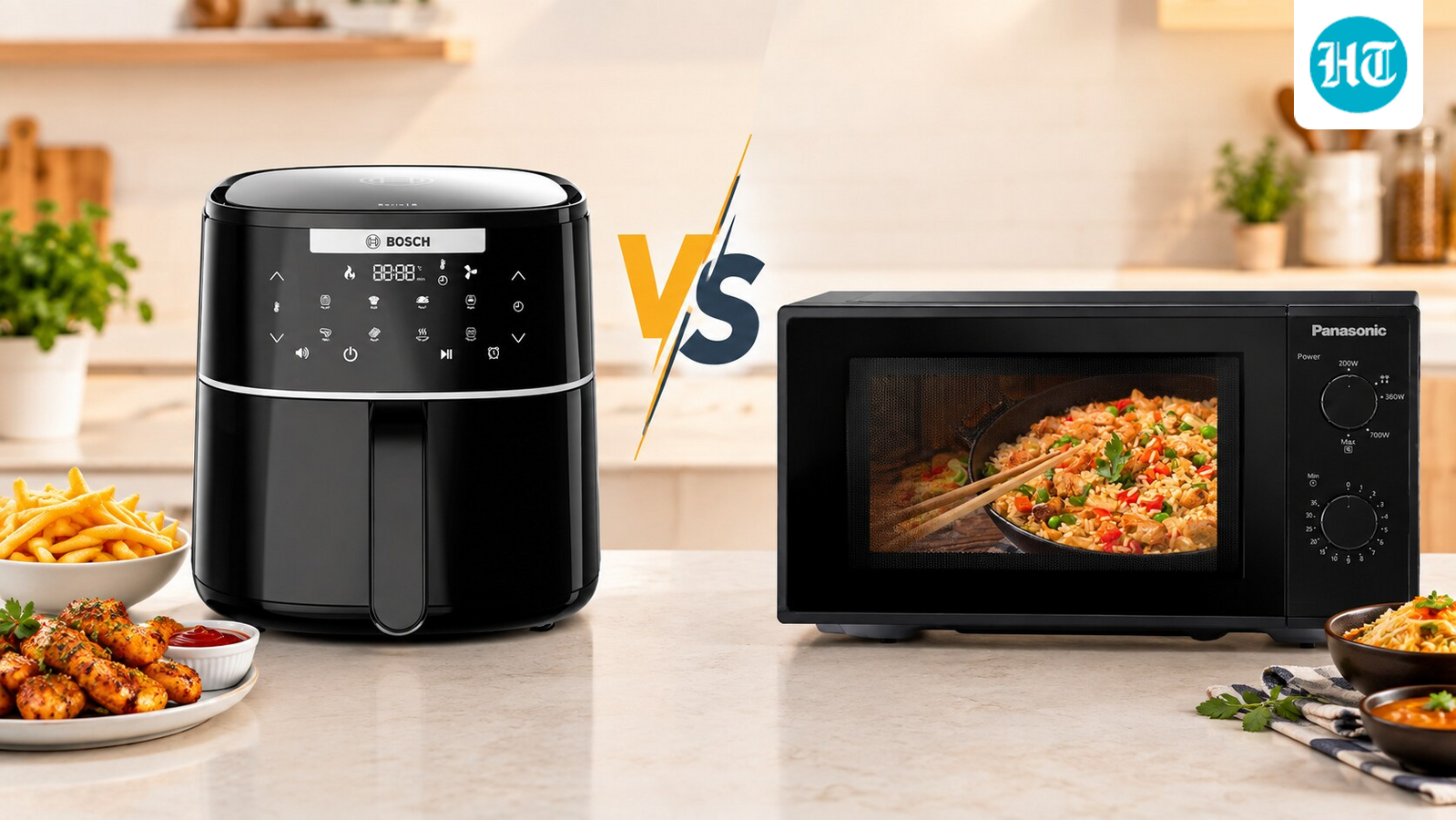



An air fryer can make samosas crispier and snacks within minutes, while a microwave can reheat dal in minutes and help make shahi paneer easily. Does that mean you need both appliances in your kitchen? Probably not. When buying a cooking appliance for a kitchen, the choice between a microwave oven and an air fryer can get surprisingly confusing. Both these appliances help in making snacks, toasting and roasting vegetables and meat. They also save time while cooking, which adds to the overall confusion. However, they are designed for very different cooking jobs.
A microwave oven is ideal for quickly reheating leftovers, warming beverages and curries, defrosting food and cooking dishes with minimal effort. Some models also come with convection and grill modes, which makes them more versatile and ideal for baking and grilling food items.
An air fryer, on the other hand, is designed for foods where you want a crisp, browned finish with little or no oil. It can be particularly useful for frozen snacks, roasted vegetables, paneer, chicken and reheating foods that tend to become soggy in a microwave.
Microwave oven vs air fryer: Top 10 differences
Here are the top 10 differences between a microwave oven and an air fryer:
Parameter |
Microwave Oven |
Air Fryer |
| Working mechanism | Uses electromagnetic waves to heat food quickly | Uses a heating element and rapid hot-air circulation |
| Best suited for | Reheating, defrosting, steaming and quick cooking | Crisping, roasting, grilling and low-oil frying |
| Reheating leftovers | Excellent – particularly good for rice, dal, curries and gravies | Good for dry foods, but can dry out moist foods |
| Crispy snacks | Limited in solo models; food can become soft | Excellent – ideal for samosas, fries, cutlets and frozen snacks |
| Indian food | Excellent for reheating dal, rice and curries | Excellent for tikka, kebabs, paneer, snacks and roasted vegetables |
| Cooking speed | Very fast for reheating and microwave cooking | Fast, but generally requires more cooking time than a microwave |
| Preheating | Usually not required in solo mode | Usually requires a few minutes, depending on the model and recipe |
| Oil requirement | Little to no oil for most microwave cooking | Little to no oil; designed to deliver a fried-like texture with minimal oil |
| Capacity | Generally offers a larger usable cavity, making it better for family-sized meals | Compact basket makes it better suited to small or medium portions |
| Versatility | Solo models are limited; grill/convection models offer baking and grilling | Excellent for air frying, roasting, grilling and baking small batches |
Microwave oven: How does it work, what is it best for, who should buy it?
A microwave oven uses electromagnetic waves called microwaves to make water molecules in food move rapidly, generating heat and cook food from inside. Grill and convection microwave ovens also have additional heating elements for grilling and roasting food evenly from all sides. For Indian kitchens, a microwave oven is useful for reheating leftovers, defrosting frozen food, warming liquids or curries and cooking everyday dishes. A solo microwave handles basic heating, reheating and defrosting, while grill and convection microwave ovens add functions such as grilling, baking and roasting.
A microwave oven is best for reheating vegetables and curries, defrosting frozen food, warming milk, beverages and snacks, cooking ready-to-eat meals, and baking and grilling. This appliance makes the more sense for families that frequently reheat home-cooked food and want speed and convenience. It is also a better option for those who want one appliance for reheating, defrosting, baking and grilling. However, buyers who want to prioritse making crispy samosas, fries, kebabs, paneer or other snacks should opt for an air fryer instead.
Air fryer: How does it work, what is it best for, who should buy it?
An air fryer uses a heating element and a powerful fan to circulate hot air rapidly around the food. This creates a hot, dry cooking environment that helps brown and crisp the outer surface while using significantly less oil than traditional deep-frying. In Indian kitchens, an air fryer is useful for making crispy snacks, roasting, grilling and reheating food items. It is particularly good for making samosas, fries, cutlets, nuggets, paneer tikka, chicken, vegetables and kebabs.
Ab air fryer best for making crispy snacks with little or no added oil, reheating snacks, pizza and other fried food items, cooking tikka, kebabs and chicken, roasting vegetables and potatoes, preparing frozen snacks quickly, baking and grilling food items.
An air fryer makes the more sense for people who regularly eat fried or roasted foods but want to use less oil. It is especially helpful for buyers who want to prioritise crispiness over reheating food. However, it isn’t a complete replacement for a microwave oven. If your everyday requirement is reheating dal, rice, curry and other liquid-heavy Indian meals, a microwave oven is a better option for you.
Disclaimer: At Hindustan Times, we help you stay up-to-date with the latest trends and products. Hindustan Times has an affiliate partnership, so we may get a part of the revenue when you make a purchase. We shall not be liable for any claim under applicable laws, including but not limited to the Consumer Protection Act, 2019, with respect to the products. The products listed in this article are in no particular order of priority.


