






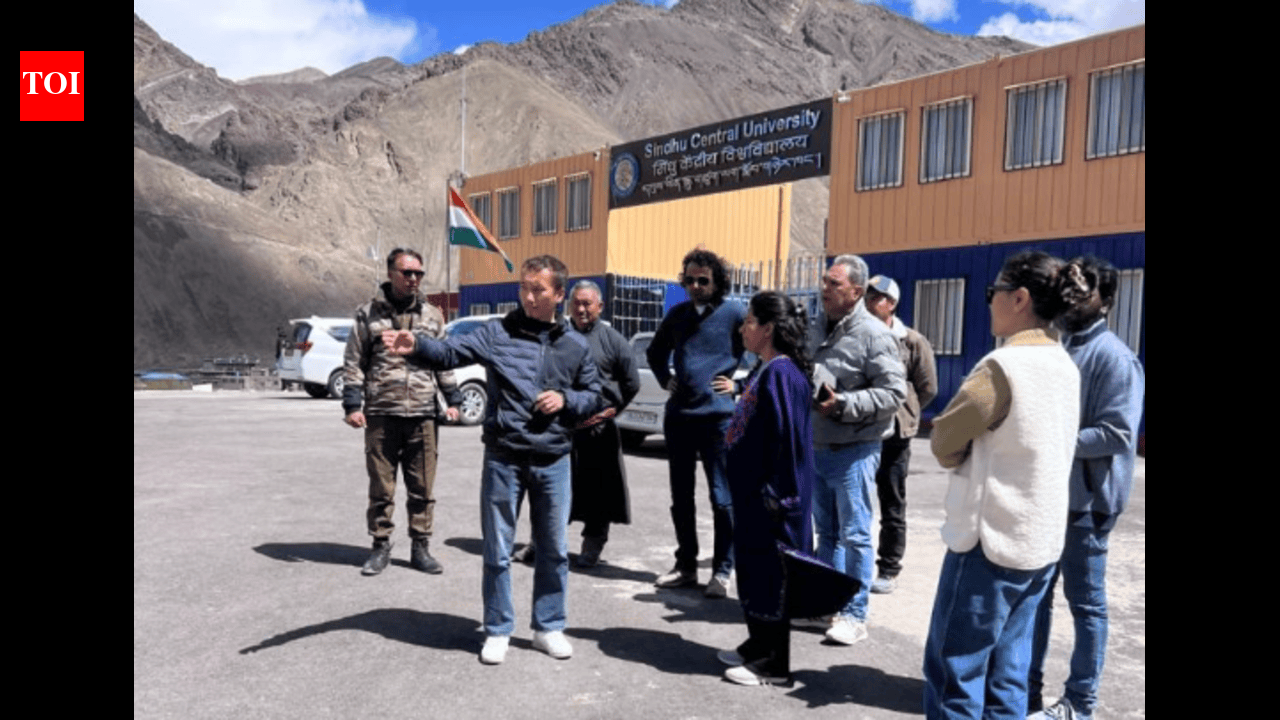
CHENNAI: Researchers from the Indian Institute of Technology Madras (IIT Madras), in collaboration with Sindhu Central University (SCU), have established a high-altitude atmospheric observatory at SCU’s campus in Khaltse, Ladakh, at an elevation of 3,450m, to study air chemistry and climate processes in the Himalayan region.The observatory uses a Proton Transfer Reaction Mass Spectrometer (PTR-MS) to measure volatile organic compounds (VOCs) in the air online and in real time, even at concentrations of parts per trillion. It means it can detect one molecule of a VOC among one trillion air molecules. A Scanning Mobility Particle Sizer (SMPS) measures the number and sizes of aerosol particles. A black carbon instrument is also being installed, with more advanced instruments planned.“The idea is to understand how the ecosystem responds to human activities, and determine whether the changes we observe are driven by human influence, natural processes or a combination of both,” said Prof Sachin S Gunthe, Centre for Atmospheric and Climate Sciences (CACS), department of civil engineering, IIT Madras.VOCs drive regional atmospheric chemistry, and understanding how this chemistry differs in the Himalayas could reveal its implications for the region, he said. The observatory will study pristine Himalayan air chemistry, aerosol formation and growth, and long-range transport of pollutants. It will also provide insights into climate change impacts on the fragile Himalayan ecosystem, CACS said in an online post.“The whole idea is to start better understanding the Himalayan climate,” Gunthe said, adding that the research would examine how climate affects atmospheric chemistry and how atmospheric chemistry, in turn, influences climate.Aerosols are tiny particles suspended in the atmosphere that can influence cloud formation, sunlight reaching the Earth and rainfall. Measurements from the observatory will help scientists investigate these processes and their links to regional climate.The facility is among India’s northernmost measurements of its kind and one of the country’s highest-altitude atmospheric composition studies. Gunthe said its location near Kargil, further north than existing Himalayan research sites such as Hanle, offered a distinct advantage.Globally, high-altitude atmospheric research facilities include the Sphinx Observatory at Jungfraujoch in the Swiss Alps, at 3,580 metres, and the Testa Grigia Observatory in the western Alps on the Italian-Swiss border, at 3,480 metres. The Ladakh facility will add atmospheric observations from a high-altitude site in the tropics.


