






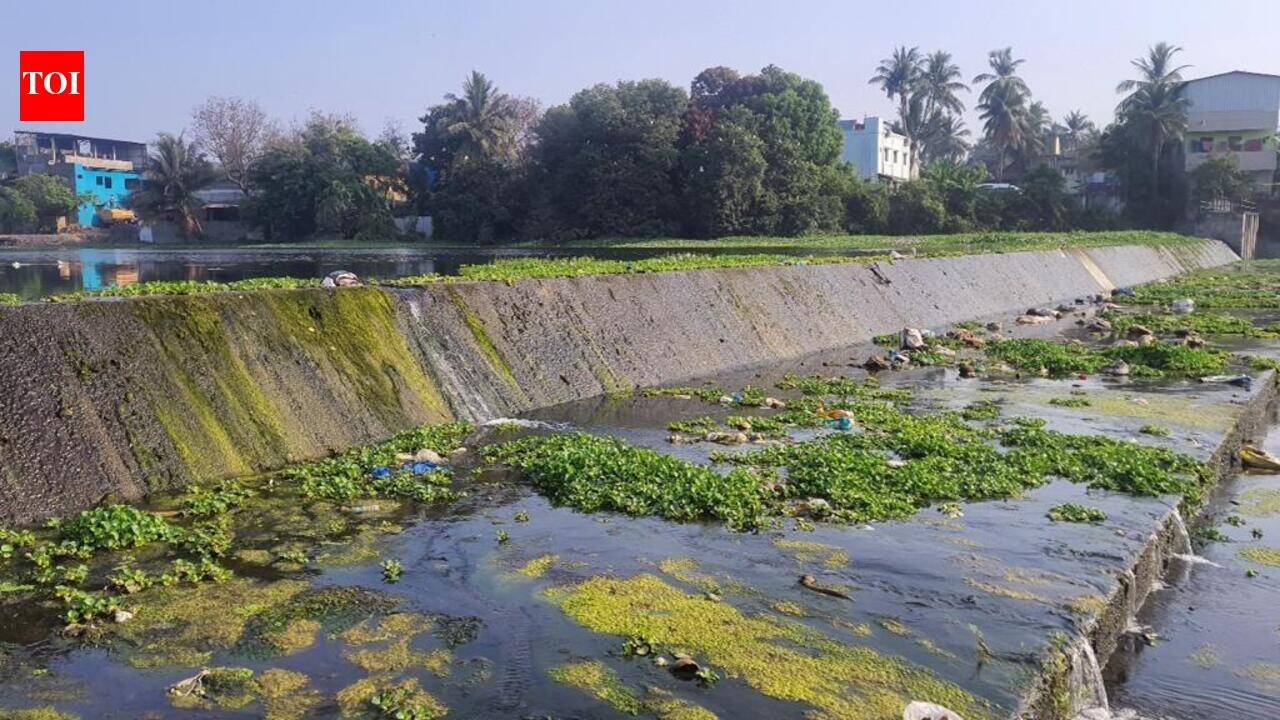
Chennai: Check dams across the Cooum basin could serve as strategic points to monitor and tackle pollution, a study into one of its tributaries has found.Researchers said the structures trapped organic matter, nutrients, salts and plastics, while diatoms (algae) shifted from types that thrive in cleaner water to pollution-tolerant types, as water slowed down in these spots, allowing material to settle in sediment.Published in Environmental Monitoring and Assessment, researchers from the National Taiwan Ocean University and the University of Madras examined 12 sites along an upper-midreach tributary in Tiruvallur district, covering Kannapalayam, Avadi, Paruthipattu and Thiruverkadu, before it joins the main Cooum.A key finding was that upstream water was relatively clean, with diatoms associated with better water quality, while pollution increased and sediment accumulated pollutants and plastics towards the urban check dam .“Diatoms are good indicators of pollution because different types survive under different water conditions. Our findings show that the check dams are also retaining pollutants in the sediment. These pollutants could affect groundwater in surrounding localities,” said Prof Nagaraj Subramani, corresponding author. He said the check dams could be intervention points because they are located before the tributary joins the Cooum. “Pollution stopped here means cleaner water flowing into the main river,” he said, adding that cleaning feeder streams should be part of Cooum restoration.A partial recovery in diatom diversity was found in a free-flowing middle stretch, linked to better water movement, before pollution-tolerant types increased again downstream.At the urban check dam, conductivity was 1,766 microsiemens per centimetre, compared with 748 upstream, indicating high pollution. Total dissolved solids were 1,236 mg/l against 524 mg/l, while chloride was 200 mg/l against 104 mg/l.Two sediment cores — up to 35cm and 20cm deep — that were studied contained organic matter, phosphorus, and chloride, while plastic material was found in several layers. The rural core showed plastic deposition at one level.“The urban sediment core had more microplastics than the rural site, likely because sewage brings them into the river and slower water at check-dams allows them to settle,” said Sagaya John Paul Joseph, first author.Environmental activist G Sundarrajan said pollution must be stopped at source. “Around 10 years ago, a march along the Cooum identified about 880 sewage inflow points. The first priority must be to stop sewage from entering the river. We have spent thousands of crores on making Chennai beautiful, but we are still not getting the results. We need delivery on the ground, not more projects on paper.”


