


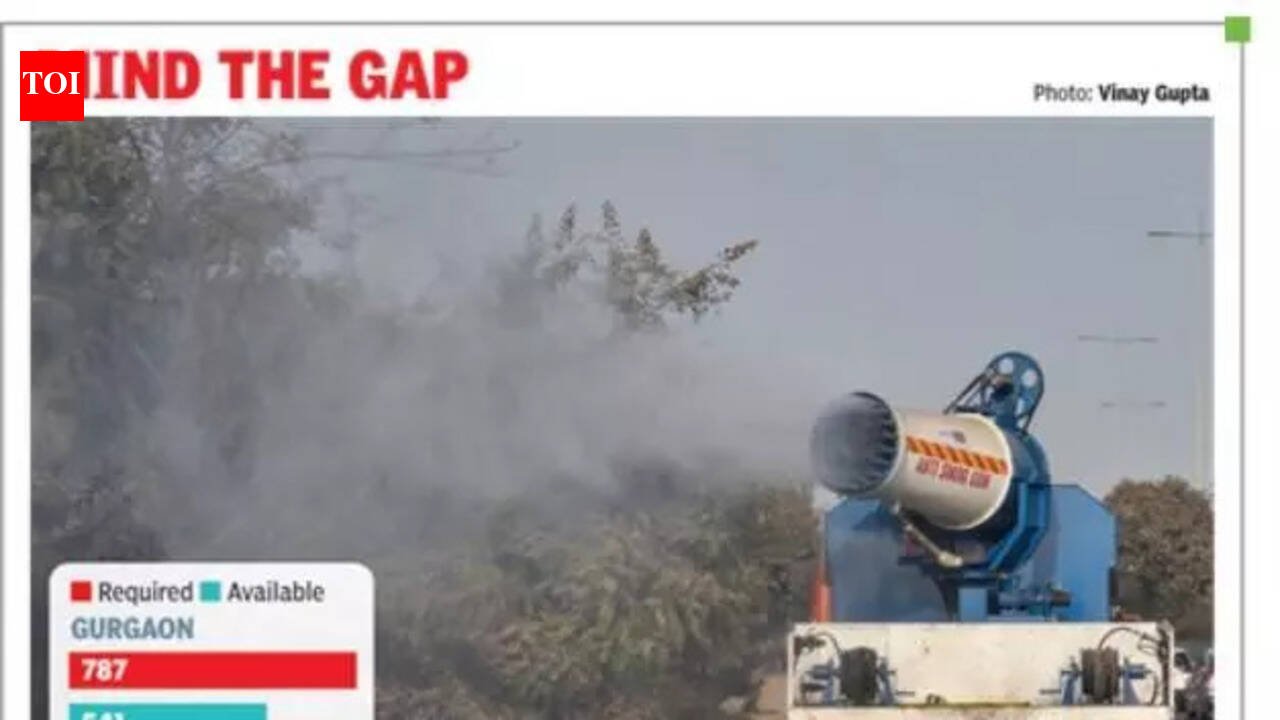
Gurgaon: The city has emerged as the “biggest laggard” where anti-smog guns are concerned. The city requires 787 anti-smog guns but has only 541 available — a gap of 246 units. In fact, several Haryana cities continue to face major shortfalls in anti-smog guns despite repeated winter action plans, according to data submitted to Commission for Air Quality Management. An anti-smog gun is a cannon-shaped device that sprays fine particles of water into the air, creating an artificial mist that helps settle dust, PM2.5 particles and other pollutants. The system is connected to a water tank for continuous supply and can be mounted on a truck, allowing it to cover larger construction areas.Coming back to the city, of the 246 units required, 235 are static guns and 11 are mobile units. While 528 static guns are currently deployed at construction sites larger than 5,000 sqm, as per Haryana State Pollution Control Board (HSPCB) norms, the city still falls significantly short of the required number. The shortfall in mobile units alone is estimated to cost around Rs 6 crore, which officials say may be sought from CAQM for truck-mounted smog guns.According to norms issued by the HSPCB, at least one anti-smog gun must be installed at a construction site spanning 5,000–10,000 sqm. Sites measuring 10,001–15,000 sqm are required to deploy two such machines, while projects covering 15,001–20,000 sqm must have three. Large construction sites exceeding 20,000 sqm are mandated to install four anti-smog guns. These norms are aimed at lowering dust and particulate emissions in the region, especially as air pollution in Delhi-NCR turns severe every winter. “We will ask those not complying with the norms to follow them. If they fail to do so, penalties will be imposed,” said an HSPCB officer (Gurgaon).Faridabad, too, shows gaps in mobile anti-smog infrastructure. While all seven required static guns are in place, only eight of the 15 required mobile units are available, leaving a shortfall of seven. The estimated cost to bridge this gap is Rs 3.85 crore, with funding proposed through the environment protection charge (EPC) fund.In Manesar, no static anti-smog guns are required or available. However, of the four mobile units required, only two are currently in place, while the remaining two are under technical evaluation. The estimated cost for procurement is Rs 0.90 crore, with funds indicated as available.Sonipat faces shortages in both categories. Of three required static guns, only one is available, while five mobile units are missing against a requirement of six. The estimated cost to fill the gap is Rs 2.5 crore, proposed to be funded through CPCB funds, while only Rs 50 lakh is currently available.Rohtak has one static anti-smog gun short, with none available against a requirement of one. Its mobile requirement has been met, with two units already deployed. The cost to bridge the static gap is pegged at Rs 0.45 crore.In Karnal, both static and mobile anti-smog guns remain unavailable despite a requirement of one each. Tenders have been invited and officials have indicated that funding support will come from CPCB.Panipat shows one of the widest gaps relative to its size. All five required static anti-smog guns are missing, with an estimated cost of Rs 0.20 crore. In the mobile category, while two units are available with the municipal corporation, seven required units under HSIIDC are yet to be procured. The total estimated cost for mobile units stands at Rs 3.36 crore, with funding arrangements underway between CPCB, the Panipat municipal corporation, and HSIIDC.The use of anti-smog guns in Delhi-NCR gained momentum after Supreme Court of India in Nov 2019 directed the central govt to install smog towers and anti-smog guns to combat air pollution in the region and asked CPCB to be part of the implementation plan. Smog towers, envisioned as large-scale air purifiers, are designed to clean up to 32 million cubic metres of air per day.


