





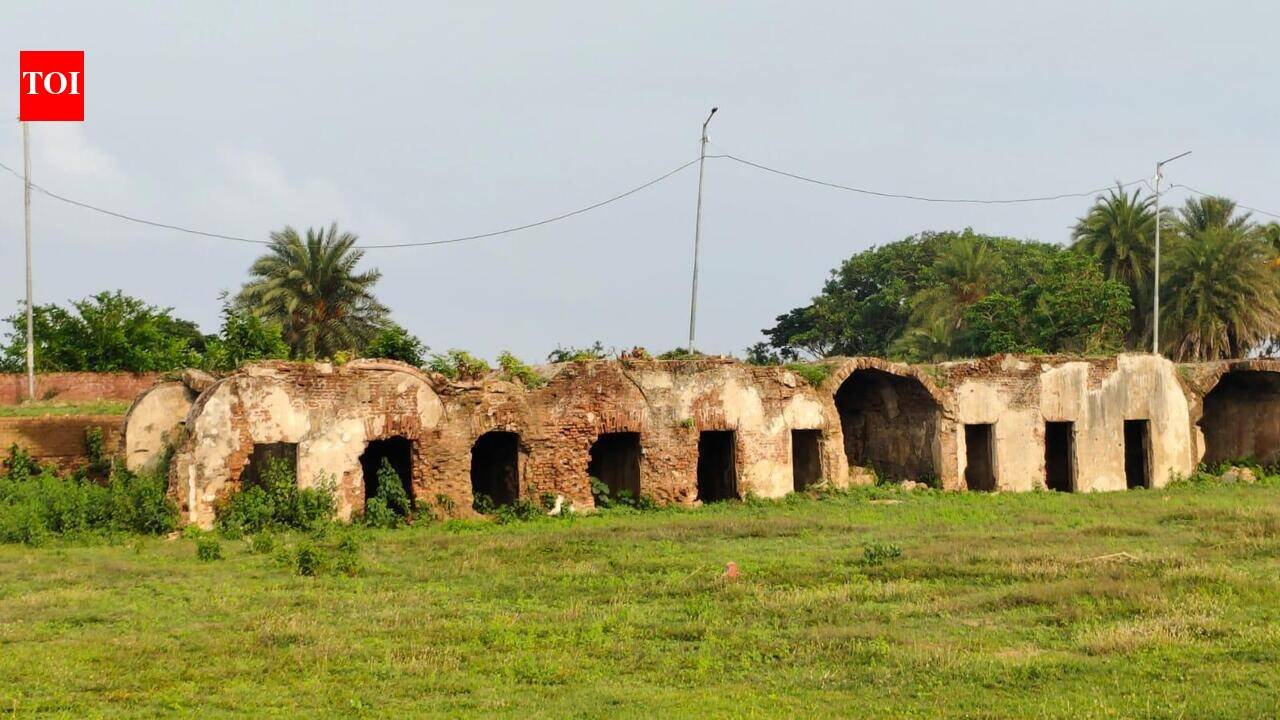
Last year, the govt signed a memorandum of understanding with IIT-Madras for structural audits and conservation of heritage monuments in the state, including Potagarh, unknown to many.A picturesque fort, Potagarh near Ganjam town was a bustling international trading hub in eastern India during the British regime, but now lies in ruins. It stands as a mute witness to Odisha’s rich maritime history from around 350 years ago.The East India Company took possession of Ganjam in 1766 AD, which became a part of the Madras Presidency. Edward Cotsford was appointed the first resident officer in Dec 1766. He constructed a fort at Ganjam in 1768, now called ‘Potagada’ (in Odia). Historians say Potagarh actually means the ‘buried fort’, when Ganjam had a busy port on the east coast. It is located near the confluence of the Rushikulya river and the Bay of Bengal near Ganjam town. It also noted as the first collectorate of Ganjam under the erstwhile Madras Presidency.“A star-shaped fort, Potagarh was surrounded by a wide and deep moat. Its strongly-built earthen rampart was about 15-ft high, while 692-metre-long and 646.19-metre-wide,” said A K Rath, a historian. The main gate of the fort was on the western side, and it has perished. The gate on the eastern side, however, is almost intact, Rath said in a published article on archaeological remains in Ganjam district.The fort compound features thick earthen ramparts, a wide moat, and two secret underground passages on the eastern wall — one designed as an emergency escape route to the sea, and another used by queens to access the river for bathing.“The star-shaped fort was suspected to protect the official buildings inside it,” said Subash Padhy, former professor in history, Berhampur University. Within the fort, there were office buildings, magazine, artillery, armoury, store, custom houses etc. He added that the devastating Rushikulya flood in 1990 caused significant damage to the fort.It is said that in 1855, the fort was permanently abandoned after a devastating epidemic claimed the lives of roughly 80% of the local populace, causing administrative offices to move to Berhampur and eventually Chatrapur.Within the fort, historians say lies buried a treasure trove of artefacts from medieval Orissan history, which can throw more light on the political, culture and social life of those times and stressed for its protection.Ram Chandra Panda, former deputy Speaker of Odisha assembly had written a letter to the chief minister Mohan Charan Majhi for protection of this unique heritage site. “As it is of historical importance, the govt should take steps for its protection before its oblivion due to the corrosive forces of nature,” said Panda, who had tried to push the development of the heritage site multiple times.Ganjam collector Keerthi Vassan V said the govt has engaged the experts of the Indian Institute of Technology, Madras, for preparation of a detailed project report for its protection and development. An expert team of the institute is conducting a survey of the sites.The expert team surveyedall aspects of the ruined fort, including its topology, material testing, geo-technical investigation etc. “The team will prepare the DPR and submit it to the govt for its long-term protection and development,” said district tourist officer, Janak Tarei.


