





Srinagar, Sep 01: Kashmir may still be known for its clean mountain air, but the numbers on its roads tell a rapidly changing story.
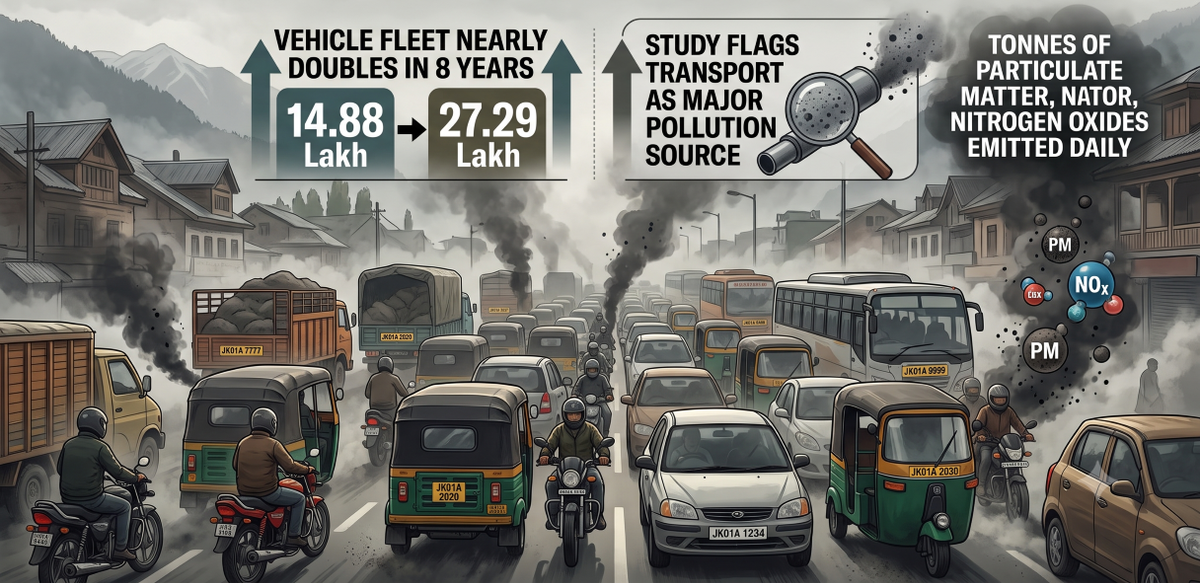
Jammu and Kashmir’s vehicle fleet has nearly doubled in less than a decade, raising fresh concerns over traffic congestion, emissions and the deteriorating quality of urban air.
According to the J&K Economic Survey 2024-25, the number of public and private vehicles increased from 14.88 lakh in March 2017 to 27.29 lakh by December 2024—an increase of nearly 84 per cent in less than eight years.
The latest figures show the growth has continued. Government data cited in the 2026 transport sector assessment put the total registered fleet at 27,36,197 vehicles at the end of 2024-25. During the financial year alone, 1,69,012 new vehicles were registered. Another 1,47,448 vehicles were added between April and December 2025, indicating that the upward trajectory has not slowed.
The official Economic Survey’s year-wise figures show the acceleration clearly—the fleet stood at 20.14 lakh in March 2020, 21.36 lakh in March 2021, 22.73 lakh in March 2022, 24.30 lakh in March 2023, 25.67 lakh in March 2024 and 27.29 lakh by December 2024.
With roads and urban infrastructure struggling to keep pace, the increase has consequences beyond traffic jams. It also means more exhaust, more fuel combustion and greater pressure on the Valley’s already fragile air environment.
A study published in Scientific Reports, examining Srinagar’s air pollution sources, identified transport as one of the major sources of PM2.5 emissions. Its emission inventory estimated 220.5 tonnes of PM2.5 annually from vehicular combustion in the study period. Another detailed emission inventory for Srinagar, published in 2022, painted an even broader picture.
Researchers Mansoor Ahmad Bhat and Eftade O. Gaga estimated that on a typical day in 2018, vehicles in Srinagar generated around 248.13 tonnes of carbon monoxide, 39.39 tonnes of nitrogen oxides and 2,400 kg of particulate matter. The study also estimated 4,415.13 tonnes of CO2 per day from fuel combustion by the vehicle fleet.
“The rapid growth of the vehicle population, urbanisation and traffic congestion had increased the pressure on Srinagar’s air quality,” the researchers noted. “The problem is not simply the number of vehicles, but how those vehicles move matters too.”
Research on Srinagar’s air has repeatedly pointed towards the interaction of vehicular emissions with other urban pollution sources. A Scientific Reports study found that while coal burning was the largest estimated PM2.5 source in its inventory, transport remained a substantial contributor, accounting for an estimated 220.5 tonnes of PM2.5 annually.
The official Srinagar City Air Quality Action Plan has also recognised vehicular emissions as a key concern and calls for regular checking of vehicular emissions and enforcement of Pollution Under Control certification. The plan records the existence of dedicated pollution-checking centres and emission-monitoring arrangements for J&K. Yet the vehicle numbers continue to climb.
“In 2023-24 alone, 1,65,278 vehicles were registered, including 36,282 commercial and 1,28,996 non-commercial vehicles. In the first nine months of 2024-25, another 1,33,197 vehicles were registered,” the Economic Survey states. This means the Valley is facing a double challenge: more vehicles and limited urban space to absorb them.
Experts have increasingly called for stronger public transport, better traffic management, stricter enforcement of emission norms, accelerated scrappage of highly polluting vehicles and greater adoption of cleaner mobility.
“Every additional vehicle adds another potential source of emissions to an urban atmosphere already under pressure from dust, construction, heating and other combustion sources,” said a climate and environment expert, Dr Tauseef Ahmad Bhat. “The question now is whether the Union Territory can keep adding vehicles at this pace without allowing its roads—and its air—to pay the price. The roads are getting fuller. The fleet is getting bigger. And unless cleaner mobility catches up, the air could become the next casualty of Kashmir’s vehicle boom.”


