







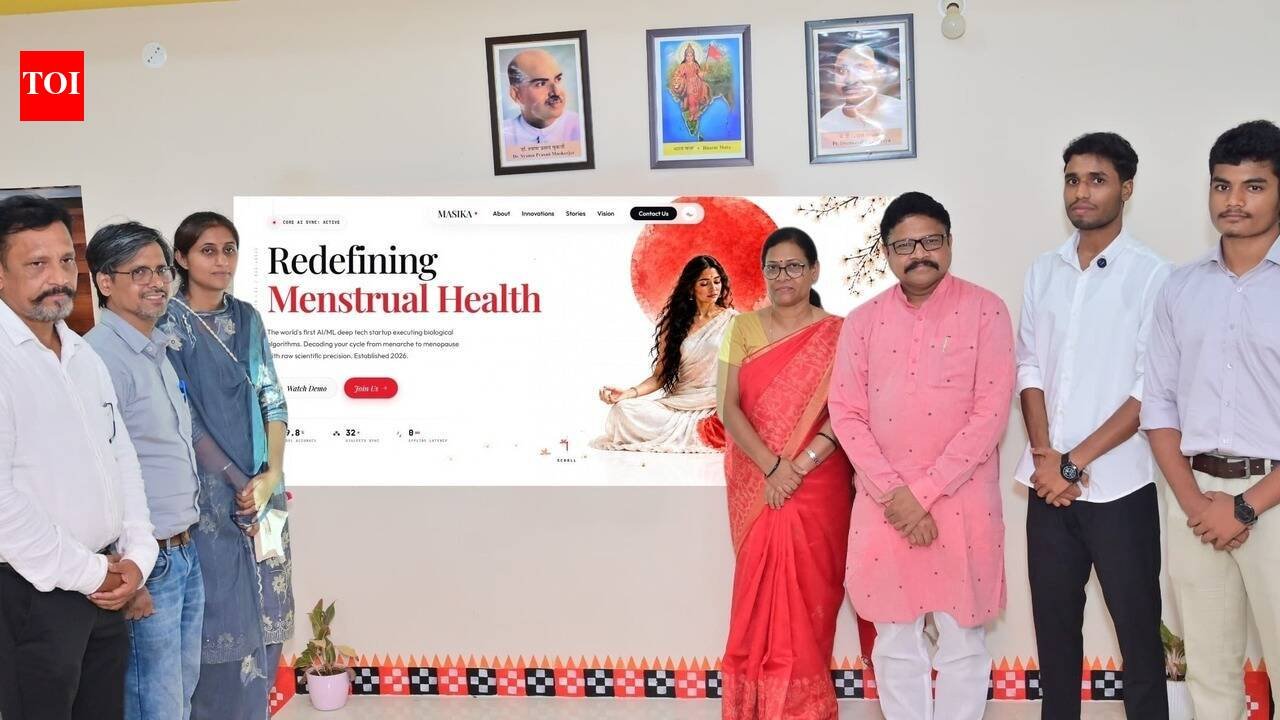
Bhubaneswar: A third-year BTech student of Biju Patnaik University of Technology (BPUT) has teamed with two women researchers to build an artificial intelligence (AI)-driven healthcare startup aimed at transforming menstrual health in rural India.Masika Care Private Limited, the deep-tech startup, founded by BPUT student Vishma Pasayat, along with co-founders Amrita Saini, a PhD scholar at the university, and Tapaswini Padhi, a PhD from NIT Rourkela, was officially launched on June 26 at Loisingha in Balangir district by health minister Mukesh Mahaling.The team is leveraging AI, machine learning (ML), deep learning and large language models to build an inclusive menstrual healthcare ecosystem for underserved communities where access, awareness and digital connectivity remain limited.Designed with accessibility at its core, the platform, recognised by DPIIT, aims to reach users through phones and assisted offline services, ensuring access even in areas with poor or no internet connectivity. It seeks to provide a safe, judgement-free space for women to understand their health and connect with professionals.“Artificial intelligence should not just make technology smarter, it should make healthcare more accessible, compassionate and inclusive. Every woman deserves the confidence to speak about her health without fear or stigma,” Pasayat said, adding that a patent application has been filed for the startup’s proprietary ML architecture, covering its system design and technical innovations.In many parts of rural India, menstruation continues to be shrouded in stigma, preventing women from seeking timely medical advice on issues such as menstrual pain, irregular cycles and reproductive health.For Vishma, the problem is personal. Nearly two years ago, his mother’s serious gynaecological condition exposed him to overcrowded hospitals, long waiting hours and the struggles women face in accessing care. Interactions with doctors underlined the importance of early consultation and menstrual awareness — a turning point that led him to develop a solution.To bridge the gap between technology and medicine, he collaborated with Dr Sharmila Pradhan of VIMSAR, Burla.The venture has received academic support from BPUT vice-chancellor Prof Amiya Kumar Rath and director Prof Sivakumar.
Attachment


