



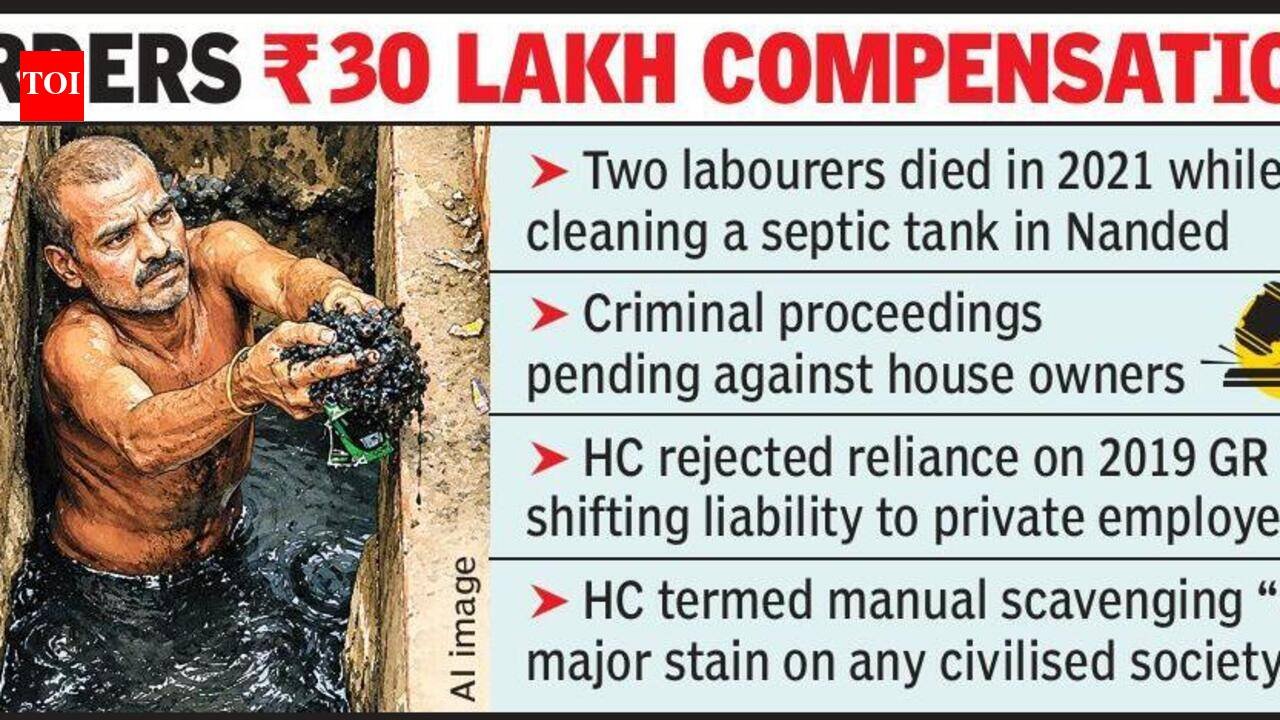
Nagpur: In a crucial ruling reinforcing the constitutional obligation to eradicate manual scavenging, the Aurangabad bench of Bombay High Court recently ruled the state must pay compensation to cleaners who choke to death inside sewers even if they were employed by private individuals and not by a govt agency.A division bench comprising Justices Nitin Suryawanshi and Vaishali Patil-Jadhav ordered Maharashtra govt to pay Rs 30 lakh to the wife and mother of two men who died while cleaning a septic tank without protective equipment or legal authorisation at Nanded in 2021. The court, however, clarified that the state would be free to recover the amount from the private employer who illegally engaged them.“Incidents of death due to manual scavenging compel us to introspect how far we have realised the constitutional vision of equality, dignity and fraternity. The continued existence of manual scavenging is a blot on civilised society and reflects the collective failure to completely eradicate this inhuman and degrading practice,” the judges said.Relying on Supreme Court’s judgments in Safai Karamchari Andolan versus Union of India and Balram Singh, the high court held the state’s duty to compensate manual scavengers extends to all such deaths, irrespective of whether workers were employed by public authorities or private persons.Referring to its earlier decision in Vimla Govind Chorotiya, the bench observed the apex court already settled the legal position that compensation cannot be denied merely because the deceased was working for a private individual.According to the petition, the two labourers died of asphyxiation and drowning inside the septic tank, as confirmed by autopsy reports.Criminal proceedings have already been initiated against house owners under Prohibition of Employment as Manual Scavengers and their Rehabilitation Act, 2013 (PEMSR Act). Although the owners agreed to pay Rs 2lakh each as compensation and Rs 50,000 towards funeral expenses, only part of the promised amount was paid.After repeated representations to the district collector seeking compensation in accordance with top court’s directives failed to yield relief, the victims’ families approached the judiciary.Rejecting the state’s reliance on a 2019 govt resolution that sought to place liability on private employers in such cases, the high court held that the constitutional and statutory responsibility to compensate victims, rests with it only.


