






FRAGRANCE OF IDEAS
Asian Games 2026 came to a glittering conclusion officially on this Sunday, 4th October 2026, in Japan where it started on 19th of September, 2026. It was the 20th edition of the sports extravaganza held in Aichi-Nagoya. The Asian Games 2026 set new records in many games and sports at national, continental and international level. We will in the columns ahead discuss the whole issue from India’s perspective and will thus focus mostly on the achievements and missed opportunities of India in the games that lasted for 16 days in Japan -the host nation of the games.
In the post-World War II scenario, it was the idea of India to initiate an exercise of Asian Games to bring cordiality in relationships among different nations of the continent. Thus the first Asian Games were held in New Delhi in 1951. Eleven nations participated in the first Asian Games. It was decided at the conclusion of the games to hold them after every four years. By now, the Asian Games have been held in 9 different countries over a period of 75 years. The games were held more than once in some nations including India where they were last organised in 1982. After the break of the USSR in 1991, the five Central Asian nations also joined the Asian Games in 1994 in Hiroshima-Japan and thereby increased the quality and quantity of the continental games.
Asia is the biggest continent in the world with the largest population in comparison with the other continents. There are around 50 nations in the continent of Asia. This time 45 nations among them took part in the Asian Games in Japan besides one ‘Asia Refugee Team’ recognised by the Olympics Council of Asia which is responsible for organising the event. A total of 10,787 athletes (with general estimates noting around 11,000 total participants including officials/support staff) took part in the Asian Games 2026. Bad weather in Japan throughout the Games, some mismanagement at different levels by the organisers and the umpiring also became an issue of debate among the sports and media fraternity this time.
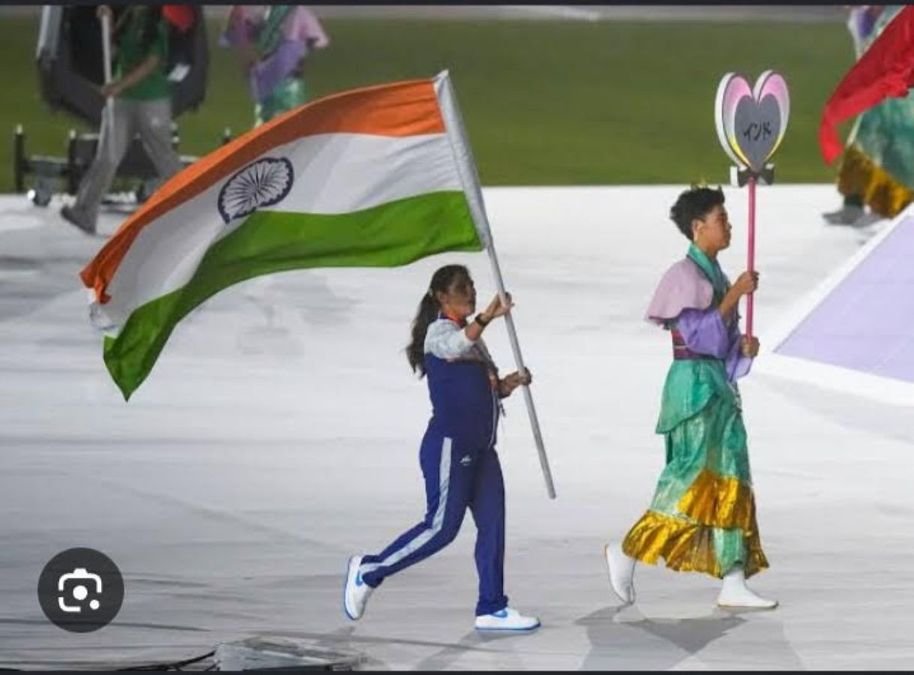
The Indian contingent in the parade on the occasion of the inauguration of the games was led by Manu Bhakar (Olympics medalist in shooting) and Pawan Sahravat (an icon of Kabaddi). An aggregate of 495 athletes from India took part in this year’s Asian Games in Japan. It was notably low as compared to the contingent of 661 athletes that took part in the Asian Games 2022 (held in 2023) in Hangzhou-China. During the games in 2023 in China, the Indian contingent took part in 35 sports and disciplines and brought home 28 gold, 38 silver and 41 bronze aggregating a total of 107 medals -India’s biggest number in the Asian Games history. For India, the Aichi-Nagoya Asian Games held this year proved to be the second best performance by India in the Asian Games till date.
At the conclusion of the Asian Games 2026, India stood again at number 4 on the medal tally after China, Japan and South Korea, the same position which was held by it in the Hangzhou Games. However, the number of medals this time stands at 21 gold, 27 silver and 37 bronze forming a total of 85 medals. In the first week of the Asian Games, there were subdued results coming forth for India, however the results picked up fast in the second week of the Games.
While there are some extraordinary achievements and performances for India in these games, there are also some subdued and low-spirited results as well consequent upon underperformances and missed opportunities throughout the duration of the games. Indian athletes won medals across 20 sports disciplines among the 35 disciplines it participated in. Majority of the medals for India came from the following disciplines: Athletics-24, Shooting-15, Archery-9, Wrestling-6, Boxing-6, Squash-5, Nautical sports-3 and Golf-2.
Besides the above results, in the games like Cricket, Hockey and Kabaddi, the Indian teams set a new record of winning both men and women gold medals this time. It is for the first time in the history of the Asian Games that India has been able to achieve this kind of a performance that it got the top medals in all these three games (men and women). Historically speaking, Kabaddi, Hockey and Cricket are the grass-root level sports in the whole of South Asia which common people therein have been emotionally attached to and involved in for the last more than one hundred years. These are practically the national games of South Asia, and India has been in the lead most of the time. This time the Indian teams have been successful in demonstrating their prowess and dominance in all these three sports very emphatically at the continental level. Moreover, both the teams of Hockey have also secured quota entry in the ensuing Olympic Games in 2028.
In addition to this, among the 21 gold medals India got, Archery contributed 5, Boxing got 3, Shooting-3, wrestling-2, Athletics-1 and Golf-1. It is for the first time that India got a gold medal in golf and the achiever was a young woman athlete, Pranavi Urs. Five women athletes in their solo events won gold medals for India and they included Lovelina Borgohain (Boxing), Parveen Hooda (Boxing), Kumkum Mohod (Archery), Neeru Dhanda (Shooting) besides Pranavi Urs. That the women’s events produced 38 medals in a total of 85 medals for India is surely heartening to observe. It exhibits the equal status of women in India and also their emancipation, empowerment and leading role.
In athletics, Gulveer Singh, the ace runner, made a hat-trick of medals in the Asian Games this time. His medals included 2 silver (10,000 mtr & 1,500 mtr) and 1 bronze (5,000 mtr). He became the first Indian athlete in 40 years (since the celebrated P.T.Usha) to win three individual medals at a single edition of the Asian Games. His performance spanned middle and long-distance events earning podium finishes from 1,500 mtr to 10,000 mtr events. He had earned a bronze medal in the 10,000 mtr in the last Asian Games in 2023.
The gold medal won by a young 17 year old woman athlete, Kumkum Mohod, is overall the 200th gold medal for India in Asian Games history. She signed off India’s campaign in Archery in an incredible fashion, becoming the first athlete from the nation to win a Recurve women’s individual medal. Her feat in the individual event came after she joined Ankita Bhakat and Kirti to win India’s first-ever Recurve women’s team gold at the continental event, breaking Korea’s historical winning streak of seven consecutive team titles at the Asian Games. Kumkum has also been successful in securing a quota place for the LA28 Olympic Games.
During the first week of the games, some disappointing performances by our athletes in the sports like Badminton, Table Tennis, Judo, Swimming, Gymnastics, Karate, Teqball and even Shooting became a cause of worry and concern for the nation. There were some very saddening underperformances as well that failed to boost the medal tally initially. It was in the second week of the games that our athletes lived up to the expectations of the millions of people of the nation. Then there were unfortunately some very close misses at the medal victory points at all the levels and then luck also played its part. However, the achievers lifted everyone’s morale and the results came forth with lots of hope, expectations and joy.
Here it needs to be noted that China, Japan and South Korea are consecutively at the top three positions of the medal tally of the Asian Games this time also. While China has got an overwhelming 341 medals (169-Gold, 89-Silver & 83-Bronze), Japan got 269 medals (83-Gold, 95-Silver & 91-Bronze) and South Korea confirmed 150 medals (39-Gold, 43-Silver & 68-Bronze). A majority of their medals come from swimming, shooting and athletics. India is practically in a race with Korea and Uzbekistan in the Asian Games who this time are above and below India respectively on the medal tally. India would need a comprehensive overhaul of the sports planning, management, selection process and infrastructure to actually compete at an international level and leave a mark noteworthy of its worth. This is also important keeping in view the ensuing Olympics in 2028 and the centenary Commonwealth Games which are scheduled to be held in India at Ahmedabad in 2030.
Any nation in the world is in practical sense viewed by others usually from its civilization, economy, sports, defence and diplomacy. Sports is a well-recognised soft power of a nation besides having its ability to bring people and nations together. India is a leading opinion maker and thought-leader in the world and it is expected that its sports equal its global reputation and recognition. We as a nation need to redouble our efforts to raise our standards in sports for which the government, people and institutions need to come forward effectively and without waste of time. That is the message that our flag-bearer, the shooting champion of the Asian Games 2026 -Neeru Dhanda, brought forward when she was assigned the task of leading the Indian contingent on the occasion of the concluding ceremony of the games with the resolve to meet again in 2030 in Doha-Qatar.
(The author is a senior BJP & KP leader, Human Rights Defender and a columnist and can be reached at: [email protected])


