



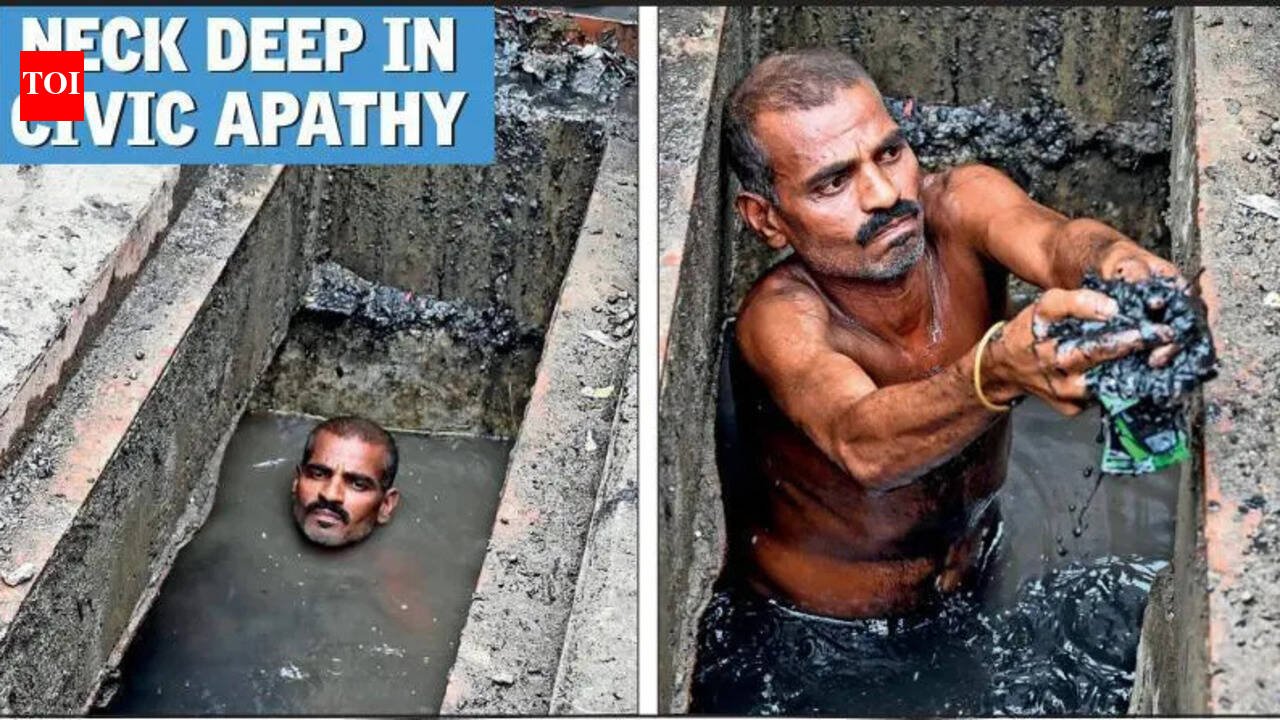
Nagpur: Barely two days after a 60-year-old woman was electrocuted allegedly due to a cable damaged by a contractor of Nagpur Municipal Corporation’s (NMC), the civic body again faced scrutiny on Friday as a sanitary worker was made to enter a stormwater chamber filled with filth near Loha Pul to dechoke it.Manual scavenging has been banned as per Supreme Court directives and Prohibition of Employment as Manual Scavengers and Rehabilitation Act, 2013.The incident unfolded as NMC launched emergency work to address chronic waterlogging problem beneath Loha Pul following Thursday’s inspection by municipal commissioner Vipin Itankar. Instead of relying solely on mechanised cleaning, civic officials allowed a sanitary worker to climb into the narrow stormwater drain after suction and jetting machines failed to remove the blockage.The worker, standing waist-deep in black, contaminated water inside the concrete chamber, manually scooped out sludge, plastic waste and silt to restore the flow.Speaking to TOI, the worker said, “The suction and jetting machine could not clear the blockage. After that, I went down into the chamber and removed the filth by hand.”Though the worker was cleaning a stormwater drain and not a sewer carrying human waste, safety experts caution that such confined spaces can contain toxic gases, oxygen-deficient atmospheres, industrial waste, sharp objects and contaminated water. Entry into such chambers requires gas detection, breathing apparatus, safety harnesses, standby rescue teams and other protective measures.However, the worker entered the chamber with no breathing apparatus, safety harness, gas detector or any specialised protective equipment, raising serious questions over NMC’s adherence to basic occupational safety norms.The irony was hard to miss. On Thursday, commissioner Itankar had personally inspected Loha Pul and directed officials to implement a permanent solution to the persistent flooding by constructing an additional stormwater drain and improving drainage connectivity. Yet, within 24 hours, the immediate response to the same problem relied on sending a man into the drain after machines failed.The incident comes against the backdrop of a string of similar tragedies and controversies. In May this year, two contractual sanitation workers died after entering a toxic sewage chamber at MIDC Butibori on their contractor’s instructions without gas masks, oxygen support or other safety equipment. Police later arrested the contractor, and the incident was widely seen as a blatant violation of the Prohibition of Employment as Manual Scavengers and their Rehabilitation Act, 2013, and Supreme Court directions prohibiting hazardous manual cleaning.Just weeks earlier, on April 21, another sanitation worker was allegedly forced into a sewer manhole at Shivaji Nagar basketball ground in Prabhag 15 without any protective gear. Photographs of the worker standing inside the manhole triggered outrage, exposing the continued reliance on hazardous manual cleaning despite repeated claims of complete mechanisation. Friday’s incident may not legally qualify as manual scavenging since it involved a stormwater drain rather than a sewer, but it underscores a recurring pattern — when machines fail, workers are still expected to enter dangerous confined spaces with little regard for their safety.Coming immediately after Wednesday night’s fatal electrocution linked to alleged negligence during civic works, the episode further raises uncomfortable questions about whether lessons from past tragedies are being translated into safer practices on the ground.


