



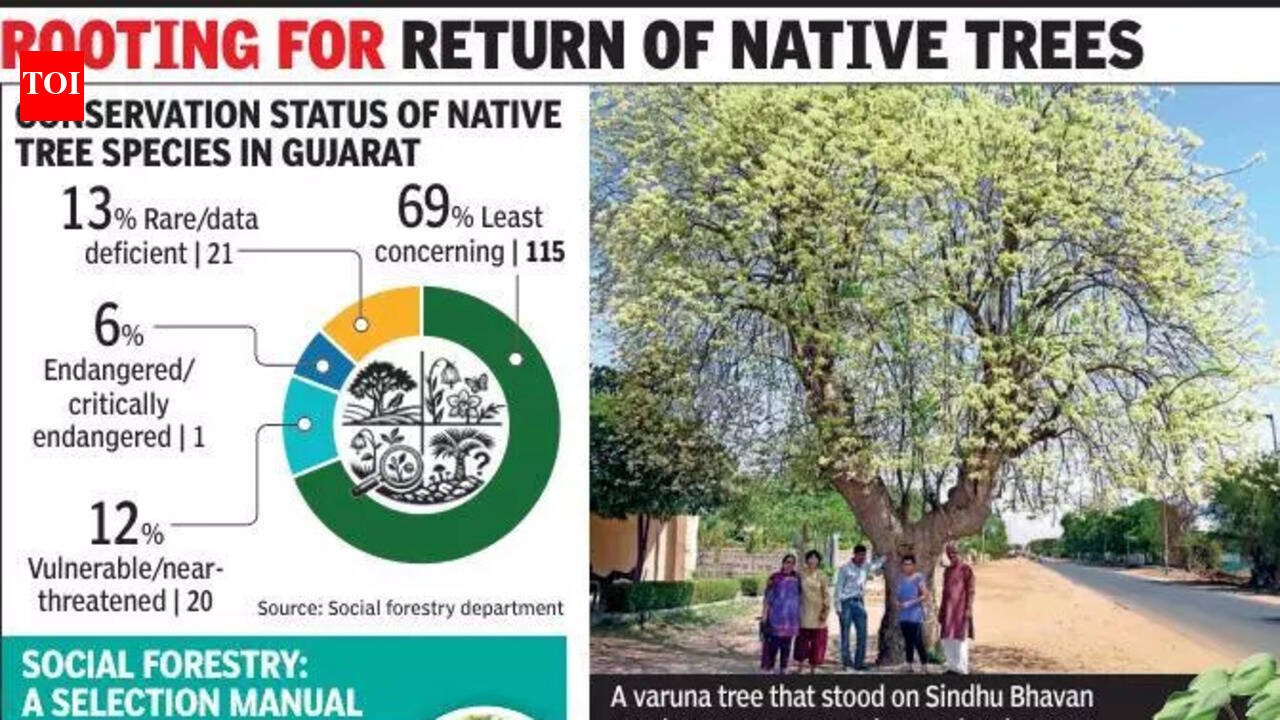
Ahmedabad: The city’s green cover is expanding, but its ecological strength may be weakening. Native trees that once anchored biodiversity are vanishing. They are being replaced by fast-growing or ornamental trees that fail to sustain the local ecosystem of insects, birds and pollinators. Experts say this shift could disrupt entire food chains. The sign is clear: not all green cover is equal.Around six decades ago, Ahmedabad was home to several vulnerable and endangered native trees such as varuna (Crataeva nurvala), tree caper or pachunda (Capparis grandis), and pilu (Salvadora persica). Officials recall a large varuna tree on Sindhu Bhavan Road that, along with the biodiversity it supported, was lost to development.Minal Jani, deputy conservator of forests (social forestry) in Ahmedabad, said such trees play a crucial ecological role. The varuna tree was an anchor for four different species of butterflies, she said, adding: “When the tree is no longer there, the butterflies, along with other insects, also vanish. Tree caper, likewise, is known to be a host for 16 different insects. When these trees disappear, we do not lose just the green canopies, but also the biodiversity it sustained.”She adds, “The native species are often replaced by neem, banyan and peepul trees or exotic species such as kigelia, lagerstroemia, tabebuia, etc. They do not share the same relationship with the biosphere.”Officials stressed that many species depend on specific plants. For instance, Indian birthwort (Aristolochia indica) is the only host for common rose and crimson rose butterflies, while dhavadi or fire flame bush (Woodfordia fruticosa) supports birds, bees and small mammals. She appealed that whenever there is a tree plantation drive, using native species yields much better results. She was speaking on the sidelines at the launch of ‘Curating Gujarat’s True Canopy’, a guide to native trees released by the state forest department on Friday. The department also organised an exhibition showcasing seeds and information on these species.Dr A P Singh, head of the forest force in Gujarat, said invasive species such as gando baval and eucalyptus have spread rapidly and need to be removed, especially from riverbanks, to restore ecological balance. He added, “The state offers incentives of Rs 5,000 to farmers to discourage cutting native trees.”Even as tree numbers increase, natural forests that have existed for centuries continue to decline due to urban expansion, said officials. Ahmedabad’s tree count doubled from 6.18 lakh in 2011 to 12 lakh in 2025, but experts say this growth must include native species to sustain biodiversity.According to the department, of 166 native species identified in Gujarat, 115 (69%) fall under least concern, 20 (12%) are vulnerable or near threatened, 10 (6%) are endangered or critically endangered, and 21 (13%) are classified as rare or data deficient.


