






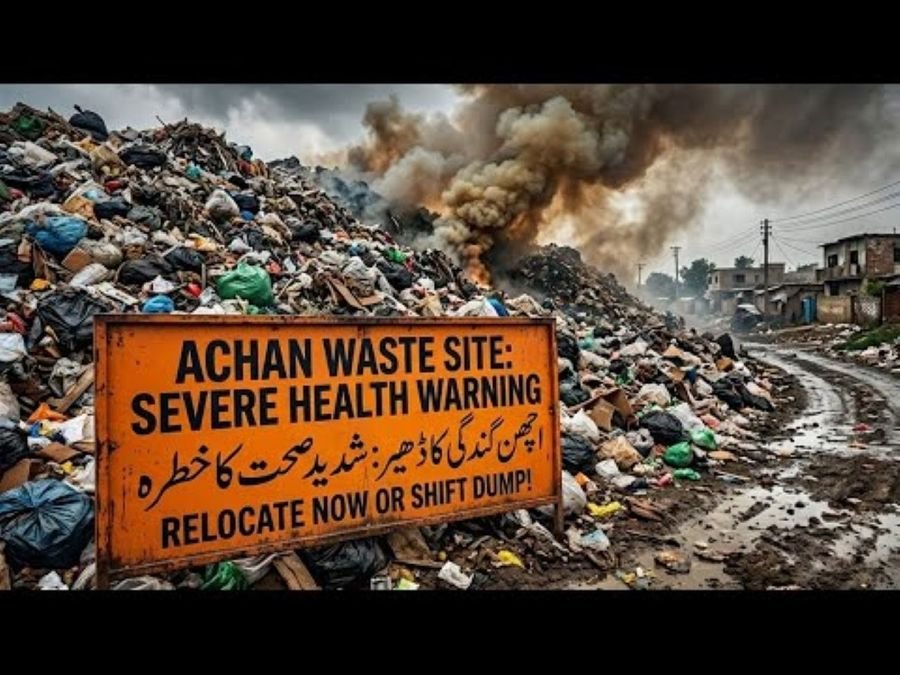
Srinagar’s Achan landfill is usually treated as a municipal waste-management problem. But through economics, it can be understood as a material expression of a deeper socio-ecological contradiction known as the metabolic rift. Around 11 lakh tonnes of waste have accumulated at Achan, while Srinagar generates roughly 550–600 tonnes of municipal waste every day, against an existing processing capacity of about 150 tonnes per day (Srinagar Municipal Corporation, 2024).
The proposed 800-tonne-per-day integrated solid-waste management facility, estimated at ₹361 crore, addresses the capacity gap. But it does not resolve the process behind it which is an urban economy whose expanding consumption continually generates material residues faster than they are recovered.
Modern economics, which organises production around accumulation, is good at following value. It tracks investment, output, income, prices, consumption and profits. It is less comfortable following the material after the transaction is over. A product is produced, sold and consumed, and its economic value is recorded. The packaging, organic residue or discarded material that remains afterwards becomes somebody else’s problem.
This distinction matters because waste is not an accidental by-product appearing outside the economy. It is produced inside the same process through which economic value is created. Every commodity has a material history: resources are extracted, energy is used, labour transforms materials, the commodity is sold, and eventually something remains. The market recognises the commodity through its exchange value. It does not automatically recognise the full cost of what happens after consumption.
This was hardly an unknown problem. Marx’s analysis of capitalism had already placed production within a material relationship between society and nature. His concern was not environmentalism in the contemporary sense, but the contradiction between capitalist production and the conditions required for social and ecological reproduction. Foster’s reconstruction of this dimension of Marx through the idea of the metabolic rift provides a framework for understanding ecological crises as consequences of the way society organises production and material flows, rather than as isolated environmental accidents.
The argument of Foster’s metabolic rift is useful for Achan precisely because it changes where we look. If waste is examined only at the landfill, the problem appears to be collection, capacity and disposal. If it is followed backwards, it becomes a question of production, consumption, value and cost. The two perspectives do not contradict each other. The second explains why the first keeps returning.
Studies published in 2023 and 2024 by Islam et al. reported that 65–75% of the waste was organic, indicating substantial scope for segregation and treatment. A separate study by Islam et al. (2023), based on four-season sampling around Achan, found the highest concentrations of several measured water-quality parameters at the leachate outflow, with values declining with distance from the landfill. At the outflow, mean BOD was 21.47 mg/L and COD 66.24 mg/L.
Achan therefore represents a double economic cost. Potentially recoverable materials are removed from productive circulation, while public institutions finance collection, transportation, treatment and disposal. Conventional economics calls part of this an externality, while political economy asks why this externalisation is reproduced. The answer lies in the separation between the immediate calculation of profitability and the long-term requirements of ecological reproduction.
Srinagar’s waste is generated by households, hotels, markets, businesses and institutions across the city, while its accumulation is concentrated at one site. Consumption is dispersed, but disposal is concentrated. The value generated through consumption is similarly dispersed, but the cost of managing the residual stream becomes a public responsibility. Achan’s 11 lakh tonnes of legacy waste are therefore not simply old garbage. They are an accumulated liability from previous rounds of consumption and production.
Besides the problem of distribution and concentration, there is an important factor that needs to be taken into consideration while forming policy, the stock and the flow. The 11 lakh tonnes are the accumulated stock. The roughly 450 tonnes arriving every day are the flow. Biomining can reduce the stock. New processing capacity can manage the flow. But neither necessarily changes the economic conditions generating the flow. If the daily inflow continues, the landfill problem will reproduce itself even after the existing stock is removed.
This is why the proposed investment, while necessary, cannot be the whole answer. The Corporation’s ₹60.50-crore biomining estimate is essentially the price of dealing with a liability already created. It is a downstream expenditure. The more difficult economic question is what happens upstream: how products are designed, how much packaging enters the market, how materials are recovered, who bears disposal costs, and whether producers have incentives to reduce the waste associated with what they sell.
This is also where the debate over growth needs greater precision. Srinagar does need economic growth. It needs jobs, investment, better infrastructure and higher household incomes. The relevant question is not growth versus environment. It is whether economic growth must remain so tightly coupled with material throughput. An economy that produces more income with less material waste is economically different from one that produces more income by continually increasing extraction, consumption and disposal.
The distinction is important because technological efficiency can otherwise create a false sense of resolution. Better waste-processing plants, biomining and recycling can reduce the burden of existing waste. But if consumption and material throughput rise faster than recovery, total waste can still increase. Efficiency can reduce the cost per unit of waste without reducing the quantity of waste itself.
The answer is therefore partly institutional. Source segregation must become the norm rather than an afterthought. Organic waste, which constitutes the largest share of Achan’s waste stream, should be diverted towards decentralised composting and other treatment systems wherever feasible.
Material recovery should occur before recyclable materials are mixed with organic and other waste. Producer responsibility should make producers more accountable for the post-consumption costs of the materials they place in the market. And Srinagar should begin evaluating waste not only in tonnes but relative to economic activity, that is, how much waste is generated for every unit of income, output or consumption?
Such measures do something more fundamental than improving waste management. They begin to reconnect economic decisions with their material consequences. That reconnection is what makes Marx and Foster relevant here. Their importance is not that Srinagar needs a Marxist waste policy. It is that this intellectual tradition had already warned against treating economic circulation and ecological reproduction as separate worlds. We have often chosen to see economics primarily through capital, markets, prices and growth, and then treated nature and waste as matters for environmental policy. Achan demonstrates the cost of that separation.
The landfill is therefore not simply where Srinagar’s waste goes. It is where an economic contradiction becomes materially visible. The value of commodities is realised within the market, while their residues remain outside it. Private transactions end, while public expenditure begins. Consumption generates welfare but also generates material liability. The longer that liability remains external to economic calculation, the more expensive it becomes to manage.
Clearing the existing landfill is essential, but it will not close the metabolic rift if the same economic flow continues to produce another one. Srinagar needs the ₹60.50-crore remediation programme, better processing capacity and stronger institutions. But it also needs to ask a harder question: not merely how to dispose of what its economy produces, but how to produce and consume in ways that leave less to dispose of.
That is the economic question Achan puts before us. The landfill is not the end of the story. It is the point at which the hidden material cost of the economic story becomes impossible to ignore.
(The author is a Climate Reality Leader and Master’s Student at the Department of Economics, IUST. He can be reached at [email protected])


