






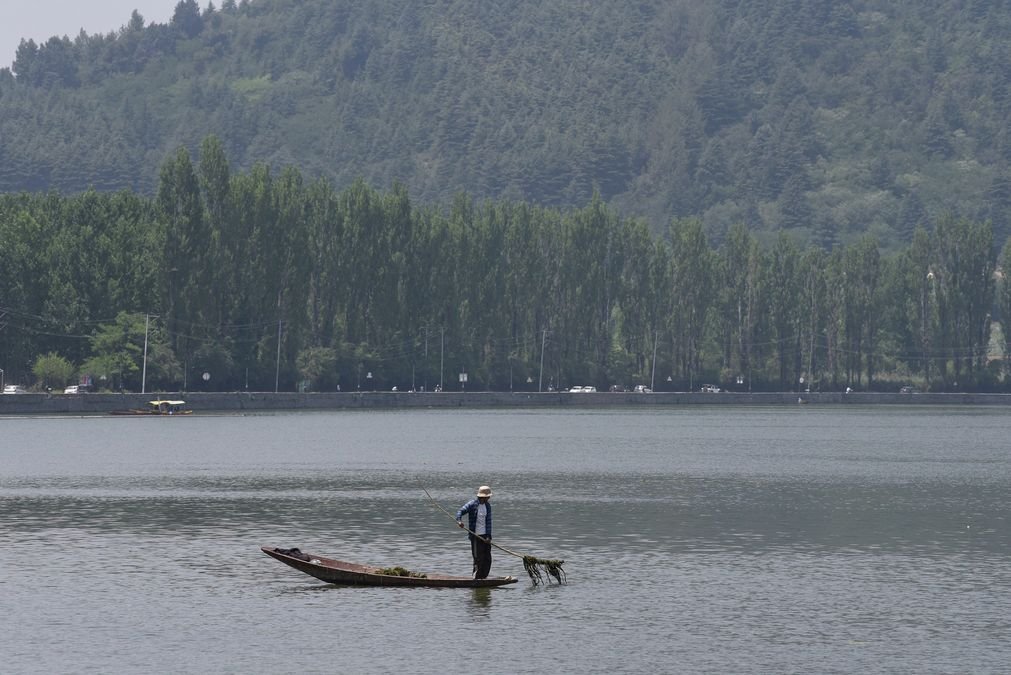
For centuries, the wooden houseboats of Kashmir have rested upon the serene waters of Dal and Nigeen lakes like floating palaces. Crafted from resilient Deodar cedar, their ornate Khatamband wood-panelled ceilings and delicate Pinjrakari lattice-work windows stand as living archives of the Valley’s artistic soul. Yet their origins were born out of clever adaptation.
During my school days at the prestigious Islamia High School, Srinagar, our school excursions would take us through the pristine waters of the lake. Starting from Baba Demb, near the present Khanyar police station, we would journey all the way to the various Mughal Gardens aboard local doongas.
These traditional boats were simple and unadorned, much like a passenger transport plane. They had a working kitchen on board, and the owner’s family lived in the aft section. We students thoroughly enjoyed those memorable trips to distant shores, freely drinking water straight from the lake—a source so pure back then that it required no boiling or filtration. Today, to my deep heartbreak, that once-pristine water body has been turned into a virtual cesspool.
In the late 19th century under Dogra rule, foreign visitors and British officers were prohibited by law from purchasing land or constructing permanent houses in Kashmir. To bypass this restriction, an enterprising Englishman named M.T. Kennard partnered with local boat builders in the late 1880s. Together, they adapted the traditional doonga into luxurious, stationary floating homes.
Waterborne living, however, is not unique to the Valley. Floating habitations exist across the globe:
Amsterdam, Netherlands: Over 2,400 houseboats (woonschepen) line historic canals, originally converted from surplus cargo barges after WWII.
Kerala, India: The famous Kettuvallams of the southern backwaters—traditionally used to transport rice and spices—now serve as gliding tourist retreats.
Inle Lake, Myanmar & SE Asia: The Intha and Bajau communities reside in stilt houses and traditional wooden craft (lepa-lepa) designed entirely around an aquatic lifestyle.
Unlike mobile river barges, Kashmir’s houseboats are stationary masterpieces. But today, they stand at a delicate crossroads. Overcrowding in prime basins restricts open water, straining the lake’s natural self-cleaning capacity. Furthermore, natural decay, strict environmental caps, and an ageing community of master carpenters (Naav Chaan) have reduced the fleet from thousands to under 800.
Indiscriminate removal would devastate local livelihoods and erase a defining cultural identity. The solution lies in scientific ecology and smart engineering. The single most vital step is implementing closed-loop, zero-discharge sanitation: attaching sealed, modular bio-tanks beneath each hull.
These floating waste containment units can collect all human waste without a single drop touching the water. Specialised service barges can then conveniently detach, drain, and reinstall the sealed tanks on a routine schedule.
Preservation does not mean freezing a tradition in time—it means allowing it to evolve safely. By combining spatial management with modern, detachable sanitary infrastructure, Kashmir can restore its pristine waters while keeping its iconic floating heritage proudly afloat for generations to come.
(The Author is a former Collector of the erstwhile Lakes and Waterways Development Authority (LAWDA) and RK Columnist. Email: [email protected])


